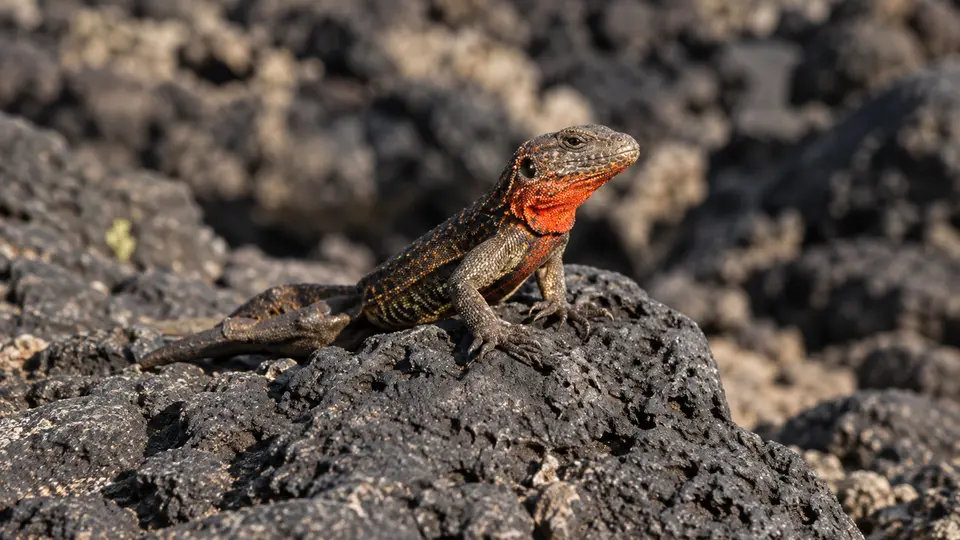
Galápagos Pink Land Iguana in its natural habitat, AI illustration

Galápagos Pink Land Iguana: where and when to see them

Conolophus marthae

Galápagos Pink Land Iguana at a glance

The Galápagos pink land iguana is confined to the upper slopes of Wolf Volcano on northern Isabela. Its tiny distribution and very small population make it one of the archipelago's most vulnerable vertebrates. Pink skin crossed by dark markings gives it a striking appearance, but it is not a visitor attraction. Its habitat lies within a restricted conservation area, far from standard landings, and access is reserved for authorized work.

Behaviour & reproduction

Size
Approximately 45–55 cm snout-to-vent length
Weight
Not reliably established
Lifespan
Not reliably established
Status
Critically Endangered

Pink land iguanas are terrestrial reptiles whose daily activity depends strongly on temperature. They bask to warm themselves and use shade or shelter when exposed conditions become excessive. Researchers have documented social signalling and reproductive activity, but many details of their movements and early life remain poorly understood. Monitoring focuses particularly on nesting and recruitment because introduced predators threaten young animals, and few juveniles have been recorded in the wild. Pink iguanas are known to dig burrows for shelter and nesting, providing protection from temperature extremes and predators. Their social structure and territorial interactions are subjects of ongoing research, offering insights into their evolutionary isolation.

Top wildlife locations

Galapagos wildlife habitat

Galapagos

Wolf Volcano's high volcanic scrub is the only known wild habitat. No shore-viewing habitat or standard landing provides access; the population is restricted, remote and unavailable for ordinary visitor excursions.

Adventure cruises in Galapagos
Destinations describe the species' habitat, not guaranteed cruise stops. Some animals require an optional inland excursion or are found in restricted reserves.

Fun facts about the Galápagos Pink Land Iguana

  • The species was formally described in 2009.
  • Its pink appearance reflects areas of skin with little pigment.
  • It shares Wolf Volcano with the more widespread Conolophus subcristatus.
  • Genetic evidence identifies it as a deeply distinct Galápagos land-iguana lineage.

Best time to see the Galápagos Pink Land Iguana

There is no public wildlife-viewing season for this species. Its restricted habitat is not included in standard visitor landings, and ordinary Galápagos travel seasons do not create access. Authorized research schedules follow conservation needs, permits and safe working conditions rather than tourism demand. Conservation efforts are year-round, focusing on population monitoring and predator control, independent of typical tourist seasons. Research permits are highly restricted and granted only to projects directly supporting the species' survival.

Galápagos Pink Land Iguana: season matrix by destination

Travel and observation windows vary by region. Highlighted months are an orientation for planning, not confirmed sightings or a guarantee of access.

Galapagos

No supported public observation window exists. Seasonal Galápagos travel conditions must not be interpreted as access to this restricted population.

JanFebMarAprMayJunJulAugSepOctNovDec
Cruise ships in Galapagos

Where the Galápagos Pink Land Iguana lives

This species occupies a restricted high-elevation zone on Wolf Volcano, where volcanic ground supports dry scrub and scattered vegetation. It is not a beach or lowland visitor-site iguana. Its entire known wild range lies on one volcano on Isabela Island. The species is found exclusively on the upper slopes of Wolf Volcano, specifically above 600 meters in elevation. This unique environment is characterized by arid scrubland transitioning to more humid zones with increasing altitude.

What the Galápagos Pink Land Iguana eats

It is primarily herbivorous, consuming available plant material in its volcanic scrub habitat. Leaves, shoots and other seasonal vegetation provide food and moisture. Detailed field data on the relative importance of individual plant species remain limited, so a precise dietary breakdown is not established. Despite limited detailed data, scientists believe that cactus pads and fruits, especially Opuntia species, constitute a significant portion of their diet. They obtain essential moisture from their food, as standing water sources are scarce in their habitat.

Species at a glance

Common name
Galápagos Pink Land Iguana
Scientific name
Conolophus marthae
Animal group
Reptiles
Size
Approximately 45–55 cm snout-to-vent length
Weight
Not reliably established
Lifespan
Not reliably established
Status
Critically Endangered
Identification
Pink skin with dark vertical markings and distinctive head and crest features separates it from the predominantly yellow or brown Galápagos land iguanas. The pink coloration is thought to be unique among extant iguana species worldwide, making it distinct from other Galapagos land iguanas. Unlike its yellow relatives, the pink iguana's scales are largely unpigmented, allowing blood vessels to show through.

Galápagos Pink Land Iguana: frequently asked questions

Where can I see the Galápagos Pink Land Iguana?
Galapagos. Do not plan an approach or independent trek to Wolf Volcano. Pink iguanas are not on standard landings; learn about them through authorized interpretation, and never share sensitive locality information that could encourage unauthorized access. Public access to the habitat of the pink land iguana is strictly prohibited to prevent disturbance and the potential introduction of invasive species. Researchers often employ remote cameras and non-invasive methods to study these elusive reptiles.
When is the best time to see the Galápagos Pink Land Iguana?
There is no public wildlife-viewing season for this species. Its restricted habitat is not included in standard visitor landings, and ordinary Galápagos travel seasons do not create access. Authorized research schedules follow conservation needs, permits and safe working conditions rather than tourism demand. Conservation efforts are year-round, focusing on population monitoring and predator control, independent of typical tourist seasons. Research permits are highly restricted and granted only to projects directly supporting the species' survival.
How big does the Galápagos Pink Land Iguana get?
Approximately 45–55 cm snout-to-vent length. Adult weight: Not reliably established. Size varies with age, sex and population.
How should I behave around the Galápagos Pink Land Iguana?
Do not plan an approach or independent trek to Wolf Volcano. Pink iguanas are not on standard landings; learn about them through authorized interpretation, and never share sensitive locality information that could encourage unauthorized access. Public access to the habitat of the pink land iguana is strictly prohibited to prevent disturbance and the potential introduction of invasive species. Researchers often employ remote cameras and non-invasive methods to study these elusive reptiles.
What does the Galápagos Pink Land Iguana eat?
It is primarily herbivorous, consuming available plant material in its volcanic scrub habitat. Leaves, shoots and other seasonal vegetation provide food and moisture. Detailed field data on the relative importance of individual plant species remain limited, so a precise dietary breakdown is not established. Despite limited detailed data, scientists believe that cactus pads and fruits, especially Opuntia species, constitute a significant portion of their diet. They obtain essential moisture from their food, as standing water sources are scarce in their habitat.
Are wildlife sightings guaranteed on an adventure cruise?
No. Animals move freely and routes, weather, access restrictions and local conditions influence every outing. Confirm the actual itinerary and shore program before booking.

Compare wildlife in the same destinations

Explore other reptiles recorded in these destinations. Similar surroundings do not mean the animals share the same habits or viewing season.

Species comparison by animal group and destination
Galápagos Pink Land IguanaGalápagos Pink Land IguanaGalápagos Land IguanaGalápagos Land IguanaGalápagos Lava LizardGalápagos Lava Lizard
Animal groupReptilesAnimal groupReptilesAnimal groupReptiles
DestinationsGalapagosDestinationsGalapagosDestinationsGalapagos
All wildlife destinations
Plan your trip

Find your next wildlife adventure

Compare destinations, shore programs and dates with the animals and habitats you would love to see.

  • Naturalist-led shore excursions
  • Responsible wildlife watching
  • Small expedition ships

Newsletter

Take Blue Rides with you

Adventure cruise offers, last-minute deals and trip inspiration.

Free, unsubscribe anytime. Details: Privacy Policy

Partner with Blue Rides

Affiliate Program

Recommend adventure cruises and earn commission on every confirmed booking.

Share. Track. Earn.

Your footage, our stage

Send us your videos or pictures.

Captured beautiful landscapes or wildlife? Share your videos and pictures with us, we may feature them on Blue Rides.