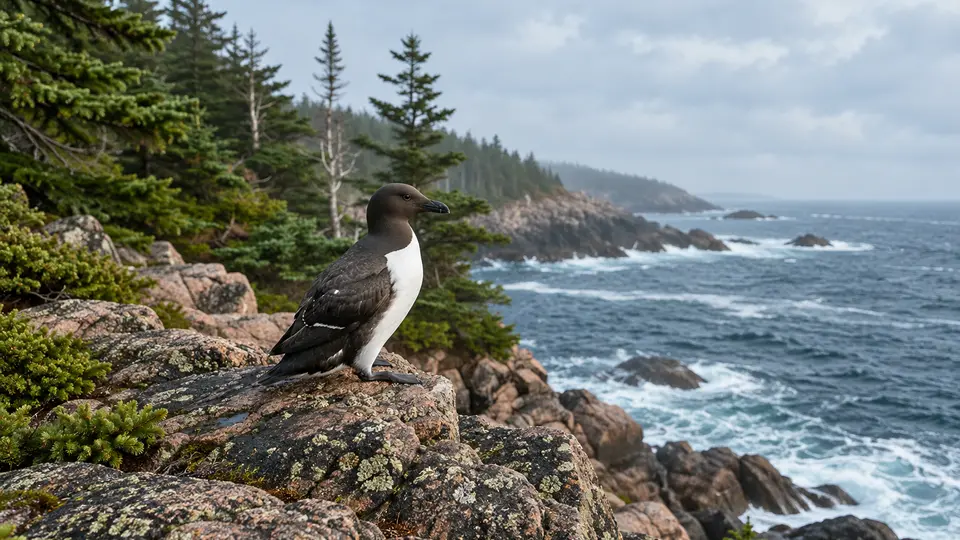
Common Murre in its natural habitat, AI illustration

Common MurreUria aalgeWhere and when to see them

Common Murre at a glance

The common murre is the North American name for the same species called common guillemot in Europe. This streamlined seabird spends most of its life at sea, coming ashore to breed on crowded rocky ledges. Its narrow bill and dark-and-white plumage look simple at a distance, but colony life is highly organised. Pacific populations can suffer severe losses when warm-water events disrupt the small fish on which adults and chicks depend.

Behaviour & reproduction

Size
38-43 cm long
Weight
0.8-1.2 kg
Lifespan
15-25 years
Status
Least Concern

At breeding colonies, murres stand shoulder to shoulder and repeatedly commute between their ledges and marine feeding grounds. Partners share incubation and recognise each other through calls and close-range interactions. The single chick leaves the colony while still unable to fly, descending toward the water and continuing development at sea with its father. After nesting, birds disperse, and the great concentrations visible on summer cliffs may disappear almost completely. Courtship displays involve bowing and mutual preening on the colony ledges. Murres often congregate in dense rafts on the water near their colonies, especially in the early morning and late evening. The male continues to provision the chick at sea for several weeks after it leaves the colony, teaching it to forage and dive effectively.

Top wildlife locations

Alaska wildlife habitat

Alaska

Seabird cliffs and rocky island colonies provide plausible summer views from authorised shore viewpoints or distant decks. Many colonies are inaccessible from land, and protected nesting areas must not be approached.

New England wildlife habitat

New England

Outer headlands and open coastal waters offer occasional winter viewing, usually of distant birds. Shore encounters are uncommon and weather-dependent; no inland excursion helps, and species identification may remain uncertain.

Destinations describe the species' habitat, not guaranteed cruise stops. Some animals require an optional inland excursion or are found in restricted reserves.

Fun facts about the Common Murre

  • Common murre and common guillemot are the same species.
  • Both parents incubate the single egg.
  • The father accompanies the flightless chick at sea after colony departure.
  • Chicks are commonly delivered one fish at a time.

Best time to see the Common Murre

Alaskan breeding colonies are most practical to observe during late spring and summer, with timing varying by latitude. New England opportunities are more associated with the colder part of the year and are less dependable from shore. Good visibility and calm conditions improve detection of scattered birds offshore. In Alaska, viewing from cruise ships offers excellent opportunities to see large breeding colonies, particularly in areas like the Chiswell Islands or the Alaska Maritime National Wildlife Refuge. For New England, boat tours for seabirds often target offshore areas in late fall and winter where murres gather. Keep an eye out for rafts of birds on the water, which can indicate feeding areas.

Common Murre: season matrix by destination

Travel and observation windows vary by region. Highlighted months are an orientation for planning, not confirmed sightings or a guarantee of access.

Alaska

This broad colony-viewing window varies with latitude, annual breeding conditions and local access.

JanFebMarAprMayJunJulAugSepOctNovDec
Cruise ships in Alaska

New England

Colder months offer the more plausible coastal window, but common murres are not dependable at any generic New England shoreline.

JanFebMarAprMayJunJulAugSepOctNovDec
Cruise ships in New England

Where the Common Murre lives

Rocky islands, steep coastal cliffs and sea stacks provide breeding ledges, with nearby marine waters supplying food. Outside breeding, murres occupy coastal and offshore shelf habitat. Alaska supports major colonies, whereas New England observations are more often scattered birds at sea. Murres are pursuit divers that often prefer waters over 20 meters deep for foraging. During winter, some populations undertake significant migrations to more southerly waters, potentially covering hundreds or thousands of kilometers. Global populations have shown mixed trends, with some localized declines due to oil spills or fisheries bycatch.

What the Common Murre eats

Small fish such as capelin, sand lance and juvenile schooling fishes are important, with crustaceans and other prey contributing locally. Adults chase prey using wing-powered swimming. A parent commonly carries a single fish back to its chick rather than a billful of many. Murres are highly efficient foragers, typically diving to depths between 20-70 meters, though they can reach over 100 meters. Their streamlined bodies and powerful wing strokes allow for agile underwater pursuit of prey. They play an important role in marine food webs, consuming a variety of schooling fish species and invertebrates.

Species at a glance

Common name
Common Murre
Scientific name
Uria aalge
Animal group
Birds
Size
38-43 cm long
Weight
0.8-1.2 kg
Lifespan
15-25 years
Status
Least Concern
Identification
Its longer, slimmer bill lacks the conspicuous pale gape line of thick-billed murre, while razorbill has a much deeper, blunt-ended bill. The Common Murre's plumage is a striking black and white, with a dark back and head contrasting sharply with a white belly. In breeding season, a distinctive dark 'bridle' mark around the eye and behind can be present on some individuals, indicating the 'bridled' morph. Its posture on land is generally upright, often appearing rather elegant, especially on breeding ledges.

Common Murre: frequently asked questions

Where can I see the Common Murre?
Alaska, New England. Observe colonies only from permitted distant viewpoints or decks, avoiding noise that could trigger mass departures. On winter shores, use a telescope from safe ground rather than moving onto wave-washed rocks for closer views. When viewing from a ship, look for birds actively diving and resurfacing, indicating feeding behavior. Pay attention to changes in bird numbers; a sudden increase can signal proximity to a colony or a good feeding ground. Use binoculars or a spotting scope to appreciate the fine details of their plumage and bill structure, even at a distance.
When is the best time to see the Common Murre?
Alaskan breeding colonies are most practical to observe during late spring and summer, with timing varying by latitude. New England opportunities are more associated with the colder part of the year and are less dependable from shore. Good visibility and calm conditions improve detection of scattered birds offshore. In Alaska, viewing from cruise ships offers excellent opportunities to see large breeding colonies, particularly in areas like the Chiswell Islands or the Alaska Maritime National Wildlife Refuge. For New England, boat tours for seabirds often target offshore areas in late fall and winter where murres gather. Keep an eye out for rafts of birds on the water, which can indicate feeding areas.
How big does the Common Murre get?
38-43 cm long. Adult weight: 0.8-1.2 kg. Size varies with age, sex and population.
How should I behave around the Common Murre?
Observe colonies only from permitted distant viewpoints or decks, avoiding noise that could trigger mass departures. On winter shores, use a telescope from safe ground rather than moving onto wave-washed rocks for closer views. When viewing from a ship, look for birds actively diving and resurfacing, indicating feeding behavior. Pay attention to changes in bird numbers; a sudden increase can signal proximity to a colony or a good feeding ground. Use binoculars or a spotting scope to appreciate the fine details of their plumage and bill structure, even at a distance.
What does the Common Murre eat?
Small fish such as capelin, sand lance and juvenile schooling fishes are important, with crustaceans and other prey contributing locally. Adults chase prey using wing-powered swimming. A parent commonly carries a single fish back to its chick rather than a billful of many. Murres are highly efficient foragers, typically diving to depths between 20-70 meters, though they can reach over 100 meters. Their streamlined bodies and powerful wing strokes allow for agile underwater pursuit of prey. They play an important role in marine food webs, consuming a variety of schooling fish species and invertebrates.
Are wildlife sightings guaranteed on an adventure cruise?
No. Animals move freely and routes, weather, access restrictions and local conditions influence every outing. Confirm the actual itinerary and shore program before booking.

Compare wildlife in the same destinations

Explore other birds recorded in these destinations. Similar surroundings do not mean the animals share the same habits or viewing season.

Species comparison by animal group and destination
Common MurreCommon MurreArctic TernArctic TernAtlantic PuffinAtlantic Puffin
Animal groupBirdsAnimal groupBirdsAnimal groupBirds
DestinationsAlaska, New EnglandDestinationsAlaska, Norway, ArcticDestinationsNew England, Norway, Scotland, Arctic
All wildlife destinations
Plan your trip

Find your next wildlife adventure

Compare destinations, shore programs and dates with the animals and habitats you would love to see.

  • Naturalist-led shore excursions
  • Responsible wildlife watching
  • Small expedition ships

Newsletter

Take Blue Rides with you

Adventure cruise offers, last-minute deals and trip inspiration.

Free, unsubscribe anytime. Details: Privacy Policy

Partner with Blue Rides

Affiliate Program

Recommend adventure cruises and earn commission on every confirmed booking.

Share. Track. Earn.

Your footage, our stage

Send us your videos or pictures.

Captured remarkable nature or wildlife on your journey? Share it with us, we may feature it on Blue Rides.