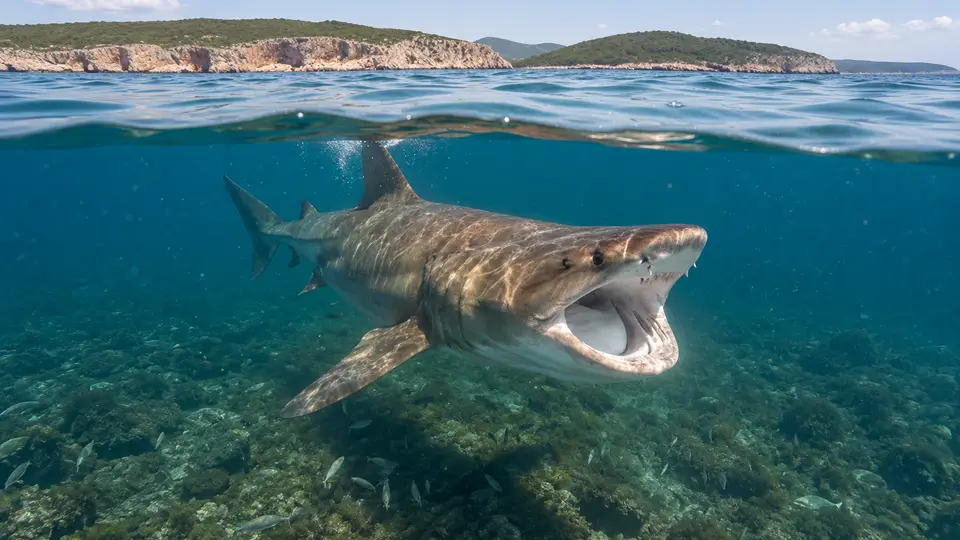
Basking Shark in its natural habitat, AI illustration

Basking Shark: where and when to see them

Cetorhinus maximus

Basking Shark at a glance

The basking shark is the world's second-largest living fish and a specialist feeder on tiny drifting animals. Despite its enormous mouth, it is not a predator of people or large marine mammals. Individuals sometimes feed close to the surface, making their dorsal fins visible from coastal viewpoints or vessel decks. Surface appearances are strongly influenced by plankton distribution, so a suitable season does not make encounters predictable or universal.

Behaviour & reproduction

Size
6–8 m long
Weight
Not reliably established
Lifespan
Not reliably established
Status
Endangered

Basking sharks typically swim slowly while feeding, passing water through the open mouth and across filtering structures associated with the gills. They may gather where currents concentrate plankton, but these aggregations can disperse quickly. Tracking has revealed extensive seasonal movements and substantial changes in depth. Courtship-like circling groups have been documented, and occasional full-body breaches show that an apparently sedate shark can produce powerful bursts of activity. Individual basking sharks are often solitary, but they can form aggregations when food is abundant. Their slow, deliberate swimming style near the surface is primarily for continuous feeding, allowing them to process large volumes of water.

Top wildlife locations

Scotland wildlife habitat

Scotland

Western Scottish headlands and island coasts overlook productive waters where surface-feeding sharks sometimes appear. Shore viewpoints are practical, but rough seas, distant animals and highly patchy plankton can prevent observations.

Adventure cruises in Scotland
Destinations describe the species' habitat, not guaranteed cruise stops. Some animals require an optional inland excursion or are found in restricted reserves.

Fun facts about the Basking Shark

  • Only the whale shark grows larger among living fishes.
  • Its feeding apparatus includes gill rakers that retain small planktonic prey.
  • Satellite tracking has shown that some individuals cross ocean basins.
  • Basking sharks can breach completely clear of the surface.

Best time to see the Basking Shark

Scottish surface observations are most plausible from late spring into early autumn, often with the strongest interest in summer. Plankton blooms, currents and weather vary annually. Calm conditions improve visibility from shore or decks but do not establish shark presence. In Scotland, the prime season aligns with increased plankton productivity, making sightings more frequent from May to September. Early mornings or late afternoons can sometimes offer calmer seas and better visibility for spotting these animals.

Basking Shark: season matrix by destination

Travel and observation windows vary by region. Highlighted months are an orientation for planning, not confirmed sightings or a guarantee of access.

Scotland

This is a credible window for coastal travel and surface activity, not a prediction of sharks at a particular viewpoint.

JanFebMarAprMayJunJulAugSepOctNovDec
Cruise ships in Scotland

Where the Basking Shark lives

This marine shark inhabits temperate coastal and offshore waters, often near productive fronts, headlands and shelf seas. It is not confined to the surface or shoreline. Seasonal movements can take individuals far offshore and into much deeper water. Despite their size, basking sharks are highly migratory, often traveling thousands of kilometers across ocean basins. They are found in both the Atlantic and Pacific Oceans, generally preferring waters between 8 and 24 degrees Celsius.

What the Basking Shark eats

Basking sharks filter zooplankton, particularly copepods, together with other small drifting crustaceans and planktonic animals. They concentrate feeding where prey density makes continuous swimming worthwhile. They do not chase seals or fish schools in the manner of large predatory sharks. Their gill rakers are specifically adapted to sieve microscopic prey from vast quantities of water, acting as a highly efficient filter-feeding apparatus. Basking sharks can filter up to 2,000 tons of water per hour to extract sufficient zooplankton.

Species at a glance

Common name
Basking Shark
Scientific name
Cetorhinus maximus
Animal group
Marine life
Size
6–8 m long
Weight
Not reliably established
Lifespan
Not reliably established
Status
Endangered
Identification
Compared with other large sharks, the basking shark has exceptionally long gill slits nearly encircling the head and an enormous filtering mouth. Their dorsal fin is typically large and triangular, often visible above the water, while the caudal (tail) fin can also be seen, particularly the upper lobe. The skin is dark grey to brownish-black and often appears mottled or scarred.

Basking Shark: frequently asked questions

Where can I see the Basking Shark?
Scotland. Scan sheltered headlands or watch from an established vessel route with binoculars. Never encourage close approaches, feed sharks or obstruct their path; their large bodies and tails require generous space. Maintain a respectful distance of at least 100 meters, which is crucial for the safety of both the shark and observers. Binoculars or a spotting scope are essential tools for identifying these sharks from a distance without disturbance.
When is the best time to see the Basking Shark?
Scottish surface observations are most plausible from late spring into early autumn, often with the strongest interest in summer. Plankton blooms, currents and weather vary annually. Calm conditions improve visibility from shore or decks but do not establish shark presence. In Scotland, the prime season aligns with increased plankton productivity, making sightings more frequent from May to September. Early mornings or late afternoons can sometimes offer calmer seas and better visibility for spotting these animals.
How big does the Basking Shark get?
6–8 m long. Adult weight: Not reliably established. Size varies with age, sex and population.
How should I behave around the Basking Shark?
Scan sheltered headlands or watch from an established vessel route with binoculars. Never encourage close approaches, feed sharks or obstruct their path; their large bodies and tails require generous space. Maintain a respectful distance of at least 100 meters, which is crucial for the safety of both the shark and observers. Binoculars or a spotting scope are essential tools for identifying these sharks from a distance without disturbance.
What does the Basking Shark eat?
Basking sharks filter zooplankton, particularly copepods, together with other small drifting crustaceans and planktonic animals. They concentrate feeding where prey density makes continuous swimming worthwhile. They do not chase seals or fish schools in the manner of large predatory sharks. Their gill rakers are specifically adapted to sieve microscopic prey from vast quantities of water, acting as a highly efficient filter-feeding apparatus. Basking sharks can filter up to 2,000 tons of water per hour to extract sufficient zooplankton.
Are wildlife sightings guaranteed on an adventure cruise?
No. Animals move freely and routes, weather, access restrictions and local conditions influence every outing. Confirm the actual itinerary and shore program before booking.

Compare wildlife in the same destinations

Explore other marine life recorded in these destinations. Similar surroundings do not mean the animals share the same habits or viewing season.

Species comparison by animal group and destination
Basking SharkBasking SharkMinke WhaleMinke WhaleRisso's DolphinRisso's Dolphin
Animal groupMarine lifeAnimal groupMarine lifeAnimal groupMarine life
DestinationsScotlandDestinationsAlaska, Norway, Scotland, ArcticDestinationsEgypt, Greece, Portugal, Scotland, Turkey, Maldives
All wildlife destinations
Plan your trip

Find your next wildlife adventure

Compare destinations, shore programs and dates with the animals and habitats you would love to see.

  • Naturalist-led shore excursions
  • Responsible wildlife watching
  • Small expedition ships

Newsletter

Take Blue Rides with you

Adventure cruise offers, last-minute deals and trip inspiration.

Free, unsubscribe anytime. Details: Privacy Policy

Partner with Blue Rides

Affiliate Program

Recommend adventure cruises and earn commission on every confirmed booking.

Share. Track. Earn.

Your footage, our stage

Send us your videos or pictures.

Captured beautiful landscapes or wildlife? Share your videos and pictures with us, we may feature them on Blue Rides.