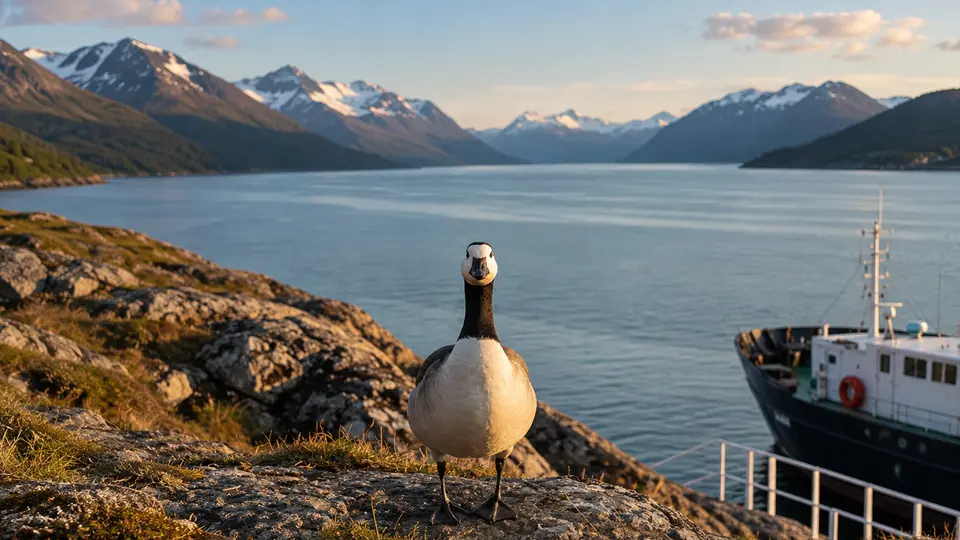
Barnacle Goose in its natural habitat, AI illustration

Barnacle Goose: where and when to see them

Branta leucopsis

Barnacle Goose at a glance

The barnacle goose is a compact, strongly patterned goose associated with Arctic breeding grounds and temperate winter pastures. Its white face, black neck and neatly barred grey back make it distinctive even in mixed flocks. Several migratory populations follow different routes across the North Atlantic region. Birds breeding in Svalbard connect Norway's high Arctic with wintering grounds farther south, while some European populations now breed well outside the Arctic.

Behaviour & reproduction

Size
58–70 cm long
Weight
1.2–2.2 kg
Lifespan
Not reliably established
Status
Least Concern

Barnacle geese maintain close family groups, and young birds commonly travel with their parents during their first migration. Pairs often remain together across successive breeding seasons. Many Arctic birds nest on cliffs or steep slopes that reduce access for terrestrial predators. Their downy chicks leave these elevated nests before they can fly, following parental calls toward feeding areas. Outside breeding, flocks graze together and use communal waterside roosts. Courtship displays involve mutual preening and head-dipping, strengthening pair bonds that can last for many years. Families exhibit strong loyalty, with parents vigorously defending their goslings from aerial predators like gulls and skuas.

Top wildlife locations

Norway wildlife habitat

Norway

Coastal grasslands and islands can hold passage flocks, while Svalbard offers tundra and cliff habitat. High Arctic access is limited to permitted routes, and nesting cliffs should be observed remotely.

Adventure cruises in Norway
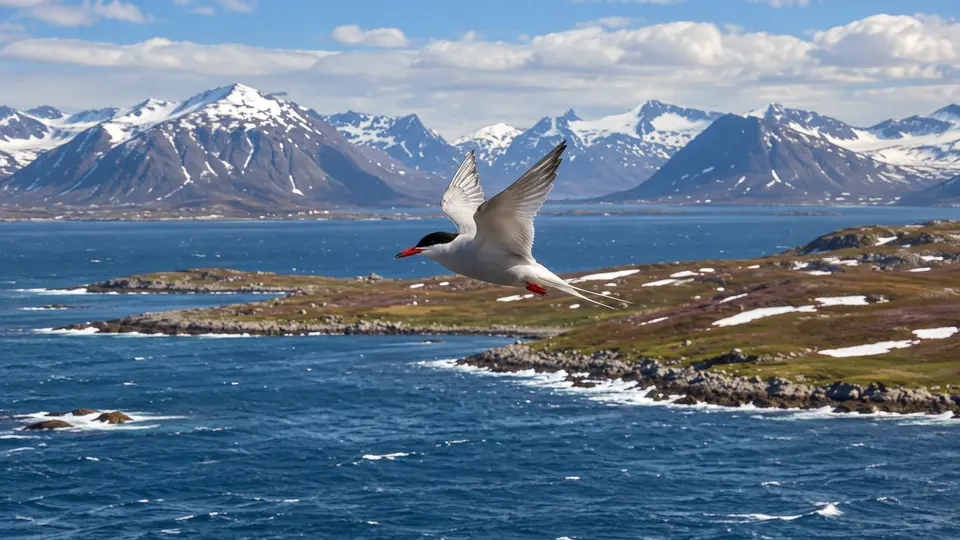
Destinations describe the species' habitat, not guaranteed cruise stops. Some animals require an optional inland excursion or are found in restricted reserves.

Fun facts about the Barnacle Goose

  • The species' name reflects an old European belief that these geese developed from goose barnacles.
  • Some chicks jump from cliff nests only a day or two after hatching.
  • Svalbard breeders traditionally winter mainly around the Solway Firth in Britain.
  • Young birds learn migration routes while travelling with their parents.

Best time to see the Barnacle Goose

In Norway, late spring through summer offers opportunities around migration staging areas and Svalbard breeding habitat. Timing varies sharply with latitude and snowmelt. May can suit mainland passage, whereas June through August is the more practical high Arctic observation window. Prime viewing in Svalbard aligns with the short Arctic summer, when the geese are active breeding and raising young. On the Norwegian mainland, watch for large migratory congregations along coastlines and in estuaries during spring and autumn passage.

Barnacle Goose: season matrix by destination

Travel and observation windows vary by region. Highlighted months are an orientation for planning, not confirmed sightings or a guarantee of access.

Norway

May suits some mainland passage; June to August supports high Arctic travel and breeding-area observation, without assuring local presence.

JanFebMarAprMayJunJulAugSepOctNovDec
Cruise ships in Norway

Where the Barnacle Goose lives

Breeding habitat includes Arctic coastal cliffs, rocky islands and nearby tundra with short vegetation. Feeding families move toward freshwater pools and productive grazing areas. During migration and winter, the species uses saltmarshes, wet grasslands, estuarine margins and managed pasture. Coastal cliff nesting provides protection from terrestrial predators like Arctic foxes. Many populations in Western Europe have expanded their range from natural coastal wetlands to include agricultural fields during the non-breeding season.

What the Barnacle Goose eats

Barnacle geese are predominantly grazers, cropping grasses, sedges and other low plants with their short bills. Arctic birds also eat leaves and shoots of tundra vegetation. Wintering flocks frequently feed on pasture grasses, with food choice changing according to local availability. Their diet shifts seasonally, with a higher proportion of protein-rich sedges and forbs consumed during the demanding breeding period. In agricultural settings, they may consume cereal crops like wheat and barley, which can sometimes lead to conflicts with farmers.

Species at a glance

Common name
Barnacle Goose
Scientific name
Branta leucopsis
Animal group
Birds
Size
58–70 cm long
Weight
1.2–2.2 kg
Lifespan
Not reliably established
Status
Least Concern
Identification
Unlike brent geese, barnacle geese have a conspicuous white face framed by a black crown, neck and breast, plus a pale, finely barred grey back. Juveniles in their first winter can be distinguished by less defined facial markings and a slightly duller plumage compared to adults. The flight pattern is strong and direct, often in V-formations or long lines, characterized by fairly rapid wingbeats.

Barnacle Goose: frequently asked questions

Where can I see the Barnacle Goose?
Norway. Watch grazing flocks from established paths or a stationary deck using binoculars. Keep well away from nests and cliff edges, and retreat if adults become alarmed or families stop feeding. Be mindful that large flocks can be easily disturbed, so approach quietly and avoid sudden movements. From cruise ships, large rafts of barnacle geese can be seen on the water, especially in sheltered fjords or near coastal feeding areas.
When is the best time to see the Barnacle Goose?
In Norway, late spring through summer offers opportunities around migration staging areas and Svalbard breeding habitat. Timing varies sharply with latitude and snowmelt. May can suit mainland passage, whereas June through August is the more practical high Arctic observation window. Prime viewing in Svalbard aligns with the short Arctic summer, when the geese are active breeding and raising young. On the Norwegian mainland, watch for large migratory congregations along coastlines and in estuaries during spring and autumn passage.
How big does the Barnacle Goose get?
58–70 cm long. Adult weight: 1.2–2.2 kg. Size varies with age, sex and population.
How should I behave around the Barnacle Goose?
Watch grazing flocks from established paths or a stationary deck using binoculars. Keep well away from nests and cliff edges, and retreat if adults become alarmed or families stop feeding. Be mindful that large flocks can be easily disturbed, so approach quietly and avoid sudden movements. From cruise ships, large rafts of barnacle geese can be seen on the water, especially in sheltered fjords or near coastal feeding areas.
What does the Barnacle Goose eat?
Barnacle geese are predominantly grazers, cropping grasses, sedges and other low plants with their short bills. Arctic birds also eat leaves and shoots of tundra vegetation. Wintering flocks frequently feed on pasture grasses, with food choice changing according to local availability. Their diet shifts seasonally, with a higher proportion of protein-rich sedges and forbs consumed during the demanding breeding period. In agricultural settings, they may consume cereal crops like wheat and barley, which can sometimes lead to conflicts with farmers.
Are wildlife sightings guaranteed on an adventure cruise?
No. Animals move freely and routes, weather, access restrictions and local conditions influence every outing. Confirm the actual itinerary and shore program before booking.

Compare wildlife in the same destinations

Explore other birds recorded in these destinations. Similar surroundings do not mean the animals share the same habits or viewing season.

Species comparison by animal group and destination
Barnacle GooseBarnacle GooseArctic TernArctic TernAtlantic PuffinAtlantic Puffin
Animal groupBirdsAnimal groupBirdsAnimal groupBirds
DestinationsNorwayDestinationsAlaska, Norway, ArcticDestinationsNew England, Norway, Scotland, Arctic
All wildlife destinations
Plan your trip

Find your next wildlife adventure

Compare destinations, shore programs and dates with the animals and habitats you would love to see.

  • Naturalist-led shore excursions
  • Responsible wildlife watching
  • Small expedition ships

Newsletter

Take Blue Rides with you

Adventure cruise offers, last-minute deals and trip inspiration.

Free, unsubscribe anytime. Details: Privacy Policy

Partner with Blue Rides

Affiliate Program

Recommend adventure cruises and earn commission on every confirmed booking.

Share. Track. Earn.

Your footage, our stage

Send us your videos or pictures.

Captured beautiful landscapes or wildlife? Share your videos and pictures with us, we may feature them on Blue Rides.

