
Reading the current
Your dive guide will brief direction and strength, but always check yourself: watch a piece of debris drift past, or release a tiny bubble. Strong currents (over 1 knot) require negative entries — you go down fast and don't surface until the dive is over.
Negative entries
Empty your BCD on the surface, hold your mask and reg, and step in. Begin descending immediately. Group up at the agreed depth (usually 5–10 m below the boat) and wait for the dive guide to lead off.
Stay with the group
On a drift, the boat follows the bubbles. Solo drifters get left behind. Stay within visual contact of your guide and roughly the same depth as the rest of the group. Don't fight the current — finning hard against it burns air and exhausts you.
Using a reef hook
In ripping currents (Blue Corner, Palau; Manta Point, Maldives) a reef hook lets you anchor onto dead substrate and watch the show. Always hook into bare rock — never coral. Add a small puff of air to your BCD so the line stays taut and you hover comfortably.
SMB deployment and pickup
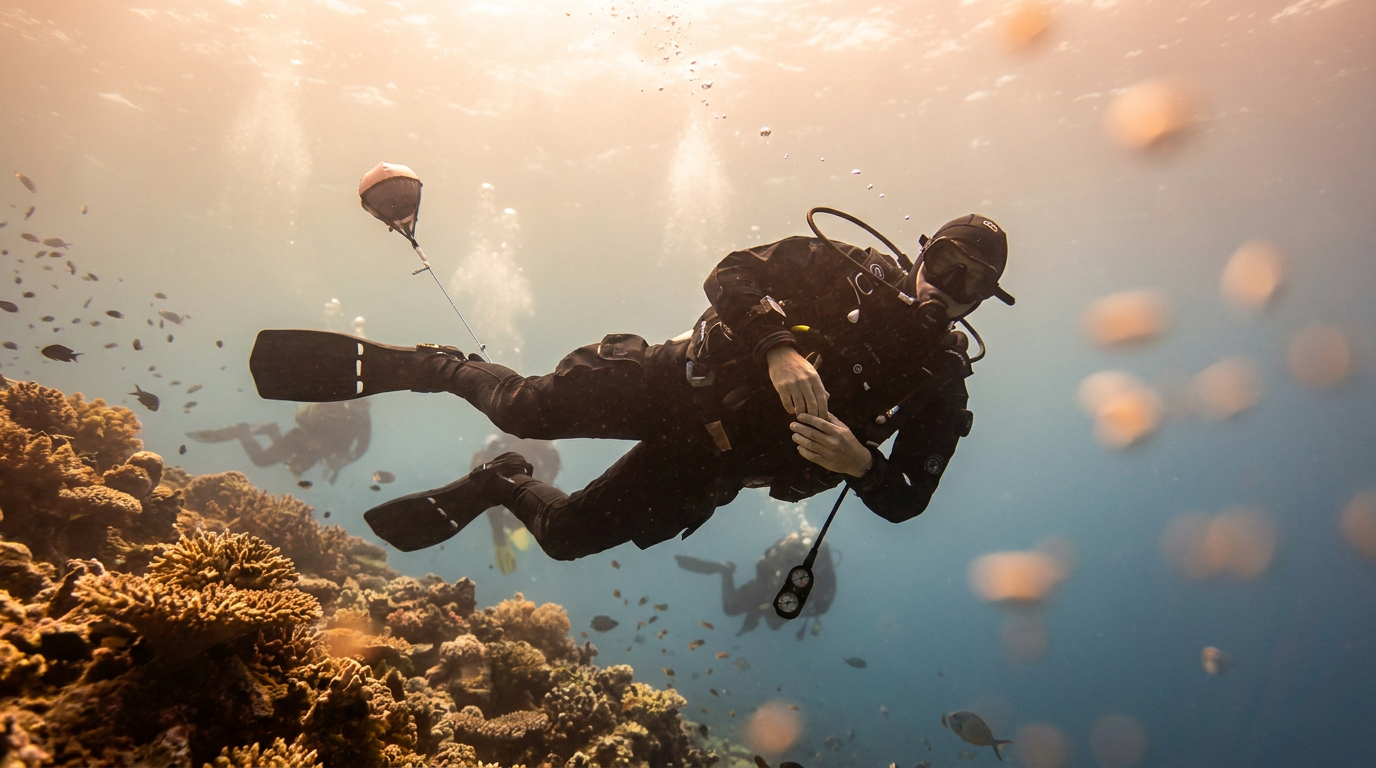
Every drift diver carries a delayed surface marker buoy (DSMB). Deploy it at your safety stop so the boat can find you. Don't release it until you're at 5 m and the line is clear of you and your buddy. The boat will pick you up where you surface — don't swim against the current to reach it.
Frequently Asked Questions
What's the minimum certification for drift diving?
Open Water is the technical minimum, but Advanced Open Water plus a Drift Diver specialty (or prior drift experience) is what most liveaboards require.
Do I need my own DSMB?
Yes. Every diver should carry their own DSMB and reel/spool. Renting on liveaboards isn't always possible.
What if I get separated?
Look for one minute, then surface, deploy your SMB, and wait. The boat is following the group's bubbles and will reach you quickly.
Related Searches
Popular searches related to this guide