
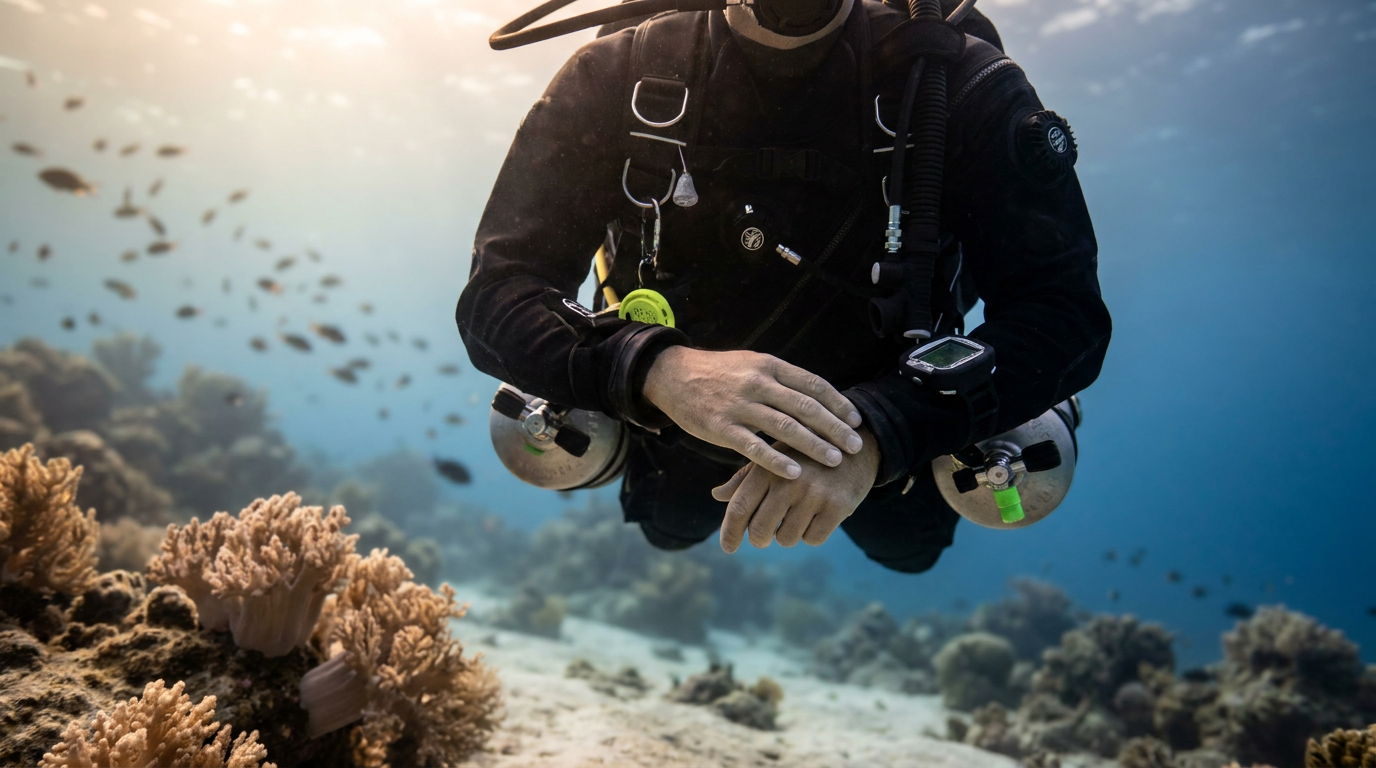
Get your weight right (you're probably over-weighted)
Most divers wear 2–4 kg too much because instructors over-weight beginners for safety. Do a proper weight check on day 1: in the water, holding a normal breath at the surface with empty BCD, you should float at eye level. Exhale fully = sink slowly. Anything more = drop weight.
Breathing IS your buoyancy control
Forget the BCD inflator for fine tuning. Inhale = rise. Exhale = sink. Slow, deep breaths give you 1–1.5m of vertical control without touching anything. Use the inflator only for major depth changes. This single shift saves 30% of your air consumption.
Get horizontal — the trim revolution
Vertical, kicking divers stir up silt and look like beginners. Aim for fully horizontal: head slightly down, fins up, frog kick. Move your weight up your body if you're bottom-heavy (trim pockets on tank strap). Most liveaboards rent BCDs with trim pockets — ask.
The hover drill — practice it daily
First 5 minutes of every dive: hover motionless at 5m, mid-water, no kick, no inflator. Within 3 days you'll cut your air consumption 20%. The dive guide will notice — and assign you the better buddies.
Common scenarios on a liveaboard
Drift dives (Maldives, Komodo): trim matters more than weighting. Wreck penetration (Truk, Egypt): perfect buoyancy required, no exceptions. Macro dives (Lembeh): sustained hover for minutes. Each scenario rewards practice — and a liveaboard gives you 25 dives in a week to practice.
Frequently Asked Questions
How long to master buoyancy?
Significant improvement in 50 dives if you focus. Many divers stay sloppy for 500.
Does steel vs aluminium tank matter?
Yes — steel is negative throughout, aluminium becomes positive at end. Recompute trim if you switch.
PADI Peak Performance Buoyancy course — worth it?
Yes if you've not been formally taught trim and breathing. 1-day course, big improvement.
Why am I always sinking at end of dive?
Likely over-weighted. Drop 1–2 kg next dive and re-test.
Will a thicker wetsuit affect buoyancy?
Yes — every 1mm adds ~0.5–1 kg of weight needed. Recompute when changing suit thickness.
Get more practice on a liveaboard
Browse trips with calm conditions perfect for refining your buoyancy.
Browse liveaboardsRelated Searches
Popular searches related to this guide