
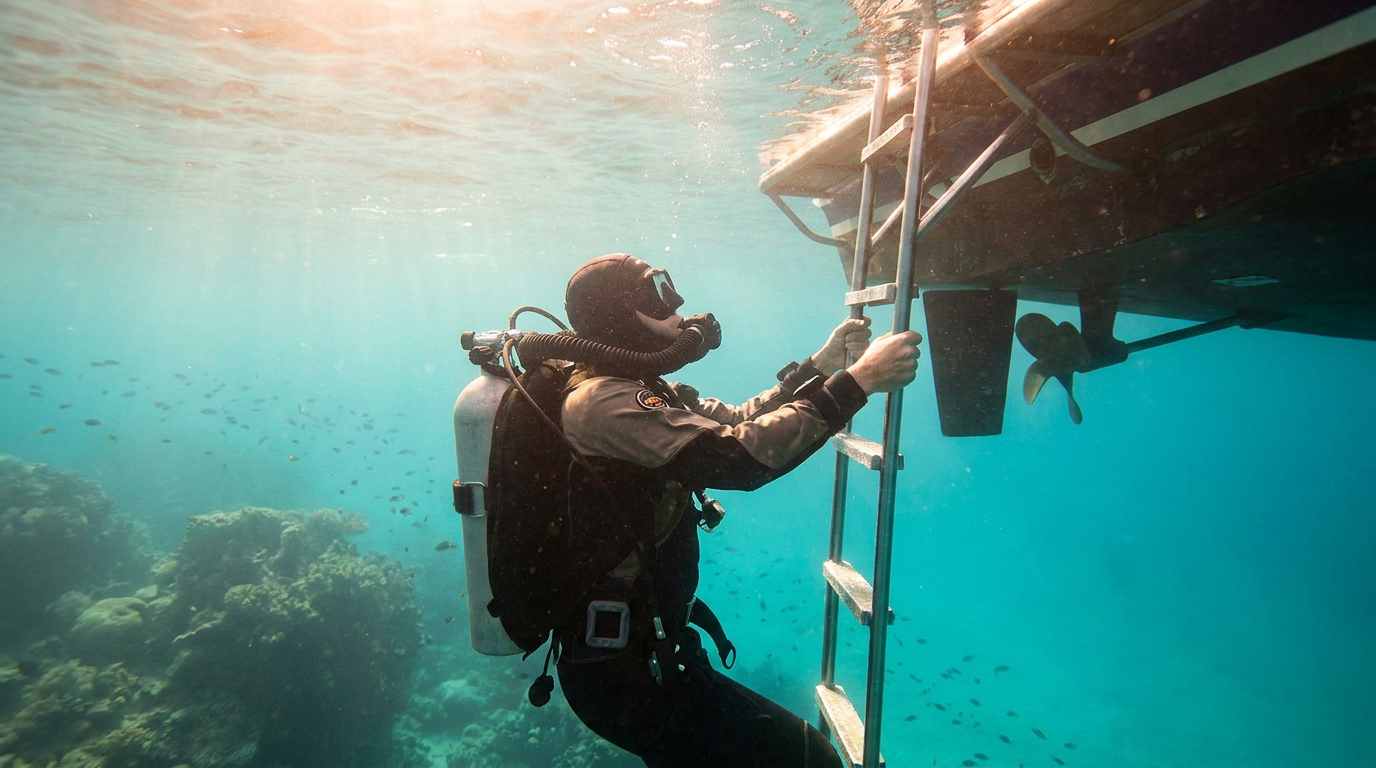
How a rebreather works
Open-circuit scuba dumps every breath you exhale as bubbles — wasteful, noisy and limited by tank size. A rebreather captures that exhaled gas, removes CO₂ through a chemical scrubber, replaces consumed oxygen from a small bottle, and delivers it back to you. Two small cylinders (oxygen + diluent) typically last 4–6 hours of diving.
Why divers choose CCR
• Long bottom times — 3–6 hours on a single setup vs 45 minutes on a standard tank
• Silent diving — no bubble noise, much closer wildlife encounters
• Optimised gas — the unit constantly adjusts your mix for your depth, maximising no-deco time
• Warm, moist breathing — far more comfortable on long or cold dives
• Deep diving — accessing 60–100m efficiently without massive open-circuit logistics
Popular CCR units
The most common units on liveaboards are the JJ-CCR, AP Inspiration / Evolution, Hollis Prism 2 and the Poseidon SE7EN. Always confirm with the operator that they stock your unit's spares (oxygen sensors, scrubber material) before booking.
Training pathway
You need an Advanced Open Water + Nitrox + Deep certification before starting CCR. The standard path:
• Air diluent CCR — 4–6 days, qualifies you to 30m
• Mod 1 / Trimix CCR — additional 4–5 days, qualifies you to 60m
• Mod 2 / Decompression CCR — for staged decompression beyond NDL
Total cost for the unit + training: typically $12,000–$20,000.
Liveaboards that welcome CCR divers
Many Red Sea, Truk Lagoon, Bikini Atoll, Coral Sea and Cocos Island liveaboards specifically cater to CCR divers. They stock sofnolime scrubber, oxygen and diluent fills, and typically charge a per-day rebreather supplement of $30–$60.
Costs to budget per trip
• Sofnolime scrubber material: $25–$50 per refill (one per day of diving)
• Oxygen fills: $5–$15 per fill
• Diluent fills (Nitrox or Trimix): $10–$80 per fill
• Operator supplement: $30–$60 per day
Frequently Asked Questions
How much does a rebreather cost?
Entry-level units like the AP Inspiration or Hollis Prism 2 start around $7,500. The popular JJ-CCR is around $11,000. Add $1,500–$3,000 for training and a similar amount for the first year of consumables.
Are rebreathers dangerous?
Rebreathers carry a higher fatality rate than open-circuit diving — but almost every incident traces to a missed pre-dive check or training violation. Disciplined divers have an excellent safety record.
Can I rent a rebreather on a liveaboard?
Rentals are very rare because each diver needs their unit set to their personal preferences. A small number of operators in the Red Sea offer training units for try-dives.
Will I see more wildlife on a rebreather?
Yes — sharks, hammerheads, cetaceans and skittish reef fish often approach much closer because there are no bubbles or breathing noise.
Plan your next dive trip
Browse hand-picked liveaboards worldwide and book with expert support.
See liveaboardsRelated Searches
Popular searches related to this guide