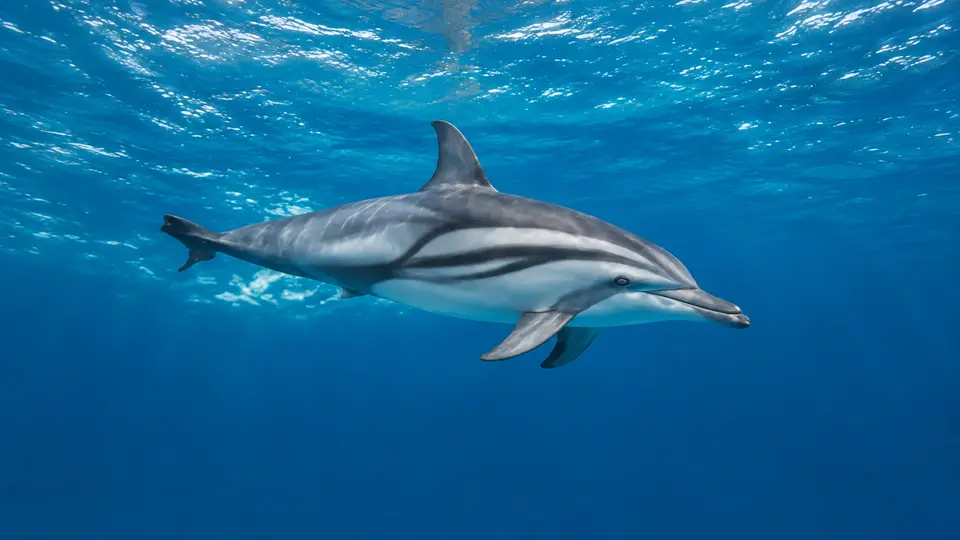
Striped Dolphin in its natural habitat, AI illustration
Size1.8–2.6 m longLifespanNot reliably establishedStatusLeast Concern

Striped Dolphin: where and when to see them

Stenella coeruleoalba

Striped Dolphin at a glance

The striped dolphin is an oceanic mammal of tropical and temperate seas, recognizable by its sharply patterned flanks. In the Mediterranean and northeastern Atlantic, it generally favors deep water rather than sheltered coastal bays. Its streamlined body and energetic surface activity can make distant groups conspicuous, although identification requires a clear view. The global assessment masks regional pressures, including accidental capture in fishing gear, chemical contamination, noise and outbreaks of infectious disease.

Behaviour & reproduction

Size
1.8–2.6 m long
Weight
90–150 kg
Lifespan
Not reliably established
Status
Least Concern

Striped dolphins are highly social, traveling in groups that may contain dozens or hundreds of individuals. Schools can spread out while feeding and gather into tighter formations when traveling. Leaps, rapid changes of direction and coordinated surfacing are common, but surface activity varies with conditions and context. They use echolocation to locate prey and communicate through whistles and other sounds. Feeding frequently follows the movements of oceanic prey toward shallower water after dark. Striped dolphins are highly social, traveling in groups that may contain dozens or hundreds of individuals. Schools can spread out while feeding and gather into tighter formations when traveling. Leaps, rapid changes of direction and coordinated surfacing are common, but surface activity varies with conditions and context. They use echolocation to locate prey and communicate through whistles and other sounds. Feeding frequently follows the movements of oceanic prey toward shallower water after dark. Their social structure involves complex interactions, including alloparental care where non-mothers assist in raising calves. They are known for their spectacular acrobatic displays, frequently leaping high out of the water, especially when traveling quickly.

Top wildlife locations

Croatia wildlife habitat

Croatia

Exposed outer Adriatic coasts offer distant views toward deeper water, but this offshore dolphin is uncommon from shore. Sheltered island channels are less suitable, and any deck observation remains opportunistic.

Adventure cruises in Croatia
Greece wildlife habitat

Greece

Steep Ionian and Aegean coastlines overlooking deep water provide plausible scanning habitat. Shore sightings are unpredictable and often distant; exposed headlands or ordinary vessel decks are more appropriate than shallow bays.

Adventure cruises in Greece
Portugal wildlife habitat

Portugal

Atlantic headlands and island coastlines facing deep ocean provide plausible distant viewing habitat. Shore encounters are irregular, and mainland observations can be especially difficult where suitable offshore waters lie far beyond the coast.

Adventure cruises in Portugal
Turkey wildlife habitat

Turkey

Mediterranean and Aegean coastal viewpoints overlooking deep water offer the most plausible shore setting. Sightings are uncommon and distant; shallow resort bays should not be treated as dependable habitat for this oceanic species.

Adventure cruises in Turkey

Destinations describe the species' habitat, not guaranteed cruise stops. Some animals require an optional inland excursion or are found in restricted reserves.

Fun facts about the Striped Dolphin

  • The species name coeruleoalba refers to its blue-and-white coloration.
  • A dark eye-to-anus stripe is a particularly useful identification feature.
  • Its prey can include lanternfishes associated with deep scattering layers.
  • Mediterranean populations have suffered major dolphin morbillivirus outbreaks.

Best time to see the Striped Dolphin

There is no universal viewing season across this wide range. Late spring through early autumn often provides better Mediterranean visibility and calmer conditions for distant deck observation. Atlantic opportunities depend strongly on local sea state; these travel windows do not indicate breeding seasons. There is no universal viewing season across this wide range. Late spring through early autumn often provides better Mediterranean visibility and calmer conditions for distant deck observation. Atlantic opportunities depend strongly on local sea state; these travel windows do not indicate breeding seasons. During these calmer periods, the probability of spotting their characteristic leaps increases significantly. Warm sea temperatures from July to September are often associated with higher offshore activity.

Striped Dolphin: season matrix by destination

Travel and observation windows vary by region. Highlighted months are an orientation for planning, not confirmed sightings or a guarantee of access.

Croatia

These months usually offer workable coastal travel and visibility, not a confirmed local sighting or breeding calendar.

JanFebMarAprMayJunJulAugSepOctNovDec
Cruise ships in Croatia

Greece

A practical coastal observation window, subject to strong regional winds; it does not imply seasonal presence at every island.

JanFebMarAprMayJunJulAugSepOctNovDec
Cruise ships in Greece

Portugal

Longer days and often more favorable sea conditions support observation, but mainland and Atlantic island conditions differ substantially.

JanFebMarAprMayJunJulAugSepOctNovDec
Cruise ships in Portugal

Turkey

This is a general fair-weather coastal window, not evidence of predictable local occurrence or a breeding season.

JanFebMarAprMayJunJulAugSepOctNovDec
Cruise ships in Turkey

Where the Striped Dolphin lives

This species occupies warm temperate and tropical offshore waters, often beyond the continental shelf or over submarine canyons. Deep water close to steep coastlines can bring animals within distant shore-viewing range, but enclosed harbors and shallow lagoons are not typical habitat. This species occupies warm temperate and tropical offshore waters, often beyond the continental shelf or over submarine canyons. Deep water close to steep coastlines can bring animals within distant shore-viewing range, but enclosed harbors and shallow lagoons are not typical habitat. They thrive in waters between 10 and 27 degrees Celsius, typically preferring temperatures above 18 degrees. In the Mediterranean Sea, they are the most common cetacean, often found in pelagic zones far from shore.

What the Striped Dolphin eats

Striped dolphins eat small schooling fishes, squid and some crustaceans. The balance varies geographically and includes prey associated with deeper oceanic layers. Their feeding movements often track daily vertical migrations, when fishes and squid rise closer to the surface at night. Striped dolphins eat small schooling fishes, squid and some crustaceans. The balance varies geographically and includes prey associated with deeper oceanic layers. Their feeding movements often track daily vertical migrations, when fishes and squid rise closer to the surface at night. They are opportunistic feeders, capable of diving to depths of 700 meters to hunt. Key prey items include lanternfish, hake, and various species of squid.

Species at a glance

Common name
Striped Dolphin
Scientific name
Stenella coeruleoalba
Animal group
Mammals
Size
1.8–2.6 m long
Weight
90–150 kg
Lifespan
Not reliably established
Status
Least Concern
Identification
Dark stripes running from the eye toward the flipper and rear flank distinguish it from the plainer bottlenose dolphin and the hourglass-patterned common dolphin. Dark stripes running from the eye toward the flipper and rear flank distinguish it from the plainer bottlenose dolphin and the hourglass-patterned common dolphin. The prominent dark stripe from the eye extends to the anus, with a thinner accessory stripe sometimes visible above it. They also feature a distinctive white or pinkish belly and a short, dark beak.

Striped Dolphin: frequently asked questions

Where can I see the Striped Dolphin?
Croatia, Greece, Portugal, Turkey. Scan deep-water horizons from established coastal viewpoints or a vessel's deck using binoculars. Keep observations distant, never encourage pursuit or feeding, and use a stable position away from rail edges when watching fast-moving groups. Scan deep-water horizons from established coastal viewpoints or a vessel's deck using binoculars. Keep observations distant, never encourage pursuit or feeding, and use a stable position away from rail edges when watching fast-moving groups. Their fast and energetic swimming makes them challenging but rewarding to observe from a moving vessel. Look for groups breaching or porpoising, which are clear indicators of their presence.
When is the best time to see the Striped Dolphin?
There is no universal viewing season across this wide range. Late spring through early autumn often provides better Mediterranean visibility and calmer conditions for distant deck observation. Atlantic opportunities depend strongly on local sea state; these travel windows do not indicate breeding seasons. There is no universal viewing season across this wide range. Late spring through early autumn often provides better Mediterranean visibility and calmer conditions for distant deck observation. Atlantic opportunities depend strongly on local sea state; these travel windows do not indicate breeding seasons. During these calmer periods, the probability of spotting their characteristic leaps increases significantly. Warm sea temperatures from July to September are often associated with higher offshore activity.
How big does the Striped Dolphin get?
1.8–2.6 m long. Adult weight: 90–150 kg. Size varies with age, sex and population.
How should I behave around the Striped Dolphin?
Scan deep-water horizons from established coastal viewpoints or a vessel's deck using binoculars. Keep observations distant, never encourage pursuit or feeding, and use a stable position away from rail edges when watching fast-moving groups. Scan deep-water horizons from established coastal viewpoints or a vessel's deck using binoculars. Keep observations distant, never encourage pursuit or feeding, and use a stable position away from rail edges when watching fast-moving groups. Their fast and energetic swimming makes them challenging but rewarding to observe from a moving vessel. Look for groups breaching or porpoising, which are clear indicators of their presence.
What does the Striped Dolphin eat?
Striped dolphins eat small schooling fishes, squid and some crustaceans. The balance varies geographically and includes prey associated with deeper oceanic layers. Their feeding movements often track daily vertical migrations, when fishes and squid rise closer to the surface at night. Striped dolphins eat small schooling fishes, squid and some crustaceans. The balance varies geographically and includes prey associated with deeper oceanic layers. Their feeding movements often track daily vertical migrations, when fishes and squid rise closer to the surface at night. They are opportunistic feeders, capable of diving to depths of 700 meters to hunt. Key prey items include lanternfish, hake, and various species of squid.
Are wildlife sightings guaranteed on an adventure cruise?
No. Animals move freely and routes, weather, access restrictions and local conditions influence every outing. Confirm the actual itinerary and shore programme before booking.

Compare wildlife in the same destinations

Explore other mammals recorded in these destinations. Similar surroundings do not mean the animals share the same habits or viewing season.

Species comparison by animal group and destination
Striped DolphinStriped DolphinBlue WhaleBlue WhaleBrown BearBrown Bear
Animal groupMammalsAnimal groupMammalsAnimal groupMammals
DestinationsCroatia, Greece, Portugal, TurkeyDestinationsMexico, Norway, Portugal, Antarctica, Arctic, Maldives, New ZealandDestinationsTurkey
All wildlife destinations
Plan your trip

Find your next wildlife adventure

Compare destinations, shore programmes and dates with the animals and habitats you would love to see.

  • Naturalist-led shore excursions
  • Responsible wildlife watching
  • Small expedition ships

Newsletter

Take Blue Rides with you

Adventure cruise offers, last-minute deals and trip inspiration.

Free, unsubscribe anytime. Details: Privacy Policy

Partner with Blue Rides

Affiliate Program

Recommend adventure cruises and earn commission on every confirmed booking.

Share. Track. Earn.