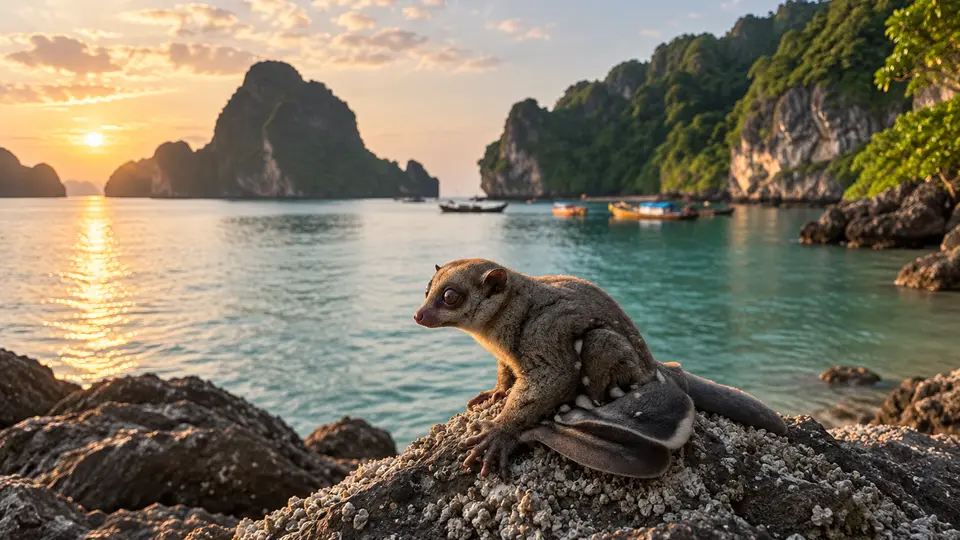
Sunda flying lemur in its natural habitat, AI illustration
Size33–42 cm head-and-body lengthLifespanNot reliably establishedStatusLeast Concern

Sunda flying lemur: where and when to see them

Galeopterus variegatus

Sunda flying lemur at a glance

The Sunda flying lemur is a colugo, not a lemur, and it glides rather than flies. A broad skin membrane links its neck, limbs, fingers, toes and tail, creating an unusually extensive gliding surface. Its mottled coat blends closely with bark, making a resting animal surprisingly difficult to notice. Native to parts of Southeast Asia, this tree-dependent mammal can occupy some modified wooded landscapes, but continuous canopy remains important for safe movement.

Behaviour & reproduction

Size
33–42 cm head-and-body length
Weight
0.9–1.8 kg
Lifespan
Not reliably established
Status
Least Concern

Colugos usually rest against trunks or beneath branches during daylight, becoming active around dusk. They climb with short, awkward-looking hops before launching into controlled glides between trees. A mother carries her dependent young against her abdomen, with the folded membrane helping support it. Animals may repeatedly use favored resting trees and feeding routes. They are generally quiet and inconspicuous, and a motionless individual can resemble a knot or patch of lichen on bark. Their gliding ability is highly efficient, allowing them to travel distances of up to 100 meters or more between trees with minimal altitude loss. They are often solitary but occasionally seen in small groups, particularly mothers with young or at favored feeding sites.

Top wildlife locations

Indonesia wildlife habitat

Indonesia

Wooded coastal lowlands within its western Indonesian range offer plausible habitat, but sightings require a targeted forest excursion rather than ordinary beach observation. The species does not occur throughout the Indonesian archipelago.

Adventure cruises in Indonesia
Thailand wildlife habitat

Thailand

Suitable habitat occurs in southern peninsular forests, including wooded lowlands near the coast. A permitted forest excursion is normally required; colugos are cryptic and should not be expected around every beach destination.

Adventure cruises in Thailand

Destinations describe the species' habitat, not guaranteed cruise stops. Some animals require an optional inland excursion or are found in restricted reserves.

Fun facts about the Sunda flying lemur

  • Colugos belong to their own mammalian order, Dermoptera.
  • Their lower incisors have comb-like divisions.
  • Young remain attached to their mother while she glides.
  • Colugos are among the closest living relatives of primates.

Best time to see the Sunda flying lemur

There is no well-supported general seasonal peak for viewing this nocturnal mammal. Locally drier months can make permitted forest walks more practical, but activity is primarily governed by darkness and weather. Quiet dusk observation near suitable trees is more useful than a breeding calendar. While largely nocturnal, observing them during a clear, moonlit night can sometimes enhance visibility as they move between trees. Local guides in Indonesia and Thailand can often advise on specific sites where they are regularly seen, regardless of the time of year.

Sunda flying lemur: season matrix by destination

Travel and observation windows vary by region. Highlighted months are an orientation for planning, not confirmed sightings or a guarantee of access.

Indonesia

Rainfall patterns differ among occupied islands, and no single national travel or viewing window is defensible without a specific locality.

JanFebMarAprMayJunJulAugSepOctNovDec
Cruise ships in Indonesia

Thailand

The peninsula's two coasts have different monsoon patterns, and there is no established species-wide viewing season.

JanFebMarAprMayJunJulAugSepOctNovDec
Cruise ships in Thailand

Where the Sunda flying lemur lives

Lowland tropical forests are central habitat, including evergreen woodland and some forest edges, plantations and wooded gardens. Suitable sites need connected trees for feeding and gliding. Broad roads, extensive clearings and intensive development can interrupt otherwise usable canopy routes. They are particularly abundant in primary and secondary rainforests, often found from sea level up to 1500 meters. The species prefers areas with a dense canopy providing both cover and food sources across its range in Indonesia and Thailand.

What the Sunda flying lemur eats

The diet consists mainly of young leaves, supplemented by buds, shoots, flowers and some fruit. Colugos select plant material in the canopy and have a digestive system suited to processing fibrous food. They do not hunt insects or other animals. Despite their name, colugos are not true lemurs and are entirely herbivorous, consuming high fiber foods that require a long digestive tract. This specialized diet means they often spend significant time foraging and digesting in the canopy.

Species at a glance

Common name
Sunda flying lemur
Scientific name
Galeopterus variegatus
Animal group
Mammals
Size
33–42 cm head-and-body length
Weight
0.9–1.8 kg
Lifespan
Not reliably established
Status
Least Concern
Identification
Its continuous membrane encloses the tail and extends between the fingers and toes, unlike a flying squirrel's less extensive gliding membrane. The Sunda flying lemur has a distinctive fur pattern, a mottled grey or brown that camouflages them effectively against tree bark. Their large, forward facing eyes are adapted for excellent night vision, a key identification feature at dusk.

Sunda flying lemur: frequently asked questions

Where can I see the Sunda flying lemur?
Indonesia, Thailand. Watch trunks from established trails at dusk, using a guide where available. Avoid flash, persistent spotlighting or standing beneath a likely glide path, and give mothers carrying young ample space. Scanning the mid to upper canopy with binoculars from a stationary point, especially along forest edges or near fruiting trees, often yields sightings. Patiently observing a promising tree at dusk can reveal their characteristic launch as they begin their nightly activity.
When is the best time to see the Sunda flying lemur?
There is no well-supported general seasonal peak for viewing this nocturnal mammal. Locally drier months can make permitted forest walks more practical, but activity is primarily governed by darkness and weather. Quiet dusk observation near suitable trees is more useful than a breeding calendar. While largely nocturnal, observing them during a clear, moonlit night can sometimes enhance visibility as they move between trees. Local guides in Indonesia and Thailand can often advise on specific sites where they are regularly seen, regardless of the time of year.
How big does the Sunda flying lemur get?
33–42 cm head-and-body length. Adult weight: 0.9–1.8 kg. Size varies with age, sex and population.
How should I behave around the Sunda flying lemur?
Watch trunks from established trails at dusk, using a guide where available. Avoid flash, persistent spotlighting or standing beneath a likely glide path, and give mothers carrying young ample space. Scanning the mid to upper canopy with binoculars from a stationary point, especially along forest edges or near fruiting trees, often yields sightings. Patiently observing a promising tree at dusk can reveal their characteristic launch as they begin their nightly activity.
What does the Sunda flying lemur eat?
The diet consists mainly of young leaves, supplemented by buds, shoots, flowers and some fruit. Colugos select plant material in the canopy and have a digestive system suited to processing fibrous food. They do not hunt insects or other animals. Despite their name, colugos are not true lemurs and are entirely herbivorous, consuming high fiber foods that require a long digestive tract. This specialized diet means they often spend significant time foraging and digesting in the canopy.
Are wildlife sightings guaranteed on an adventure cruise?
No. Animals move freely and routes, weather, access restrictions and local conditions influence every outing. Confirm the actual itinerary and shore programme before booking.

Compare wildlife in the same destinations

Explore other mammals recorded in these destinations. Similar surroundings do not mean the animals share the same habits or viewing season.

Species comparison by animal group and destination
Sunda flying lemurSunda flying lemurAnoaAnoaBabirusaBabirusa
Animal groupMammalsAnimal groupMammalsAnimal groupMammals
DestinationsIndonesia, ThailandDestinationsIndonesiaDestinationsIndonesia
All wildlife destinations
Plan your trip

Find your next wildlife adventure

Compare destinations, shore programmes and dates with the animals and habitats you would love to see.

  • Naturalist-led shore excursions
  • Responsible wildlife watching
  • Small expedition ships

Newsletter

Take Blue Rides with you

Adventure cruise offers, last-minute deals and trip inspiration.

Free, unsubscribe anytime. Details: Privacy Policy

Partner with Blue Rides

Affiliate Program

Recommend adventure cruises and earn commission on every confirmed booking.

Share. Track. Earn.