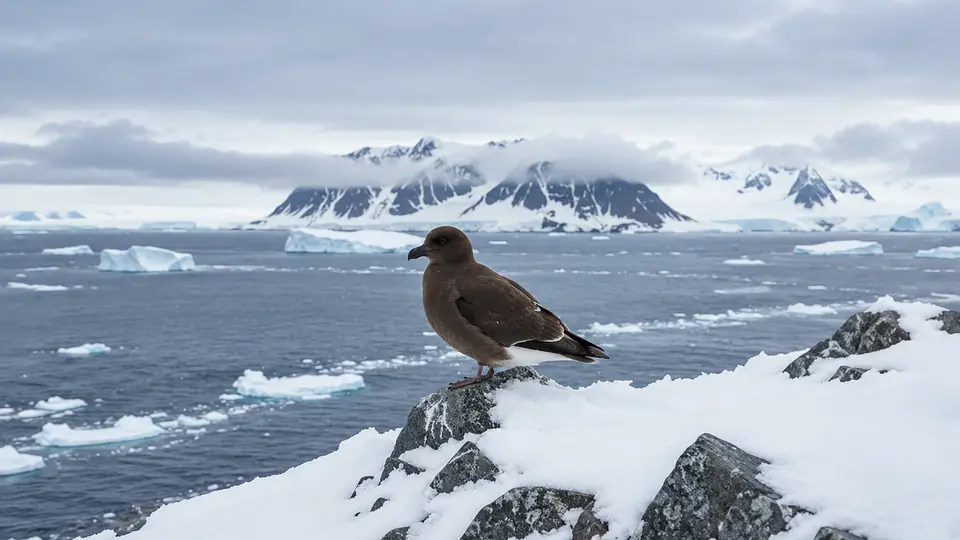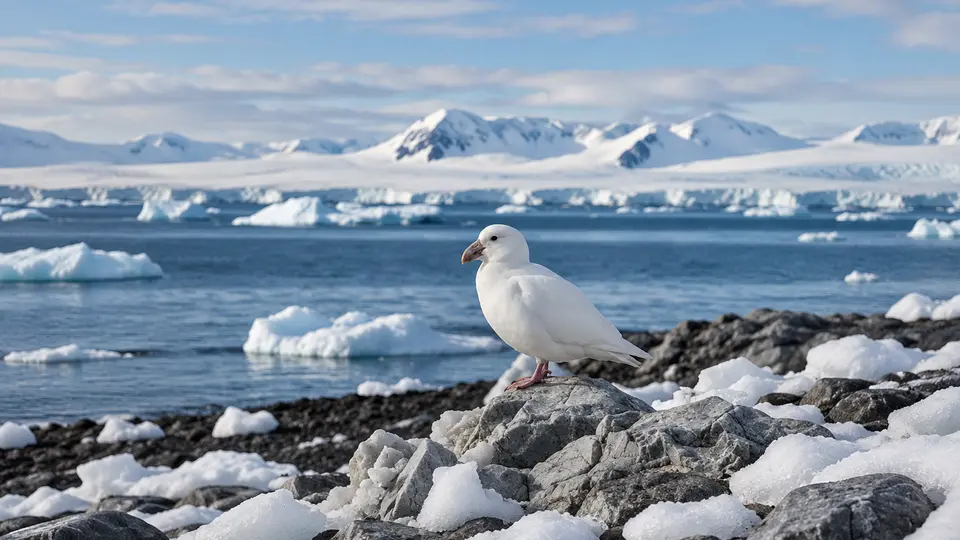
Sheathbill in its natural habitat, AI illustration

Sheathbill: where and when to see them

Chionis albus

Sheathbill at a glance

The snowy sheathbill is a stocky, white coastal bird associated with the Antarctic Peninsula, nearby islands and southern South America. Although often seen walking among penguins, it is neither a penguin nor a seabird specialized for feeding at sea. Its broad diet makes it an important scavenger around animal colonies. The pale sheath covering the base of its bill gives the group its name, while pink legs and bare facial skin reinforce its unusual appearance.

Behaviour & reproduction

Size
34-41 cm long
Weight
450-780 g
Lifespan
Not reliably established
Status
Least Concern

Sheathbills spend much of their time walking, pecking and investigating the ground around penguin and seal colonies. They may steal food, seize exposed eggs or take advantage of scraps left by larger animals. Breeding pairs defend territories and nest in sheltered rocky spaces. Outside breeding they can gather around rich food sources, and some move north as Antarctic conditions become harsher during winter. Sheathbills are known for their fearlessness and curiosity, often approaching humans and investigating bags or open containers. During the breeding season, pairs will engage in aggressive displays to defend their nesting territories, chasing away intruders with pecks and squawks.

Top wildlife locations

Antarctica wildlife habitat

Antarctica

Permitted rocky coastal sites around the Antarctic Peninsula may offer views near penguin colonies. Restricted colony interiors remain off limits, and the species is not widespread across all Antarctic coasts.

Adventure cruises in Antarctica
Destinations describe the species' habitat, not guaranteed cruise stops. Some animals require an optional inland excursion or are found in restricted reserves.

Fun facts about the Sheathbill

  • Its toes are not webbed, unlike those of many Antarctic coastal birds.
  • The bill's basal sheath is a hard, horny covering.
  • It sometimes steals food during penguin chick-feeding exchanges.
  • Despite its pigeonlike appearance, it belongs to the shorebird order Charadriiformes.

Best time to see the Sheathbill

November through March is the main Antarctic visitor window and a useful period for observing birds near active coastal colonies. Breeding broadly overlaps the austral summer, while some individuals leave Antarctic areas during winter and others remain farther south. Prime viewing opportunities are during the austral summer when large colonies of penguins and seals are active, providing ample food sources. While some individuals migrate north to sub-Antarctic islands for winter, others remain in ice-free areas of the Antarctic Peninsula year-round.

Sheathbill: season matrix by destination

Travel and observation windows vary by region. Highlighted months are an orientation for planning, not confirmed sightings or a guarantee of access.

Antarctica

This is the usual visitor window and overlaps summer colony activity; regional distribution, permissions and ice conditions determine opportunities rather than the calendar alone.

JanFebMarAprMayJunJulAugSepOctNovDec
Cruise ships in Antarctica

Where the Sheathbill lives

Rocky coasts, intertidal margins and seabird or seal colonies provide feeding and nesting habitat. Sheltered cavities among rocks are used for nests. Unlike many Antarctic birds, sheathbills obtain much of their food on land rather than ranging offshore to forage. Found exclusively in the Antarctic and sub-Antarctic regions, these opportunistic birds are strong fliers and can be seen on ice floes, particularly near whale or seal carcasses. They frequently associate with human settlements and research stations, scavenging for refuse.

What the Sheathbill eats

The diet includes carrion, invertebrates, eggs, small chicks, fecal material and food stolen from other birds. Around penguin colonies, sheathbills exploit spilled or regurgitated food. On shorelines they also search for edible material exposed among rocks and seaweed. Their diet reflects their omnivorous and scavenging nature, including krill, mollusks, crustaceans, and marine worms found in the intertidal zone. They also actively consume placentas after seal births and prey on weak or unguarded chicks of other bird species.

Species at a glance

Common name
Sheathbill
Scientific name
Chionis albus
Animal group
Birds
Size
34-41 cm long
Weight
450-780 g
Lifespan
Not reliably established
Status
Least Concern
Identification
Compared with the black-faced sheathbill, the snowy sheathbill has pinkish facial skin and a pale horn-colored bill sheath rather than a predominantly black face and bill. Their entirely white plumage, reminiscent of a pigeon, is distinctive among Antarctic birds, though some individuals may exhibit a faint creamy or yellowish wash. The sheathbill's unique horny bill sheath is a defining feature, giving the species its common name.

Sheathbill: frequently asked questions

Where can I see the Sheathbill?
Antarctica. Keep food and equipment secured, and never encourage these inquisitive scavengers to approach. Follow colony distances and strict boot-cleaning procedures, since moving between colony areas can transport pathogens and organic material. Although seemingly tame, they are wild animals; maintaining a respectful distance prevents habituation and potential aggression. Their bold nature means they will often approach closely, especially if food is perceived, so strict adherence to wildlife viewing guidelines is essential.
When is the best time to see the Sheathbill?
November through March is the main Antarctic visitor window and a useful period for observing birds near active coastal colonies. Breeding broadly overlaps the austral summer, while some individuals leave Antarctic areas during winter and others remain farther south. Prime viewing opportunities are during the austral summer when large colonies of penguins and seals are active, providing ample food sources. While some individuals migrate north to sub-Antarctic islands for winter, others remain in ice-free areas of the Antarctic Peninsula year-round.
How big does the Sheathbill get?
34-41 cm long. Adult weight: 450-780 g. Size varies with age, sex and population.
How should I behave around the Sheathbill?
Keep food and equipment secured, and never encourage these inquisitive scavengers to approach. Follow colony distances and strict boot-cleaning procedures, since moving between colony areas can transport pathogens and organic material. Although seemingly tame, they are wild animals; maintaining a respectful distance prevents habituation and potential aggression. Their bold nature means they will often approach closely, especially if food is perceived, so strict adherence to wildlife viewing guidelines is essential.
What does the Sheathbill eat?
The diet includes carrion, invertebrates, eggs, small chicks, fecal material and food stolen from other birds. Around penguin colonies, sheathbills exploit spilled or regurgitated food. On shorelines they also search for edible material exposed among rocks and seaweed. Their diet reflects their omnivorous and scavenging nature, including krill, mollusks, crustaceans, and marine worms found in the intertidal zone. They also actively consume placentas after seal births and prey on weak or unguarded chicks of other bird species.
Are wildlife sightings guaranteed on an adventure cruise?
No. Animals move freely and routes, weather, access restrictions and local conditions influence every outing. Confirm the actual itinerary and shore program before booking.

Compare wildlife in the same destinations

Explore other birds recorded in these destinations. Similar surroundings do not mean the animals share the same habits or viewing season.

Species comparison by animal group and destination
SheathbillSheathbillAdélie PenguinAdélie PenguinAntarctic PetrelAntarctic Petrel
Animal groupBirdsAnimal groupBirdsAnimal groupBirds
DestinationsAntarcticaDestinationsAntarcticaDestinationsAntarctica
All wildlife destinations
Plan your trip

Find your next wildlife adventure

Compare destinations, shore programs and dates with the animals and habitats you would love to see.

  • Naturalist-led shore excursions
  • Responsible wildlife watching
  • Small expedition ships

Newsletter

Take Blue Rides with you

Adventure cruise offers, last-minute deals and trip inspiration.

Free, unsubscribe anytime. Details: Privacy Policy

Partner with Blue Rides

Affiliate Program

Recommend adventure cruises and earn commission on every confirmed booking.

Share. Track. Earn.

Your footage, our stage

Send us your videos or pictures.

Captured beautiful landscapes or wildlife? Share your videos and pictures with us, we may feature them on Blue Rides.