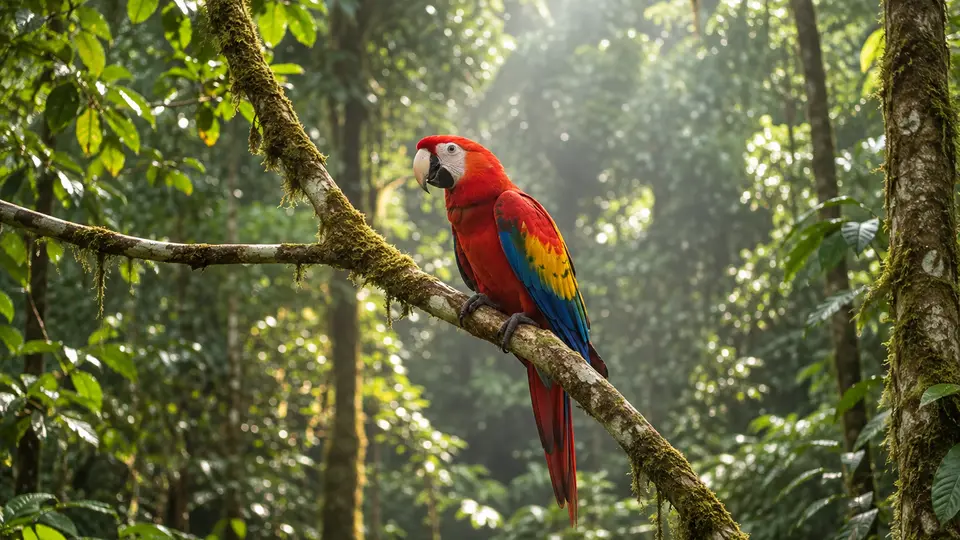
Scarlet Macaw in its natural habitat, AI illustration

Scarlet MacawAra macaoWhere and when to see them

Scarlet Macaw at a glance

The scarlet macaw is a large tropical American parrot whose brilliant plumage is surprisingly effective at breaking up its outline among sunlit leaves. Costa Rica supports important populations, particularly in Pacific lowland forests, although habitat loss and historical trapping have reduced its distribution elsewhere. Long wings and a streaming tail carry birds between scattered feeding trees, while a powerful bill opens foods that many smaller birds cannot use.

Behaviour & reproduction

Size
81–96 cm total length
Weight
0.9–1.2 kg
Lifespan
Not reliably established
Status
Least Concern

Scarlet macaws usually travel as pairs or family parties, sometimes gathering in larger groups at feeding trees and communal roosts. Partners maintain their bond through close contact and mutual preening. They nest in large tree cavities rather than building exposed nests. Loud, rough calls help birds remain in contact across forest gaps, and young birds continue learning feeding routes and food handling from their parents. Courtship displays involve mutual preening, head bobbing, and regurgitation of food. Breeding pairs typically raise one to two chicks per season, with both parents sharing incubation and feeding duties. Their strong pair bonds can last for many years, often for life.

Top wildlife locations

Costa Rica wildlife habitat

Costa Rica

Pacific coastal forest near Carara and the Osa Peninsula offers plausible land-based viewing from public trails and forest edges. Populations are localized, so not every coastal stop provides suitable habitat.
Destinations describe the species' habitat, not guaranteed cruise stops. Some animals require an optional inland excursion or are found in restricted reserves.

Fun facts about the Scarlet Macaw

  • The upper bill can move relative to the skull, helping manipulate tough foods.
  • Its two forward-facing and two backward-facing toes work like a gripping hand.
  • Pairs use existing tree cavities and do not excavate a complete nest hole themselves.
  • The long central tail feathers account for a substantial part of its total length.

Best time to see the Scarlet Macaw

Macaws can be observed throughout the year in established Costa Rican populations. December through April often offers easier access and clearer mornings on the Pacific coast. Local fruit availability and daily movements matter more than a single national viewing season. While generally observable year-round, successful fledging of young typically occurs from February to April, potentially offering sightings of entire family groups. During the dry season, fruit sources can become more concentrated, drawing birds to fewer, more predictable locations. Riverboat tours can offer excellent perspectives during this time.

Scarlet Macaw: season matrix by destination

Travel and observation windows vary by region. Highlighted months are an orientation for planning, not confirmed sightings or a guarantee of access.

Costa Rica

These months generally offer drier Pacific-coast travel conditions; resident macaws may be present year-round, and this is not a claim about breeding dates.

JanFebMarAprMayJunJulAugSepOctNovDec
Cruise ships in Costa Rica

Where the Scarlet Macaw lives

They occupy tropical lowland forest, seasonally dry woodland, forest edges and wooded agricultural landscapes where substantial trees survive. In Costa Rica, coastal forest and mangrove margins can provide feeding and travel corridors, but mature cavity-bearing trees remain essential for nesting. They are highly dependent on large, old-growth trees for nesting and roosting, which are often targets for logging. Deforestation and habitat fragmentation are major threats to their populations. Reforestation efforts using native tree species are crucial for their long-term survival.

What the Scarlet Macaw eats

Seeds, nuts and fruits form the main diet, supplemented by flowers and other plant material. The bill cracks resistant shells, while the muscular tongue manipulates food precisely. Birds move among trees as different species fruit rather than relying on one crop. Clay licks, rich in minerals, are also frequented by macaws, likely to neutralize toxins from unripe fruits or aid digestion. Young birds learn which plants are safe to eat and how to extract nutrients from them by observing their parents. This learned dietary knowledge is passed down through generations.

Species at a glance

Common name
Scarlet Macaw
Scientific name
Ara macao
Animal group
Birds
Size
81–96 cm total length
Weight
0.9–1.2 kg
Lifespan
Not reliably established
Status
Least Concern
Identification
Unlike the related red-and-green macaw, the scarlet macaw has a broad yellow wing band and largely unfeathered white facial skin without prominent red feather lines. Their brilliant red plumage covers most of their body, contrasting sharply with the bright yellow and blue on their wings and tail. The extensive red on the shoulder and upperwing coverts distinguishes it from other large macaws. They are among the largest and most colorful parrots in the world.

Scarlet Macaw: frequently asked questions

Where can I see the Scarlet Macaw?
Costa Rica. Watch coastal forest edges from established paths, preferably early in the morning. Keep clear of nest trees, never offer food, and avoid standing beneath feeding birds that may drop heavy fruit or shell fragments. Their bright plumage often makes them surprisingly difficult to spot against the dense foliage unless they are flying or actively feeding. Listening for their distinctive loud calls is often the best way to locate them before visual contact. Patience is key, as they may remain hidden high in the canopy.
When is the best time to see the Scarlet Macaw?
Macaws can be observed throughout the year in established Costa Rican populations. December through April often offers easier access and clearer mornings on the Pacific coast. Local fruit availability and daily movements matter more than a single national viewing season. While generally observable year-round, successful fledging of young typically occurs from February to April, potentially offering sightings of entire family groups. During the dry season, fruit sources can become more concentrated, drawing birds to fewer, more predictable locations. Riverboat tours can offer excellent perspectives during this time.
How big does the Scarlet Macaw get?
81–96 cm total length. Adult weight: 0.9–1.2 kg. Size varies with age, sex and population.
How should I behave around the Scarlet Macaw?
Watch coastal forest edges from established paths, preferably early in the morning. Keep clear of nest trees, never offer food, and avoid standing beneath feeding birds that may drop heavy fruit or shell fragments. Their bright plumage often makes them surprisingly difficult to spot against the dense foliage unless they are flying or actively feeding. Listening for their distinctive loud calls is often the best way to locate them before visual contact. Patience is key, as they may remain hidden high in the canopy.
What does the Scarlet Macaw eat?
Seeds, nuts and fruits form the main diet, supplemented by flowers and other plant material. The bill cracks resistant shells, while the muscular tongue manipulates food precisely. Birds move among trees as different species fruit rather than relying on one crop. Clay licks, rich in minerals, are also frequented by macaws, likely to neutralize toxins from unripe fruits or aid digestion. Young birds learn which plants are safe to eat and how to extract nutrients from them by observing their parents. This learned dietary knowledge is passed down through generations.
Are wildlife sightings guaranteed on an adventure cruise?
No. Animals move freely and routes, weather, access restrictions and local conditions influence every outing. Confirm the actual itinerary and shore program before booking.

Compare wildlife in the same destinations

Explore other birds recorded in these destinations. Similar surroundings do not mean the animals share the same habits or viewing season.

Species comparison by animal group and destination
Scarlet MacawScarlet MacawBlack-mandibled ToucanBlack-mandibled ToucanBlue-footed BoobyBlue-footed Booby
Animal groupBirdsAnimal groupBirdsAnimal groupBirds
DestinationsCosta RicaDestinationsCosta RicaDestinationsCosta Rica, Galapagos, Mexico
All wildlife destinations
Plan your trip

Find your next wildlife adventure

Compare destinations, shore programs and dates with the animals and habitats you would love to see.

  • Naturalist-led shore excursions
  • Responsible wildlife watching
  • Small expedition ships

Newsletter

Take Blue Rides with you

Adventure cruise offers, last-minute deals and trip inspiration.

Free, unsubscribe anytime. Details: Privacy Policy

Partner with Blue Rides

Affiliate Program

Recommend adventure cruises and earn commission on every confirmed booking.

Share. Track. Earn.

Your footage, our stage

Send us your videos or pictures.

Captured remarkable nature or wildlife on your journey? Share it with us, we may feature it on Blue Rides.