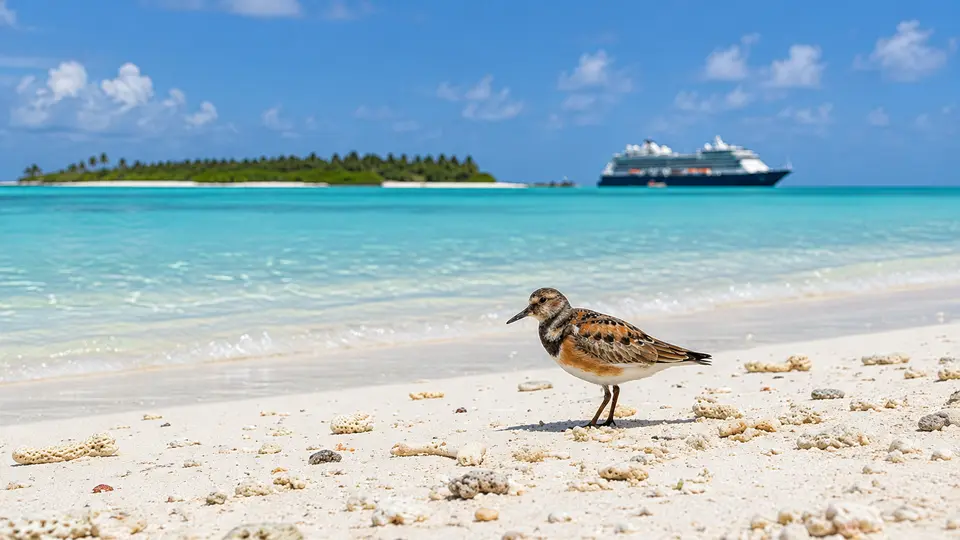
Ruddy turnstone in its natural habitat, AI illustration
Size21–26 cm longLifespanNot reliably establishedStatusCheck current assessment

Ruddy turnstone: where and when to see them

Arenaria interpres

Ruddy turnstone at a glance

The ruddy turnstone is a compact migratory shorebird named for its habit of flipping small objects to uncover food. It breeds around the Arctic but spends the nonbreeding season on coastlines across much of the world, including tropical islands. Its short legs and sturdy bill suit rough shorelines better than deep mud. In the Maldives, visitors are most likely to encounter migrants or nonbreeding birds rather than nesting individuals.

Behaviour & reproduction

Size
21–26 cm long
Weight
85–150 g
Lifespan
Not reliably established
Status
Check current assessment

Turnstones work methodically along the shore, levering shells, seaweed and small stones with the bill. They often feed in loose groups and join other shorebirds at high-tide roosts. When waves wash over a feeding patch, birds retreat briefly and return as the water recedes. Breeding birds defend tundra territories, whereas tropical visitors chiefly divide their time between feeding, resting and preparing for long migratory journeys. These birds exhibit strong site fidelity, often returning to the same wintering grounds in the Maldives year after year. Their communal roosting behavior helps conserve energy and provides safety in numbers against predators, particularly during high tide.

Top wildlife locations

Maldives wildlife habitat

Maldives

Island beaches, coral-rubble shores and exposed reef-flat margins provide plausible shore-viewing habitat. Birds are seasonal visitors rather than breeders, and suitable feeding or roosting patches may be absent on heavily developed islands.

Adventure cruises in Maldives
Destinations describe the species' habitat, not guaranteed cruise stops. Some animals require an optional inland excursion or are found in restricted reserves.

Fun facts about the Ruddy turnstone

  • Its strong bill can lever objects larger than expected for such a small bird.
  • Breeding plumage combines chestnut, black and white in a bold mosaic.
  • Its white back and wing markings create a distinctive flight pattern.
  • Individuals can show strong fidelity to the same nonbreeding coastline.

Best time to see the Ruddy turnstone

In the Maldives, roughly September through April is the most plausible period for northern migrants and winter visitors. The drier part of that interval often improves shore access. A few nonbreeding birds may remain beyond the main migration season. Peak numbers of Ruddy Turnstones in the Maldives are typically observed from October to March, coinciding with the northern winter. During this time, they are a common sight on many atolls, often alongside other migratory shorebirds.

Ruddy turnstone: season matrix by destination

Travel and observation windows vary by region. Highlighted months are an orientation for planning, not confirmed sightings or a guarantee of access.

Maldives

This interval reflects the broad nonbreeding and migration period; dry-season travel conditions do not determine exact arrival or departure dates.

JanFebMarAprMayJunJulAugSepOctNovDec
Cruise ships in Maldives

Where the Ruddy turnstone lives

Outside breeding, ruddy turnstones favor rocky shores, reef-flat margins, coral rubble, sandy beaches and wrack lines. They also use jetties and other coastal structures. Arctic nesting habitat is very different, consisting of open tundra near wetlands or the coast. In the Maldives, they are particularly associated with exposed reef flats, sandy spits, and small islets with access to tidal foraging areas. They readily adapt to human-modified environments like harbor walls and fish farm perimeters where food is available.

What the Ruddy turnstone eats

Coastal invertebrates dominate the diet, including small crustaceans, mollusks, worms and insects hidden under stranded material. Turnstones also exploit carrion and other opportunistic foods. On Arctic breeding grounds they take abundant insects, with occasional eggs or plant material supplementing the diet. In the Maldives, a significant portion of their diet consists of small crabs, gastropods, and bivalves found in the intertidal zone. They are known to flip over pebbles and small debris with their robust bills to uncover hidden prey.

Species at a glance

Common name
Ruddy turnstone
Scientific name
Arenaria interpres
Animal group
Birds
Size
21–26 cm long
Weight
85–150 g
Lifespan
Not reliably established
Status
Check current assessment
Identification
Ruddy turnstone differs from black turnstone through its orange legs, stronger black-and-white facial pattern and chestnut upperparts in breeding plumage. Beyond the striking orange legs, note their short, slightly upturned bill, which is uniquely adapted for their 'turning' feeding method. Their bold, pied plumage pattern, even in nonbreeding duller winter dress, remains distinctive with a dark breast band.

Ruddy turnstone: frequently asked questions

Where can I see the Ruddy turnstone?
Maldives. Watch feeding birds from a stationary position above the tide line. Avoid disturbing high-tide roosts, and do not move coral rubble or enter wave-washed reef edges to follow a flock. From a deck, look for them foraging along the water's edge on low-lying islands or exposed sandbanks, especially during low tide. On shore excursions, maintain a respectful distance to observe their characteristic feeding behavior without causing disturbance.
When is the best time to see the Ruddy turnstone?
In the Maldives, roughly September through April is the most plausible period for northern migrants and winter visitors. The drier part of that interval often improves shore access. A few nonbreeding birds may remain beyond the main migration season. Peak numbers of Ruddy Turnstones in the Maldives are typically observed from October to March, coinciding with the northern winter. During this time, they are a common sight on many atolls, often alongside other migratory shorebirds.
How big does the Ruddy turnstone get?
21–26 cm long. Adult weight: 85–150 g. Size varies with age, sex and population.
How should I behave around the Ruddy turnstone?
Watch feeding birds from a stationary position above the tide line. Avoid disturbing high-tide roosts, and do not move coral rubble or enter wave-washed reef edges to follow a flock. From a deck, look for them foraging along the water's edge on low-lying islands or exposed sandbanks, especially during low tide. On shore excursions, maintain a respectful distance to observe their characteristic feeding behavior without causing disturbance.
What does the Ruddy turnstone eat?
Coastal invertebrates dominate the diet, including small crustaceans, mollusks, worms and insects hidden under stranded material. Turnstones also exploit carrion and other opportunistic foods. On Arctic breeding grounds they take abundant insects, with occasional eggs or plant material supplementing the diet. In the Maldives, a significant portion of their diet consists of small crabs, gastropods, and bivalves found in the intertidal zone. They are known to flip over pebbles and small debris with their robust bills to uncover hidden prey.
Are wildlife sightings guaranteed on an adventure cruise?
No. Animals move freely and routes, weather, access restrictions and local conditions influence every outing. Confirm the actual itinerary and shore programme before booking.

Compare wildlife in the same destinations

Explore other birds recorded in these destinations. Similar surroundings do not mean the animals share the same habits or viewing season.

Species comparison by animal group and destination
Ruddy turnstoneRuddy turnstoneAsian koelAsian koelAudubon's shearwaterAudubon's shearwater
Animal groupBirdsAnimal groupBirdsAnimal groupBirds
DestinationsMaldivesDestinationsMaldivesDestinationsMaldives
All wildlife destinations
Plan your trip

Find your next wildlife adventure

Compare destinations, shore programmes and dates with the animals and habitats you would love to see.

  • Naturalist-led shore excursions
  • Responsible wildlife watching
  • Small expedition ships

Newsletter

Take Blue Rides with you

Adventure cruise offers, last-minute deals and trip inspiration.

Free, unsubscribe anytime. Details: Privacy Policy

Partner with Blue Rides

Affiliate Program

Recommend adventure cruises and earn commission on every confirmed booking.

Share. Track. Earn.