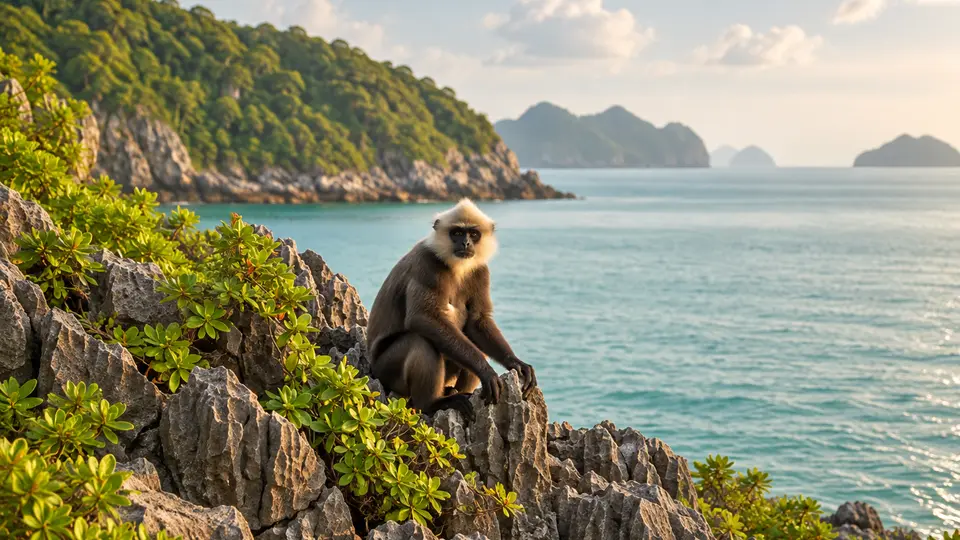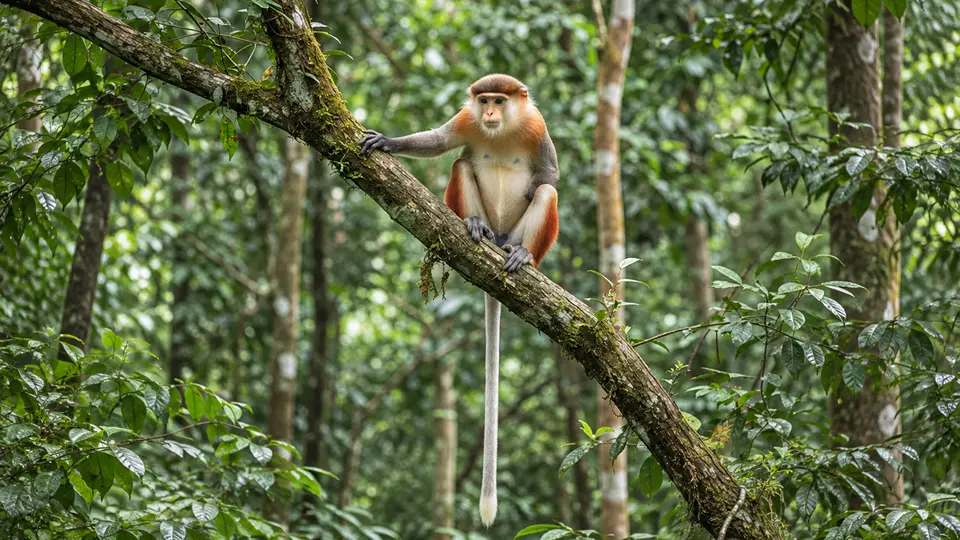
Red-shanked douc in its natural habitat, AI illustration

Red-shanked douc: where and when to see them

Pygathrix nemaeus

Red-shanked douc at a glance

The red-shanked douc is a vividly patterned leaf-eating monkey native to parts of mainland Southeast Asia, including Vietnam. Chestnut lower legs, white forearms, a pale face and a long white tail create an unmistakable appearance in clear views. Despite this striking coloration, doucs can disappear remarkably well in a shaded canopy. Hunting, habitat loss and fragmentation have caused severe declines, making protection of remaining forest populations far more important than obtaining close photographs.

Behaviour & reproduction

Size
Head and body 55–76 cm
Weight
6–11 kg
Lifespan
Not reliably established
Status
Critically Endangered

Doucs live in social groups and spend most of their time above ground, travelling, feeding and resting among branches. Individuals move with controlled climbing and long leaps between supports. Extended resting periods help accommodate the processing of leafy food in their specialized digestive system. Group members communicate through facial expressions, body postures and calls. When disturbed, they may retreat through the canopy, so apparent tolerance should never be treated as permission to approach. Doucs are diurnal and typically live in multi-male, multi-female groups ranging from 4 to 15 individuals, though larger aggregations can form. Group cohesion is maintained through a variety of social interactions including grooming and play, and they are known for their spectacular leaps of up to 6 meters between trees.

Top wildlife locations

Vietnam wildlife habitat

Vietnam

Protected coastal peninsula forest near Da Nang can offer canopy views from permitted routes. This is a forest excursion, not beach wildlife viewing; access can change, and remaining groups require especially careful disturbance control.

Adventure cruises in Vietnam
Destinations describe the species' habitat, not guaranteed cruise stops. Some animals require an optional inland excursion or are found in restricted reserves.

Fun facts about the Red-shanked douc

  • Its long white tail is used for balance, not grasping.
  • Microbes in its specialized stomach help process leaves.
  • White forearms contrast sharply with darker upper arms.
  • It belongs to the colobine group of leaf-eating monkeys.

Best time to see the Red-shanked douc

There is no brief viewing season tied to migration because doucs remain in their forest ranges year-round. In central Vietnam, relatively drier months often improve trail access and canopy visibility. Local rainfall, permissions and population sensitivity should determine plans rather than breeding expectations. In Vietnam, the dry season (roughly November to April) generally offers more predictable weather for forest treks. Early mornings are often the best time for sightings, as they are most active feeding after dawn.

Red-shanked douc: season matrix by destination

Travel and observation windows vary by region. Highlighted months are an orientation for planning, not confirmed sightings or a guarantee of access.

Vietnam

A broadly practical central Vietnamese travel window; heat, rainfall, access rules and local conservation guidance take priority.

JanFebMarAprMayJunJulAugSepOctNovDec
Cruise ships in Vietnam

Where the Red-shanked douc lives

Evergreen and semi-evergreen forests provide canopy travel routes, food and sleeping sites. Populations survive in some limestone and coastal peninsula forests, but their distribution is fragmented. Most observation requires a guided forest excursion, even where suitable habitat lies relatively close to the sea. They are typically found in lowland and montane rainforests up to 2,000 meters in elevation. Habitat destruction, primarily due to logging and agriculture, is the main threat to their survival.

What the Red-shanked douc eats

Young leaves are especially important, supplemented by older leaves, fruit, seeds and flowers. A complex stomach supports microbial fermentation of fibrous vegetation. Feeding choices vary with seasonal plant availability, and human food is inappropriate for both digestive health and natural behaviour. Their diet is highly folivorous, meaning it is largely made up of leaves, which can constitute up to 80% of their intake. They also consume buds and petioles, selectively choosing new growth which is easier to digest.

Species at a glance

Common name
Red-shanked douc
Scientific name
Pygathrix nemaeus
Animal group
Mammals
Size
Head and body 55–76 cm
Weight
6–11 kg
Lifespan
Not reliably established
Status
Critically Endangered
Identification
Red-shanked doucs have chestnut lower legs and white forearms, unlike the grey-shanked douc's grey legs and the black-shanked douc's dark limbs. Beyond leg coloration, all douc species feature striking white forearms, dark hands, and distinctive facial markings including a bright orange or yellow facial patch. Red-shanked doucs specifically have a prominent white rump patch and a long, white tail that often exceeds their body length.

Red-shanked douc: frequently asked questions

Where can I see the Red-shanked douc?
Vietnam. Use a responsible local guide and stay on permitted forest routes. Keep a generous distance, never feed or call to monkeys, and avoid sharing precise locations of vulnerable groups. Do not visit when ill, given disease-transmission concerns. Be mindful of their arboreal nature; spotting them often requires looking up into the mid to upper canopy. Maintaining absolute quiet increases the chances of observing their natural behaviors without disturbance.
When is the best time to see the Red-shanked douc?
There is no brief viewing season tied to migration because doucs remain in their forest ranges year-round. In central Vietnam, relatively drier months often improve trail access and canopy visibility. Local rainfall, permissions and population sensitivity should determine plans rather than breeding expectations. In Vietnam, the dry season (roughly November to April) generally offers more predictable weather for forest treks. Early mornings are often the best time for sightings, as they are most active feeding after dawn.
How big does the Red-shanked douc get?
Head and body 55–76 cm. Adult weight: 6–11 kg. Size varies with age, sex and population.
How should I behave around the Red-shanked douc?
Use a responsible local guide and stay on permitted forest routes. Keep a generous distance, never feed or call to monkeys, and avoid sharing precise locations of vulnerable groups. Do not visit when ill, given disease-transmission concerns. Be mindful of their arboreal nature; spotting them often requires looking up into the mid to upper canopy. Maintaining absolute quiet increases the chances of observing their natural behaviors without disturbance.
What does the Red-shanked douc eat?
Young leaves are especially important, supplemented by older leaves, fruit, seeds and flowers. A complex stomach supports microbial fermentation of fibrous vegetation. Feeding choices vary with seasonal plant availability, and human food is inappropriate for both digestive health and natural behaviour. Their diet is highly folivorous, meaning it is largely made up of leaves, which can constitute up to 80% of their intake. They also consume buds and petioles, selectively choosing new growth which is easier to digest.
Are wildlife sightings guaranteed on an adventure cruise?
No. Animals move freely and routes, weather, access restrictions and local conditions influence every outing. Confirm the actual itinerary and shore programme before booking.

Compare wildlife in the same destinations

Explore other mammals recorded in these destinations. Similar surroundings do not mean the animals share the same habits or viewing season.

Species comparison by animal group and destination
Red-shanked doucRed-shanked doucBryde's WhaleBryde's WhaleCat Ba langurCat Ba langur
Animal groupMammalsAnimal groupMammalsAnimal groupMammals
DestinationsVietnamDestinationsGalapagos, Mexico, Egypt, Thailand, VietnamDestinationsVietnam
All wildlife destinations
Plan your trip

Find your next wildlife adventure

Compare destinations, shore programmes and dates with the animals and habitats you would love to see.

  • Naturalist-led shore excursions
  • Responsible wildlife watching
  • Small expedition ships

Newsletter

Take Blue Rides with you

Adventure cruise offers, last-minute deals and trip inspiration.

Free, unsubscribe anytime. Details: Privacy Policy

Partner with Blue Rides

Affiliate Program

Recommend adventure cruises and earn commission on every confirmed booking.

Share. Track. Earn.