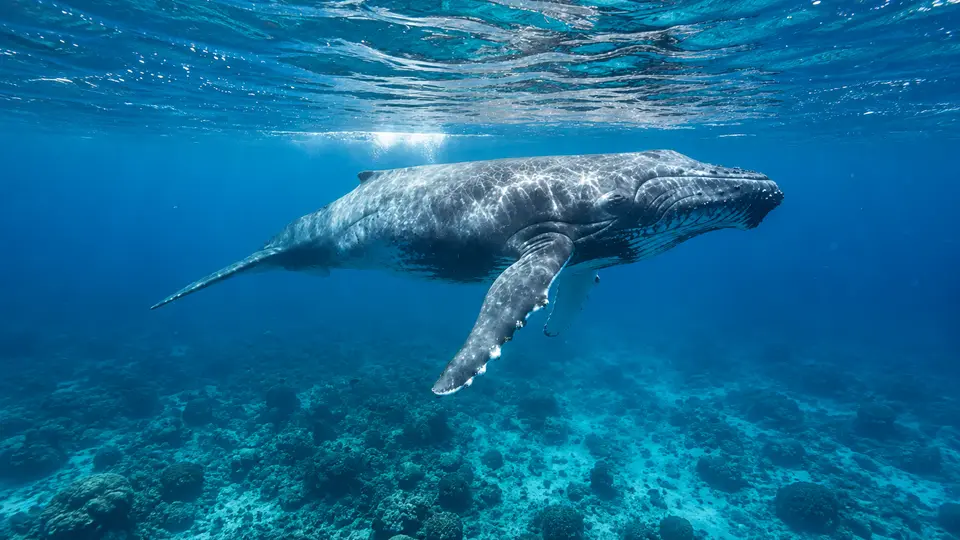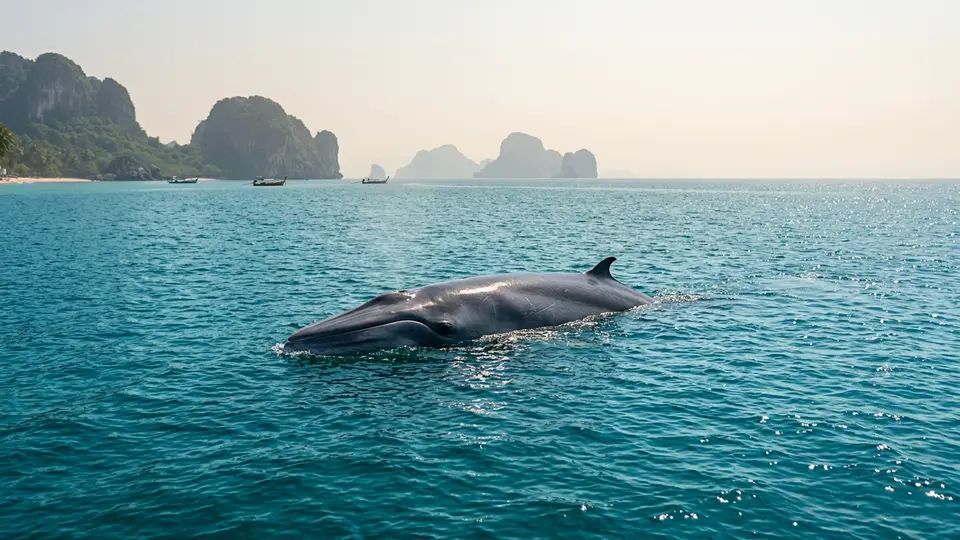
Bryde's Whale in its natural habitat, AI illustration

Bryde's Whale: where and when to see them

Balaenoptera edeni

Bryde's Whale at a glance

Bryde's whales are warm-water baleen whales that feed in tropical and subtropical seas rather than routinely undertaking the long polar migrations familiar from some other great whales. The common name covers a taxonomically complicated group, with coastal and offshore forms treated differently by different authorities. A distant sighting should therefore be recorded cautiously. Their distribution follows productive feeding conditions, and coastal occurrence can shift markedly as fish schools and oceanographic conditions change.

Behaviour & reproduction

Size
11-15 m long
Weight
12-25 tonnes
Lifespan
Not reliably established
Status
Assessment varies

These whales usually travel alone or in small, loose groups, although several may gather where prey is concentrated. Feeding can involve lunges, turns and surface skimming, while some Gulf of Thailand animals use distinctive open-mouthed tread-water feeding. Surfacing sequences are variable, and the dorsal fin often becomes visible soon after the blow. They can change direction abruptly while following prey, making patient observation more useful than predicting a fixed travel route. These whales usually travel alone or in small, loose groups, although several may gather where prey is concentrated. Feeding can involve lunges, turns and surface skimming, while some Gulf of Thailand animals use distinctive open-mouthed tread-water feeding. Surfacing sequences are variable, and the dorsal fin often becomes visible soon after the blow. They can change direction abruptly while following prey, making patient observation more useful than predicting a fixed travel route. Unlike many other baleen whales, Bryde's whales do not undertake extensive migrations, generally remaining in their warm water habitats year-round. They typically surface with a low, diffuse blow that is often difficult to see from afar.

Top wildlife locations

Galapagos wildlife habitat

Galapagos

Watch distant channels and productive coastal waters from authorized shore viewpoints or an existing vessel's deck. Bryde's whales are irregularly encountered, and no particular visitor landing should be treated as reliable whale habitat.

Adventure cruises in Galapagos
Mexico wildlife habitat

Mexico

Elevated Gulf of California coastal viewpoints overlook plausible feeding waters, particularly where fish schools gather. Shore sightings are unpredictable and distant; reaching a suitable overlook may require a separate land excursion.

Adventure cruises in Mexico
Egypt wildlife habitat

Egypt

Red Sea coastal overlooks provide open-water views, but records attributed to Bryde's whales are scarce and identification can be uncertain. This is not a dependable shore-viewing target or standard coastal wildlife expectation.

Adventure cruises in Egypt
Thailand wildlife habitat

Thailand

The upper Gulf of Thailand supports coastal feeding whales, but many feeding areas lie beyond useful shore-viewing range. Watch only from suitable coastal overlooks or an existing vessel's deck; encounters remain unpredictable.

Adventure cruises in Thailand
Vietnam wildlife habitat

Vietnam

Coastal headlands overlook potentially suitable warm shelf waters, but Bryde's whale records are scattered and often difficult to verify. Shore observation is an exceptional possibility, not a dependable feature of coastal visits.

Adventure cruises in Vietnam

Destinations describe the species' habitat, not guaranteed cruise stops. Some animals require an optional inland excursion or are found in restricted reserves.

Fun facts about the Bryde's Whale

  • The name commemorates Norwegian whaling entrepreneur Johan Bryde.
  • Typical Bryde's whales have three prominent upper-head ridges rather than one.
  • Some Gulf of Thailand whales feed by holding their mouths open at the surface.
  • Bryde's whale taxonomy includes coastal and offshore forms whose treatment remains unsettled.

Best time to see the Bryde's Whale

There is no dependable species-wide viewing season. Local prey movements and sea conditions matter more than a single migration calendar. Choose destination-specific calm-weather windows for distant shore or deck watching, recognizing that published whale records may involve different members of the Bryde's whale complex. There is no dependable species-wide viewing season. Local prey movements and sea conditions matter more than a single migration calendar. Choose destination-specific calm-weather windows for distant shore or deck watching, recognizing that published whale records may involve different members of the Bryde's whale complex. Their presence is generally tied to seasonal productivity and prey availability in specific areas. Calm sea conditions enhance the chances of spotting these whales, especially their subtle surface behaviors.

Bryde's Whale: season matrix by destination

Travel and observation windows vary by region. Highlighted months are an orientation for planning, not confirmed sightings or a guarantee of access.

Galapagos

Occurrence is possible across the year, but a dependable destination-wide shore observation window is not established.

JanFebMarAprMayJunJulAugSepOctNovDec
Cruise ships in Galapagos

Mexico

A practical cooler-season coastal travel window, not a Bryde's whale migration or guaranteed occurrence period; wind can limit visibility.

JanFebMarAprMayJunJulAugSepOctNovDec
Cruise ships in Mexico

Egypt

Sparse records do not support a credible species-specific shore observation season in Egypt.

JanFebMarAprMayJunJulAugSepOctNovDec
Cruise ships in Egypt

Thailand

These are generally practical coastal travel months, not a breeding season; prey distribution and local sea conditions determine whale visibility.

JanFebMarAprMayJunJulAugSepOctNovDec
Cruise ships in Thailand

Vietnam

Regional weather varies substantially, and available occurrence information does not justify a destination-wide species observation window.

JanFebMarAprMayJunJulAugSepOctNovDec
Cruise ships in Vietnam

Where the Bryde's Whale lives

They inhabit warm continental-shelf waters and offshore tropical or subtropical seas. Productive coastal fronts, upwelling zones and fish-rich bays can attract feeding animals. Records attributed to Bryde's whales require particular caution where related forms occur or identification was based on brief surface views. They inhabit warm continental-shelf waters and offshore tropical or subtropical seas. Productive coastal fronts, upwelling zones and fish-rich bays can attract feeding animals. Records attributed to Bryde's whales require particular caution where related forms occur or identification was based on brief surface views. Their range extends across the Atlantic, Indian, and Pacific Oceans, generally between 40 degrees north and 40 degrees south latitude. These whales typically stay in waters warmer than 16 degrees Celsius year-round, avoiding polar and subpolar regions entirely.

What the Bryde's Whale eats

Schooling fishes such as sardines, anchovies and herrings are major prey, with krill and other small crustaceans important in some populations. Baleen plates filter food from engulfed water. Diet varies geographically, so feeding habits documented in one coastal population should not be generalized everywhere. Schooling fishes such as sardines, anchovies and herrings are major prey, with krill and other small crustaceans important in some populations. Baleen plates filter food from engulfed water. Diet varies geographically, so feeding habits documented in one coastal population should not be generalized everywhere. They are known to be opportunistic feeders, adapting their diet to locally abundant prey, often feeding closer to the surface. Their flexible feeding strategy allows them to thrive in various productive marine environments.

Species at a glance

Common name
Bryde's Whale
Scientific name
Balaenoptera edeni
Animal group
Mammals
Size
11-15 m long
Weight
12-25 tonnes
Lifespan
Not reliably established
Status
Assessment varies
Identification
Three longitudinal ridges on the upper head distinguish typical Bryde's whales from similar sei whales, although these are rarely resolvable from distant shore or deck viewpoints. Three longitudinal ridges on the upper head distinguish typical Bryde's whales from similar sei whales, although these are rarely resolvable from distant shore or deck viewpoints. The central ridge runs from the blowhole to the rostrum tip, flanked by two shorter accessory ridges. Their relatively small, falcate dorsal fin, often visible simultaneously with the blow, is set far back on the body, which can be a useful distant clue.

Bryde's Whale: frequently asked questions

Where can I see the Bryde's Whale?
Galapagos, Mexico, Egypt, Thailand, Vietnam. Use binoculars from coastal viewpoints or an existing vessel's deck. Never encourage pursuit or interception of feeding whales; keep attention on vessel safety, and treat distant identification as provisional when diagnostic head ridges are invisible. Use binoculars from coastal viewpoints or an existing vessel's deck. Never encourage pursuit or interception of feeding whales; keep attention on vessel safety, and treat distant identification as provisional when diagnostic head ridges are invisible. Focus on observing their breathing patterns and the frequency of their surfacing, which can vary depending on feeding activity. Respect local marine wildlife regulations and maintain a safe, non-intrusive distance to avoid disturbing them.
When is the best time to see the Bryde's Whale?
There is no dependable species-wide viewing season. Local prey movements and sea conditions matter more than a single migration calendar. Choose destination-specific calm-weather windows for distant shore or deck watching, recognizing that published whale records may involve different members of the Bryde's whale complex. There is no dependable species-wide viewing season. Local prey movements and sea conditions matter more than a single migration calendar. Choose destination-specific calm-weather windows for distant shore or deck watching, recognizing that published whale records may involve different members of the Bryde's whale complex. Their presence is generally tied to seasonal productivity and prey availability in specific areas. Calm sea conditions enhance the chances of spotting these whales, especially their subtle surface behaviors.
How big does the Bryde's Whale get?
11-15 m long. Adult weight: 12-25 tonnes. Size varies with age, sex and population.
How should I behave around the Bryde's Whale?
Use binoculars from coastal viewpoints or an existing vessel's deck. Never encourage pursuit or interception of feeding whales; keep attention on vessel safety, and treat distant identification as provisional when diagnostic head ridges are invisible. Use binoculars from coastal viewpoints or an existing vessel's deck. Never encourage pursuit or interception of feeding whales; keep attention on vessel safety, and treat distant identification as provisional when diagnostic head ridges are invisible. Focus on observing their breathing patterns and the frequency of their surfacing, which can vary depending on feeding activity. Respect local marine wildlife regulations and maintain a safe, non-intrusive distance to avoid disturbing them.
What does the Bryde's Whale eat?
Schooling fishes such as sardines, anchovies and herrings are major prey, with krill and other small crustaceans important in some populations. Baleen plates filter food from engulfed water. Diet varies geographically, so feeding habits documented in one coastal population should not be generalized everywhere. Schooling fishes such as sardines, anchovies and herrings are major prey, with krill and other small crustaceans important in some populations. Baleen plates filter food from engulfed water. Diet varies geographically, so feeding habits documented in one coastal population should not be generalized everywhere. They are known to be opportunistic feeders, adapting their diet to locally abundant prey, often feeding closer to the surface. Their flexible feeding strategy allows them to thrive in various productive marine environments.
Are wildlife sightings guaranteed on an adventure cruise?
No. Animals move freely and routes, weather, access restrictions and local conditions influence every outing. Confirm the actual itinerary and shore program before booking.

Compare wildlife in the same destinations

Explore other mammals recorded in these destinations. Similar surroundings do not mean the animals share the same habits or viewing season.

Species comparison by animal group and destination
Bryde's WhaleBryde's WhaleBaja California Rock SquirrelBaja California Rock SquirrelBlue WhaleBlue Whale
Animal groupMammalsAnimal groupMammalsAnimal groupMammals
DestinationsGalapagos, Mexico, Egypt, Thailand, VietnamDestinationsMexicoDestinationsMexico, Norway, Portugal, Antarctica, Arctic, Maldives, New Zealand
All wildlife destinations
Plan your trip

Find your next wildlife adventure

Compare destinations, shore programs and dates with the animals and habitats you would love to see.

  • Naturalist-led shore excursions
  • Responsible wildlife watching
  • Small expedition ships

Newsletter

Take Blue Rides with you

Adventure cruise offers, last-minute deals and trip inspiration.

Free, unsubscribe anytime. Details: Privacy Policy

Partner with Blue Rides

Affiliate Program

Recommend adventure cruises and earn commission on every confirmed booking.

Share. Track. Earn.

Your footage, our stage

Send us your videos or pictures.

Captured beautiful landscapes or wildlife? Share your videos and pictures with us, we may feature them on Blue Rides.