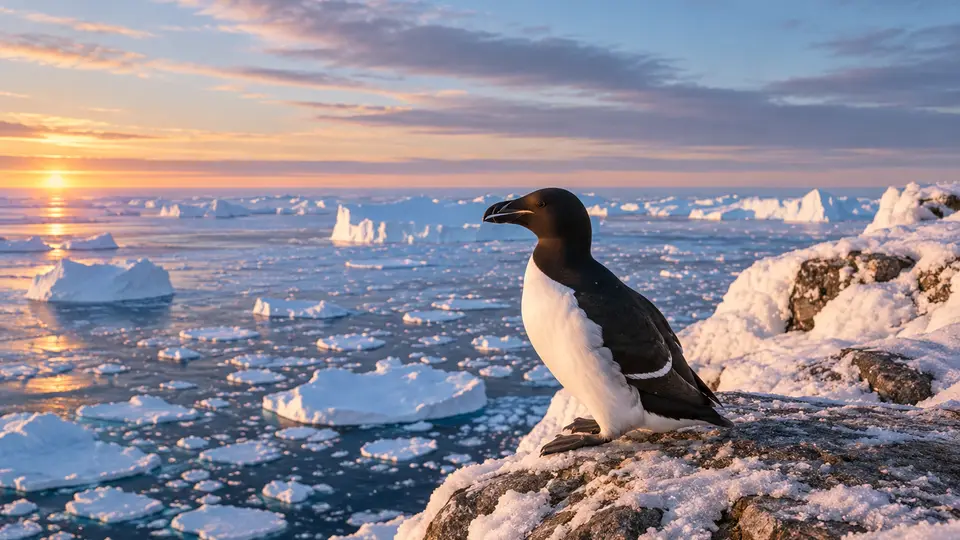
Brünnich's Guillemot in its natural habitat, AI illustration

Brünnich's GuillemotUria lomviaWhere and when to see them

Brünnich's Guillemot at a glance

The thick-billed murre, also called Brünnich's guillemot, is a black-and-white seabird of Arctic and subarctic seas. Huge breeding colonies can crowd narrow cliff ledges, but populations and trends differ markedly among regions. Its compact body and short wings are adapted to a demanding marine life, while the breeding season briefly concentrates adults on land. Warming seas, shifting prey, accidental capture and pollution can affect this species despite its broad global distribution.

Behaviour & reproduction

Size
40–45 cm long
Weight
0.75–1.2 kg
Lifespan
Not reliably established
Status
Least Concern

Breeding birds occupy tightly packed cliff ledges and defend small spaces rather than building substantial nests. Each pair incubates a single egg, with both adults sharing care. Parents bring individual prey items to the chick. Before it can fly, the youngster leaves the ledge for the sea accompanied by its father, who continues caring for it. Outside the breeding season, birds disperse across marine waters and become far less accessible from shore. Courtship displays on ledges involve bowing, head-bobbing, and mutual preening to reinforce pair bonds. The single pear-shaped egg is resistant to rolling off the narrow ledges due to its unique conical form.

Top wildlife locations

Norway wildlife habitat

Norway

The most relevant Norwegian colonies are in Svalbard, where steep coastal cliffs can be scanned from permitted viewpoints or distant decks. Many ledges are inaccessible, and mainland opportunities are much more limited.

Arctic wildlife habitat

Arctic

Breeding cliffs around the Arctic provide plausible coastal viewing, but colonies are widely separated and often inaccessible. Use established local viewpoints or distant deck observation rather than assuming every rocky coastline supports murres.

Destinations describe the species' habitat, not guaranteed cruise stops. Some animals require an optional inland excursion or are found in restricted reserves.

Fun facts about the Brünnich's Guillemot

  • It lays its single egg directly on a rocky ledge.
  • The male accompanies and feeds the chick after it leaves the colony.
  • Its wings propel it both through air and while pursuing prey below the sea surface.
  • Individual eggs vary greatly in color and markings.

Best time to see the Brünnich's Guillemot

Late spring and summer provide the strongest coastal opportunities because adults attend breeding cliffs. June and July are broadly useful at many high-latitude colonies, but timing varies with latitude and ice conditions. Outside breeding, offshore dispersal makes ordinary shore observation much less dependable. In the High Arctic, accessible ice-free coastal areas might not open up until late June or early July, influencing colony access. Early season cruises might encounter migrating flocks offshore before breeding begins.

Brünnich's Guillemot: season matrix by destination

Travel and observation windows vary by region. Highlighted months are an orientation for planning, not confirmed sightings or a guarantee of access.

Norway

This broadly matches Svalbard summer access and colony attendance; late-season departures and local restrictions can reduce opportunities.

JanFebMarAprMayJunJulAugSepOctNovDec
Cruise ships in Norway

Arctic

A broad summer travel window only; colony timing, sea ice and access differ considerably across the Arctic.

JanFebMarAprMayJunJulAugSepOctNovDec
Cruise ships in Arctic

Where the Brünnich's Guillemot lives

Breeding habitat consists of steep coastal cliffs with narrow ledges near productive cold seas. Outside summer, murres occupy offshore Arctic and subarctic waters, sometimes associated with sea-ice margins. Many colonies are inaccessible from land and can only be viewed distantly from permitted coastal routes. While some populations migrate, many Arctic populations remain in ice-free polynyas or areas of reduced ice cover throughout the winter. These high-energy areas support abundant prey, allowing murres to persist in harsh conditions.

What the Brünnich's Guillemot eats

The diet includes small fishes such as polar cod and capelin, alongside crustaceans and other marine prey. Composition changes with region, season and prey availability. Adults often deliver a single fish held lengthwise in the bill when returning to feed a chick. They are skilled pursuit divers, using their wings for propulsion underwater to chase down prey at considerable depths. Diving depths can exceed 100 meters, making them one of the deepest-diving auks.

Species at a glance

Common name
Brünnich's Guillemot
Scientific name
Uria lomvia
Animal group
Birds
Size
40–45 cm long
Weight
0.75–1.2 kg
Lifespan
Not reliably established
Status
Least Concern
Identification
A short, deep bill with a pale gape stripe and generally darker upperparts separates it from the longer-billed common murre. The Thick-billed Murre is generally stockier than its common counterpart, with a noticeably shorter and thicker neck. Juveniles are similar to adults but have a less distinct gape stripe and a slightly less robust bill.

Brünnich's Guillemot: frequently asked questions

Where can I see the Brünnich's Guillemot?
Norway, Arctic. Observe colonies from marked viewpoints or distant decks, keeping clear of cliff edges and falling rocks. Avoid loud noise, drones and approaches that flush birds, which can expose eggs or chicks to danger. Specialized viewing optics like binoculars or spotting scopes are essential for observing details of distant cliff-nesting birds. Remember that photography with flash or loud shutter noises can also disturb sensitive wildlife.
When is the best time to see the Brünnich's Guillemot?
Late spring and summer provide the strongest coastal opportunities because adults attend breeding cliffs. June and July are broadly useful at many high-latitude colonies, but timing varies with latitude and ice conditions. Outside breeding, offshore dispersal makes ordinary shore observation much less dependable. In the High Arctic, accessible ice-free coastal areas might not open up until late June or early July, influencing colony access. Early season cruises might encounter migrating flocks offshore before breeding begins.
How big does the Brünnich's Guillemot get?
40–45 cm long. Adult weight: 0.75–1.2 kg. Size varies with age, sex and population.
How should I behave around the Brünnich's Guillemot?
Observe colonies from marked viewpoints or distant decks, keeping clear of cliff edges and falling rocks. Avoid loud noise, drones and approaches that flush birds, which can expose eggs or chicks to danger. Specialized viewing optics like binoculars or spotting scopes are essential for observing details of distant cliff-nesting birds. Remember that photography with flash or loud shutter noises can also disturb sensitive wildlife.
What does the Brünnich's Guillemot eat?
The diet includes small fishes such as polar cod and capelin, alongside crustaceans and other marine prey. Composition changes with region, season and prey availability. Adults often deliver a single fish held lengthwise in the bill when returning to feed a chick. They are skilled pursuit divers, using their wings for propulsion underwater to chase down prey at considerable depths. Diving depths can exceed 100 meters, making them one of the deepest-diving auks.
Are wildlife sightings guaranteed on an adventure cruise?
No. Animals move freely and routes, weather, access restrictions and local conditions influence every outing. Confirm the actual itinerary and shore program before booking.

Compare wildlife in the same destinations

Explore other birds recorded in these destinations. Similar surroundings do not mean the animals share the same habits or viewing season.

Species comparison by animal group and destination
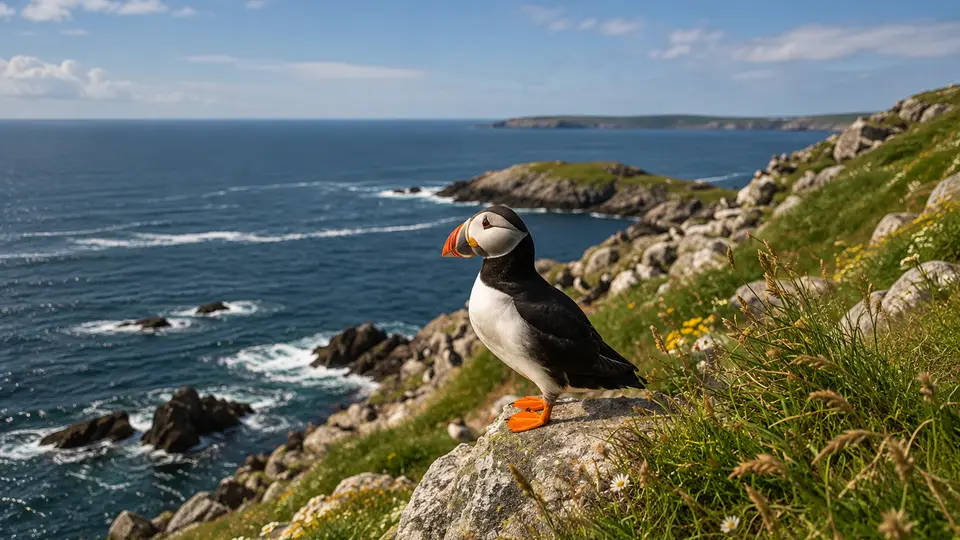
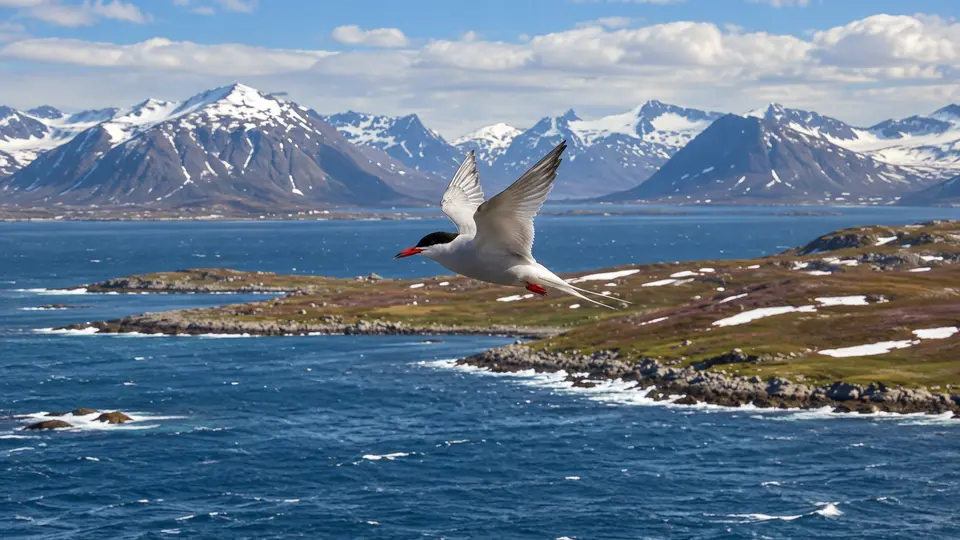
Brünnich's GuillemotBrünnich's GuillemotArctic TernArctic TernAtlantic PuffinAtlantic Puffin
Animal groupBirdsAnimal groupBirdsAnimal groupBirds
DestinationsNorway, ArcticDestinationsAlaska, Norway, ArcticDestinationsNew England, Norway, Scotland, Arctic
All wildlife destinations
Plan your trip

Find your next wildlife adventure

Compare destinations, shore programs and dates with the animals and habitats you would love to see.

  • Naturalist-led shore excursions
  • Responsible wildlife watching
  • Small expedition ships

Newsletter

Take Blue Rides with you

Adventure cruise offers, last-minute deals and trip inspiration.

Free, unsubscribe anytime. Details: Privacy Policy

Partner with Blue Rides

Affiliate Program

Recommend adventure cruises and earn commission on every confirmed booking.

Share. Track. Earn.

Your footage, our stage

Send us your videos or pictures.

Captured remarkable nature or wildlife on your journey? Share it with us, we may feature it on Blue Rides.