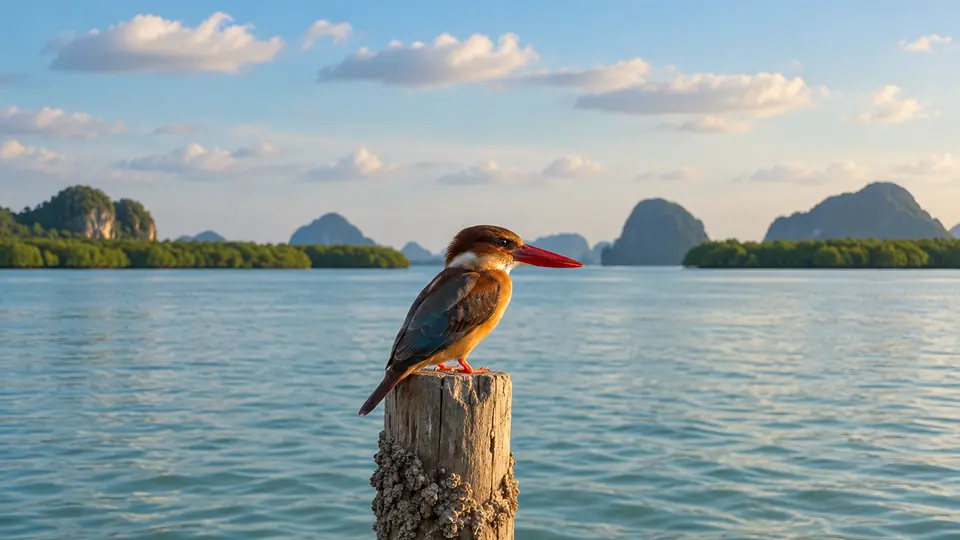
Brown-winged kingfisher in its natural habitatAI-modified

Brown-winged kingfisherPelargopsis amauropteraWhere and when to see them

Brown-winged kingfisher at a glance

The brown-winged kingfisher is a large coastal kingfisher associated especially closely with mangroves around the northeastern Indian Ocean. Its orange head, massive red bill and dark brown wings give it a striking appearance, although a motionless bird can disappear surprisingly well into shaded branches. In Thailand it is principally an Andaman coast species. Loss and alteration of mature mangrove habitat are important concerns because suitable feeding perches and nesting banks must occur together.

Behaviour & reproduction

Size
35-40 cm (14-16 in) long
Weight
204 g (0.45 lb) (related species)
Lifespan
7 years (related species)
Status
Near Threatened

Usually encountered alone or in pairs, this kingfisher watches shallow creeks from a prominent branch before dropping onto prey. It often returns to a perch to beat and reposition a catch before swallowing it. Loud, repeated cackling calls can reveal a bird well before it becomes visible. Pairs defend feeding areas, and nesting involves excavating a tunnel in an earthen bank, where disturbance or bank clearance can cause substantial disruption. Courtship rituals include fish-carrying displays and mutual bill-tapping between a pair. Nest tunnels can extend over a meter deep into the bank, making them highly vulnerable to erosion or human activity. Juveniles often exhibit duller plumage and a slightly less intense bill coloration.

Top wildlife locations

Thailand wildlife habitatAI-modified

Thailand

Established mangrove boardwalks and wooded estuary margins on the Andaman coast offer plausible shore habitat. Distribution is localized, and a dedicated coastal excursion may be needed rather than a general beach visit.
Destinations describe the species' habitat, not guaranteed cruise stops. Some animals require an optional inland excursion or are found in restricted reserves.

Fun facts about the Brown-winged kingfisher

  • Its scientific epithet amauroptera refers to its dark wings.
  • It belongs to the same genus as the stork-billed kingfisher.
  • Crabs are a regular component of its coastal diet.
  • Its loud cackling call often carries through mangroves farther than the bird can be seen.

Best time to see the Brown-winged kingfisher

On Thailand's Andaman coast, November to April generally offers more manageable weather for shore visits to mangrove areas. The species is resident, so this is an access and observation window rather than a migration season. Tide, local habitat quality and quiet conditions remain important. During this period, drier conditions generally lead to clearer water, improving foraging success and visibility. Lower humidity also makes shore excursions into mangrove areas more comfortable for observers. Strong winds or heavy rain during the monsoon can disrupt its hunting activities and make observation difficult.

Brown-winged kingfisher: season matrix by destination

Travel and observation windows vary by region. Highlighted months are an orientation for planning, not confirmed sightings or a guarantee of access.

Thailand

These months generally favor Andaman coast access; this resident bird's presence depends on suitable mangroves, not a seasonal arrival.

JanFebMarAprMayJunJulAugSepOctNovDec
Cruise ships in Thailand

Where the Brown-winged kingfisher lives

Mangrove forest, tidal creeks and wooded estuaries form its core habitat. It also uses adjacent coastal waterways with suitable trees and banks. Sheltered channels with exposed hunting perches are more characteristic than open beaches, offshore islands without mangroves or inland mountain streams. While predominantly coastal, individuals may also venture short distances up large rivers, especially if mangrove patches extend inland. Optimal habitat includes a mosaic of dense mangrove forest for roosting and nesting, interspersed with open mudflats for foraging. It demonstrates a preference for low-salinity estuarine environments rather than fully marine coastal areas.

What the Brown-winged kingfisher eats

Crabs and fish are important prey, supplemented by other small animals available along muddy creek margins. Hunting is predominantly perch-based rather than prolonged hovering. Its heavy bill helps seize and process substantial prey, including hard-bodied crustaceans that smaller kingfishers may not handle. They will also opportunistically take small reptiles and amphibians encountered at the water's edge. Its hunting strategy involves patiently scanning from a fixed perch, often a low branch or exposed root, before making a rapid, direct dive. The sturdy bill is adept at crushing the carapaces of crabs and other crustaceans.

Species at a glance

Common name
Brown-winged kingfisher
Scientific name
Pelargopsis amauroptera
Animal group
Birds
Size
35-40 cm (14-16 in) long
Weight
204 g (0.45 lb) (related species)
Lifespan
7 years (related species)
Status
Near Threatened
Identification
Compared with the stork-billed kingfisher, it has distinctly brown rather than blue-green wings, combined with a rich orange head and large red bill. The large size, roughly 35-38 cm (14-15 in), immediately distinguishes it from smaller kingfisher species. Its overall stocky build and disproportionately large head and bill are key features. The contrast between its bright rufous underparts and dark brown upperparts is also highly characteristic.

Brown-winged kingfisher: frequently asked questions

Where can I see the Brown-winged kingfisher?
Thailand. Watch mangrove creeks quietly from established boardwalks or firm banks. Keep away from suspected nest tunnels, avoid call playback, and do not step onto unstable tidal mud to improve a view. Scanning the edges of tidal channels during an incoming or outgoing tide can often reveal active foraging. Binoculars are essential for observing this often-cryptic species from a distance without causing disturbance. Look for movement in the lower to middle canopy layers along the water's edge.
When is the best time to see the Brown-winged kingfisher?
On Thailand's Andaman coast, November to April generally offers more manageable weather for shore visits to mangrove areas. The species is resident, so this is an access and observation window rather than a migration season. Tide, local habitat quality and quiet conditions remain important. During this period, drier conditions generally lead to clearer water, improving foraging success and visibility. Lower humidity also makes shore excursions into mangrove areas more comfortable for observers. Strong winds or heavy rain during the monsoon can disrupt its hunting activities and make observation difficult.
How big does the Brown-winged kingfisher get?
35-40 cm (14-16 in) long. Adult weight: 204 g (0.45 lb) (related species). Size varies with age, sex and population.
How should I behave around the Brown-winged kingfisher?
Watch mangrove creeks quietly from established boardwalks or firm banks. Keep away from suspected nest tunnels, avoid call playback, and do not step onto unstable tidal mud to improve a view. Scanning the edges of tidal channels during an incoming or outgoing tide can often reveal active foraging. Binoculars are essential for observing this often-cryptic species from a distance without causing disturbance. Look for movement in the lower to middle canopy layers along the water's edge.
What does the Brown-winged kingfisher eat?
Crabs and fish are important prey, supplemented by other small animals available along muddy creek margins. Hunting is predominantly perch-based rather than prolonged hovering. Its heavy bill helps seize and process substantial prey, including hard-bodied crustaceans that smaller kingfishers may not handle. They will also opportunistically take small reptiles and amphibians encountered at the water's edge. Its hunting strategy involves patiently scanning from a fixed perch, often a low branch or exposed root, before making a rapid, direct dive. The sturdy bill is adept at crushing the carapaces of crabs and other crustaceans.
Are wildlife sightings guaranteed on an adventure cruise?
No. Animals move freely and routes, weather, access restrictions and local conditions influence every outing. Confirm the actual itinerary and shore program before booking.

Compare wildlife in the same destinations

Explore other birds recorded in these destinations. Similar surroundings do not mean the animals share the same habits or viewing season.

Species comparison by animal group and destination
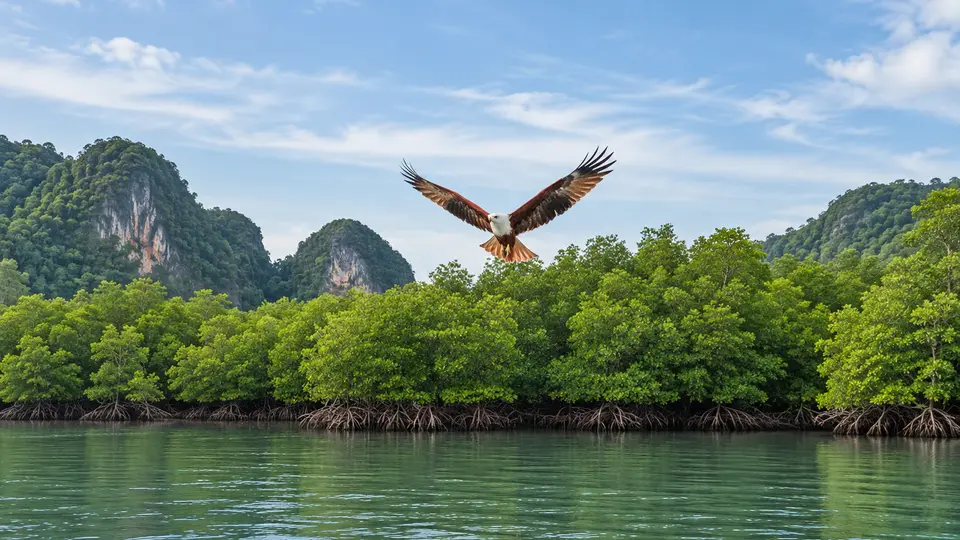
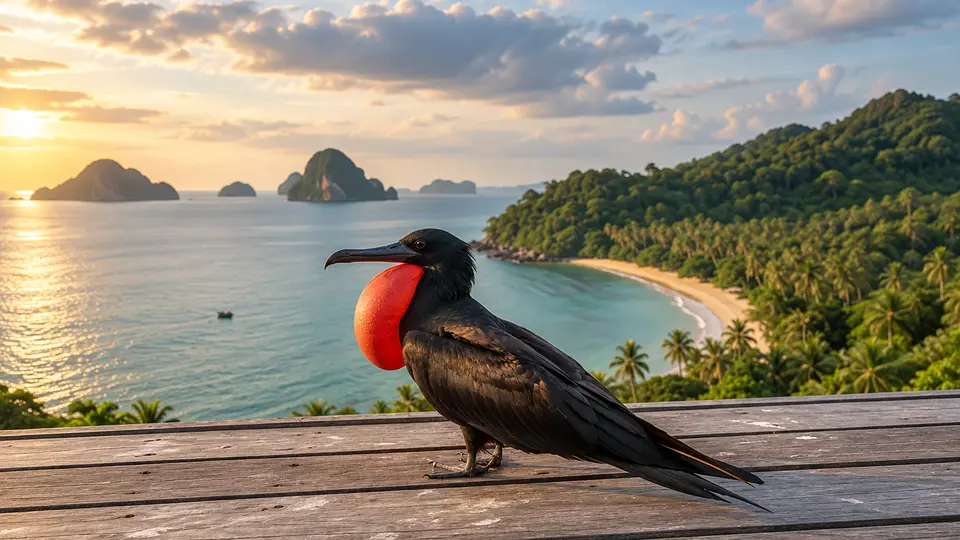
Brown-winged kingfisherAI-modifiedBrown-winged kingfisherBrahminy kiteAI-modifiedBrahminy kiteChristmas Island frigatebirdAI-modifiedChristmas Island frigatebird
Animal groupBirdsAnimal groupBirdsAnimal groupBirds
DestinationsThailandDestinationsIndonesia, Thailand, VietnamDestinationsThailand
Scientific namePelargopsis amauropteraScientific nameScientific name
All wildlife destinations
AI-modified
Plan your trip

Find your next wildlife adventure

Compare destinations, shore programs and dates with the animals and habitats you would love to see.

  • Naturalist-led shore excursions
  • Responsible wildlife watching
  • Small expedition ships