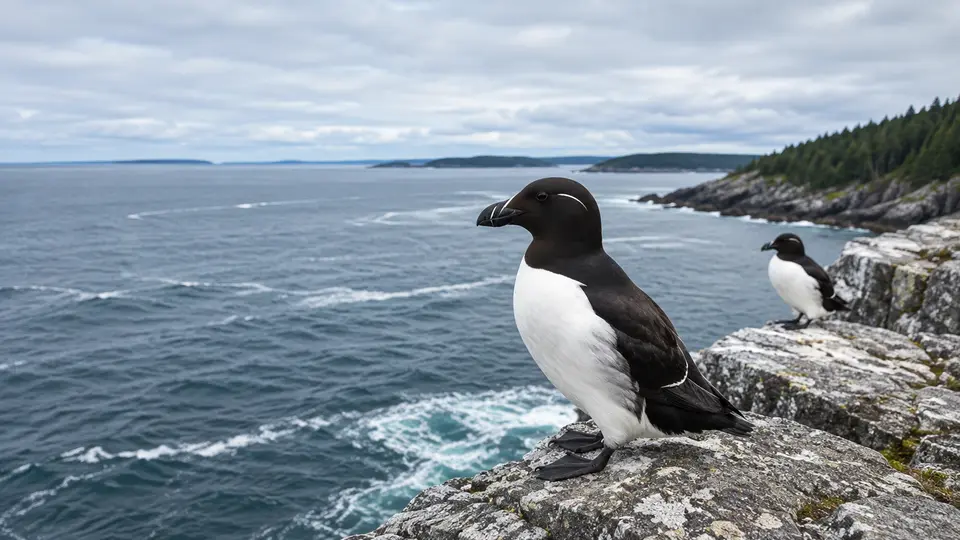
Razorbill in its natural habitat, AI illustration

Razorbill: where and when to see them

Alca torda

Razorbill at a glance

The razorbill is a black-and-white North Atlantic auk with a deep, compressed bill crossed by a narrow white line. It nests on coastal cliffs and rocky islands, then spends much of the year at sea. Closely related to the extinct great auk, it is the only living member of its genus. From shore, breeding colonies provide the clearest opportunities to appreciate its upright posture, strong pair associations and precise landings among crowded rocks.

Behaviour & reproduction

Size
37–39 cm body length
Weight
500–890 g
Lifespan
About 15–25 years
Status
Least Concern

Razorbills breed colonially, choosing sheltered crevices, spaces beneath boulders or protected ledges rather than building elaborate nests. Both parents incubate the single egg and provision the chick. Before it can fly, the chick leaves the nesting site and accompanies its father to sea, where care continues. Outside breeding, birds disperse across marine feeding grounds. Courtship includes mutual preening and bill contact, while established pairs may reunite across successive breeding seasons. Razorbills are monogamous, forming strong pair bonds that can last for many breeding seasons. They are known for their distinctive upright posture on land and their direct, powerful flight. Post-breeding, adults undergo a complete molt, rendering them flightless for a period, during which they remain at sea.

Top wildlife locations

New England wildlife habitat

New England

Winter birds may be visible offshore from headlands and coastal viewpoints. Maine's breeding colonies are largely on offshore islands, often inaccessible to landing visitors; distant deck observation must respect colony protection zones.

Adventure cruises in New England
Norway wildlife habitat

Norway

Rocky seabird cliffs and coastal islands provide breeding habitat, with some colonies observable from established viewpoints or decks. Many sites are remote or closed to landing, and exposure varies greatly along Norway's coast.

Adventure cruises in Norway
Scotland wildlife habitat

Scotland

Established viewpoints above seabird cliffs and rocky island shores offer plausible colony views. Some colonies require a ferry excursion, while others are accessible from land; nesting ledges themselves should remain undisturbed.

Adventure cruises in Scotland

Destinations describe the species' habitat, not guaranteed cruise stops. Some animals require an optional inland excursion or are found in restricted reserves.

Fun facts about the Razorbill

  • The razorbill is the only living species in the genus Alca.
  • It normally lays just one egg per breeding attempt.
  • Chicks leave the colony before they can fly.
  • The male accompanies and feeds the chick at sea after colony departure.

Best time to see the Razorbill

Late spring and summer are best for watching breeding colonies in Scotland and Norway. In New England, winter often offers more accessible coastal observations, although breeding colonies occur in Maine. Exact timing varies with latitude, colony location and annual conditions. In New England, significant numbers of razorbills are often observed during winter offshore boat trips or from headlands, particularly after storms. Migratory movements can be observed in spring and autumn along coastal flyways. Peak breeding activity in the Northern Atlantic generally occurs from May to July.

Razorbill: season matrix by destination

Travel and observation windows vary by region. Highlighted months are an orientation for planning, not confirmed sightings or a guarantee of access.

New England

This window emphasizes mainland shore observation of wintering birds, not Maine's separate summer breeding season.

JanFebMarAprMayJunJulAugSepOctNovDec
Cruise ships in New England

Norway

These months broadly cover colony attendance; northern sites may run later, and weather can prevent access.

JanFebMarAprMayJunJulAugSepOctNovDec
Cruise ships in Norway

Scotland

Spring through midsummer generally offers colony attendance, with departures varying by site and breeding progress.

JanFebMarAprMayJunJulAugSepOctNovDec
Cruise ships in Scotland

Where the Razorbill lives

Breeding habitat consists of rocky North Atlantic islands and sea cliffs offering protected nest spaces near productive waters. Away from colonies, razorbills occupy coastal and offshore seas. They are marine birds throughout the year, not land animals beyond their nesting requirements. This pelagic seabird typically remains within the cold temperate waters of the North Atlantic, ranging from the northeastern United States and eastern Canada to Greenland, Iceland, and across northern Europe. During the non-breeding season, razorbills can be found far from shore, sometimes hundreds of kilometers out to sea, and may range further south into coastal waters. They often gather in large rafts on the water's surface before heading to their breeding colonies.

What the Razorbill eats

Small schooling fish, including sandeels, sprats, herring and capelin, dominate the diet according to region. Crustaceans and other marine prey are also eaten. Adults may carry several fish crosswise in the bill when returning to feed their single chick. Prey is typically caught in shallow, nearshore waters during dives, although they can forage further offshore. Their diet reflects the local abundance of small, pelagic fish. Young razorbills are fed frequently throughout the day by both parents.

Species at a glance

Common name
Razorbill
Scientific name
Alca torda
Animal group
Birds
Size
37–39 cm body length
Weight
500–890 g
Lifespan
About 15–25 years
Status
Least Concern
Identification
Unlike common guillemots, razorbills have a deep, blunt black bill with a white vertical stripe and a longer, more pointed tail. Adult razorbills have a striking, thick black bill with a prominent white band on the upper mandible and a thinner white gape stripe at the base. Juveniles have a smaller bill without the white band and often lack the full gape stripe, making them appear somewhat different from adults. Their upperparts are uniformly black, contrasting sharply with their white underparts.

Razorbill: frequently asked questions

Where can I see the Razorbill?
New England, Norway, Scotland. Use marked clifftop paths or watch distant birds from shore and decks. Keep away from cliff edges and nesting crevices, and never position yourself between departing chicks and their route to sea. When viewing colonies from decks or shore, look for birds on ledges, flying to and from the sea, or rafting on the water below cliffs. Binoculars or a spotting scope are essential for detailed observation of distant birds. Respect all signage regarding colony disturbance and maintain quiet on observation platforms.
When is the best time to see the Razorbill?
Late spring and summer are best for watching breeding colonies in Scotland and Norway. In New England, winter often offers more accessible coastal observations, although breeding colonies occur in Maine. Exact timing varies with latitude, colony location and annual conditions. In New England, significant numbers of razorbills are often observed during winter offshore boat trips or from headlands, particularly after storms. Migratory movements can be observed in spring and autumn along coastal flyways. Peak breeding activity in the Northern Atlantic generally occurs from May to July.
How big does the Razorbill get?
37–39 cm body length. Adult weight: 500–890 g. Size varies with age, sex and population.
How should I behave around the Razorbill?
Use marked clifftop paths or watch distant birds from shore and decks. Keep away from cliff edges and nesting crevices, and never position yourself between departing chicks and their route to sea. When viewing colonies from decks or shore, look for birds on ledges, flying to and from the sea, or rafting on the water below cliffs. Binoculars or a spotting scope are essential for detailed observation of distant birds. Respect all signage regarding colony disturbance and maintain quiet on observation platforms.
What does the Razorbill eat?
Small schooling fish, including sandeels, sprats, herring and capelin, dominate the diet according to region. Crustaceans and other marine prey are also eaten. Adults may carry several fish crosswise in the bill when returning to feed their single chick. Prey is typically caught in shallow, nearshore waters during dives, although they can forage further offshore. Their diet reflects the local abundance of small, pelagic fish. Young razorbills are fed frequently throughout the day by both parents.
Are wildlife sightings guaranteed on an adventure cruise?
No. Animals move freely and routes, weather, access restrictions and local conditions influence every outing. Confirm the actual itinerary and shore program before booking.

Compare wildlife in the same destinations

Explore other birds recorded in these destinations. Similar surroundings do not mean the animals share the same habits or viewing season.

Species comparison by animal group and destination
RazorbillRazorbillArctic TernArctic TernAtlantic PuffinAtlantic Puffin
Animal groupBirdsAnimal groupBirdsAnimal groupBirds
DestinationsNew England, Norway, ScotlandDestinationsAlaska, Norway, ArcticDestinationsNew England, Norway, Scotland, Arctic
All wildlife destinations
Plan your trip

Find your next wildlife adventure

Compare destinations, shore programs and dates with the animals and habitats you would love to see.

  • Naturalist-led shore excursions
  • Responsible wildlife watching
  • Small expedition ships

Newsletter

Take Blue Rides with you

Adventure cruise offers, last-minute deals and trip inspiration.

Free, unsubscribe anytime. Details: Privacy Policy

Partner with Blue Rides

Affiliate Program

Recommend adventure cruises and earn commission on every confirmed booking.

Share. Track. Earn.

Your footage, our stage

Send us your videos or pictures.

Captured beautiful landscapes or wildlife? Share your videos and pictures with us, we may feature them on Blue Rides.