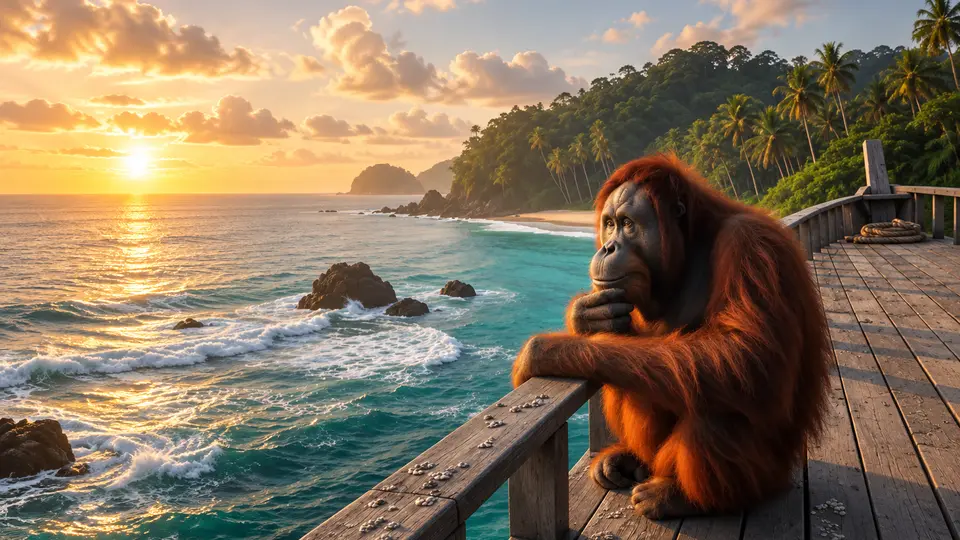
Orangutan in its natural habitat, AI illustration

OrangutanWhere and when to see them

Orangutan at a glance

Orangutan is a collective name for three great ape species: the Bornean, Sumatran and Tapanuli orangutans. All occur in Indonesia, but their ranges are distinct, and this generic catalog key cannot be assigned one scientific name. These long-armed, largely tree-dwelling apes have slow life histories and depend on forest landscapes. All three species are globally assessed as Critically Endangered, with habitat loss, killing and fragmentation threatening their remaining populations.

Behaviour & reproduction

Size
1.0-1.5 m head-and-body length
Weight
30-100 kg
Lifespan
30-50 years
Status
Assessment varies

Orangutans usually travel and feed alone or in small temporary associations, with mothers and dependent young forming the most enduring bonds. They construct leafy sleeping nests, often making a fresh one each evening. Adult males with cheek flanges produce far-carrying calls that communicate their presence. Social patterns vary with species and food supply, and young animals spend years learning feeding routes, food processing and other skills from their mothers. Orangutan mothers teach their young for up to eight years, making them among the animals with the longest childhood dependency. Adult males with prominent cheek flanges are known as flanged males, while non-flanged males are also reproductively active.

Top wildlife locations

Indonesia wildlife habitat

Indonesia

Protected forests in Indonesian Borneo and Sumatra offer regulated viewing opportunities, usually requiring a substantial inland excursion. Coastal ports and standard beach landings are unsuitable, and Tapanuli habitat is particularly restricted and remote.
Destinations describe the species' habitat, not guaranteed cruise stops. Some animals require an optional inland excursion or are found in restricted reserves.

Fun facts about the Orangutan

  • Three living orangutan species are currently recognized.
  • Tapanuli orangutans were described as a separate species in 2017.
  • Young orangutans may remain dependent on their mothers for seven years or longer.
  • Some populations use tools, including sticks for extracting food.

Best time to see the Orangutan

Observation planning must be specific to the island, forest and species. Relatively drier periods can ease trail or river access, but rainfall remains possible year-round and fruiting patterns change animal movements. There is no defensible Indonesia-wide season guaranteeing wild orangutan encounters. While orangutans are active year-round, fruiting seasons can concentrate individuals in certain areas, potentially increasing viewing opportunities. Local guides are best equipped to advise on current conditions and animal movements.

Orangutan: season matrix by destination

Travel and observation windows vary by region. Highlighted months are an orientation for planning, not confirmed sightings or a guarantee of access.

Indonesia

Rainfall, access and observation conditions vary greatly between islands and sites; select a specific authorized forest program before assigning a monthly travel window.

JanFebMarAprMayJunJulAugSepOctNovDec
Cruise ships in Indonesia

Where the Orangutan lives

Habitats include lowland rainforest, peat-swamp forest and hill forest in parts of Borneo and Sumatra. The Tapanuli orangutan occupies a restricted Sumatran upland landscape. Coastal forest may be suitable locally, but beaches and ordinary port areas are not realistic observation habitat. They are arboreal, spending most of their lives in the trees and rarely descending to the forest floor. Habitat loss due to deforestation for agriculture, particularly palm oil, and logging is the primary threat to their survival across their range.

What the Orangutan eats

Fruit is especially important, supplemented by leaves, bark, flowers, insects and other foods depending on availability. Orangutans remember productive trees and adjust feeding when preferred fruit becomes scarce. Diet differs among habitats and species, so no single food list describes every population. A significant portion of their diet consists of ripe, fleshy fruits, but they also consume young leaves, flowers, and even soil to obtain essential minerals. They play a crucial role in seed dispersal within their forest ecosystems.

Species at a glance

Common name
Orangutan
Scientific name
Name covers more than one taxon
Animal group
Mammals
Size
1.0-1.5 m head-and-body length
Weight
30-100 kg
Lifespan
30-50 years
Status
Assessment varies
Identification
Their reddish hair, very long arms and lack of a tail distinguish orangutans from regional monkeys and gibbons, but separating the three species requires geographic context and expert assessment. Infant orangutans cling tightly to their mothers' fur and are typically observed with them for many years. The three distinct species are Bornean (Pongo pygmaeus), Sumatran (Pongo abelii), and Tapanuli (Pongo tapanuliensis).

Orangutan: frequently asked questions

Where can I see the Orangutan?
Indonesia. Use authorized forest guides, maintain the required distance and never feed or touch apes. Wear a mask when required, postpone visits if ill, and leave animals an unobstructed route. Participating in eco-tourism initiatives that support local communities and conservation efforts helps protect orangutan populations. Never disturb their natural foraging or movement patterns.
When is the best time to see the Orangutan?
Observation planning must be specific to the island, forest and species. Relatively drier periods can ease trail or river access, but rainfall remains possible year-round and fruiting patterns change animal movements. There is no defensible Indonesia-wide season guaranteeing wild orangutan encounters. While orangutans are active year-round, fruiting seasons can concentrate individuals in certain areas, potentially increasing viewing opportunities. Local guides are best equipped to advise on current conditions and animal movements.
How big does the Orangutan get?
1.0-1.5 m head-and-body length. Adult weight: 30-100 kg. Size varies with age, sex and population.
How should I behave around the Orangutan?
Use authorized forest guides, maintain the required distance and never feed or touch apes. Wear a mask when required, postpone visits if ill, and leave animals an unobstructed route. Participating in eco-tourism initiatives that support local communities and conservation efforts helps protect orangutan populations. Never disturb their natural foraging or movement patterns.
What does the Orangutan eat?
Fruit is especially important, supplemented by leaves, bark, flowers, insects and other foods depending on availability. Orangutans remember productive trees and adjust feeding when preferred fruit becomes scarce. Diet differs among habitats and species, so no single food list describes every population. A significant portion of their diet consists of ripe, fleshy fruits, but they also consume young leaves, flowers, and even soil to obtain essential minerals. They play a crucial role in seed dispersal within their forest ecosystems.
Are wildlife sightings guaranteed on an adventure cruise?
No. Animals move freely and routes, weather, access restrictions and local conditions influence every outing. Confirm the actual itinerary and shore program before booking.

Compare wildlife in the same destinations

Explore other mammals recorded in these destinations. Similar surroundings do not mean the animals share the same habits or viewing season.

Species comparison by animal group and destination
OrangutanOrangutanAnoaAnoaBabirusaBabirusa
Animal groupMammalsAnimal groupMammalsAnimal groupMammals
DestinationsIndonesiaDestinationsIndonesiaDestinationsIndonesia
All wildlife destinations
Plan your trip

Find your next wildlife adventure

Compare destinations, shore programs and dates with the animals and habitats you would love to see.

  • Naturalist-led shore excursions
  • Responsible wildlife watching
  • Small expedition ships

Newsletter

Take Blue Rides with you

Adventure cruise offers, last-minute deals and trip inspiration.

Free, unsubscribe anytime. Details: Privacy Policy

Partner with Blue Rides

Affiliate Program

Recommend adventure cruises and earn commission on every confirmed booking.

Share. Track. Earn.

Your footage, our stage

Send us your videos or pictures.

Captured remarkable nature or wildlife on your journey? Share it with us, we may feature it on Blue Rides.