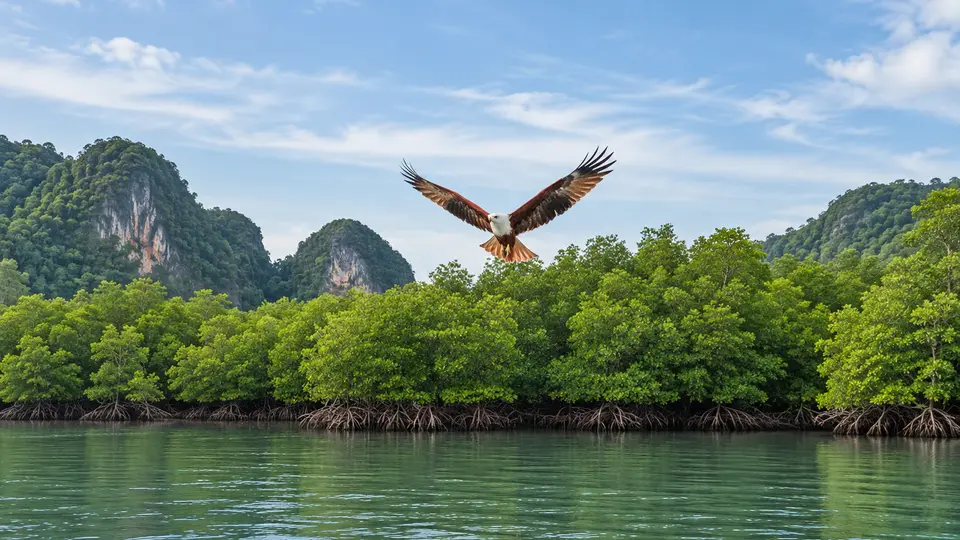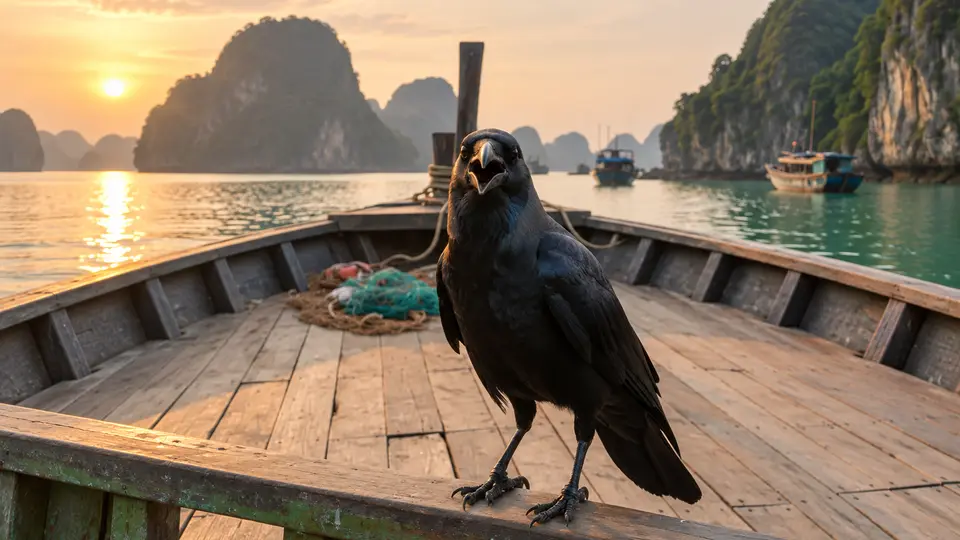
Large-billed crow in its natural habitat, AI illustration

Large-billed crowCorvus macrorhynchosWhere and when to see them

Large-billed crow at a glance

The large-billed crow is a glossy black Asian corvid with a substantial arched bill and a prominent forehead. Its English name has historically covered a broader complex of populations than some modern taxonomies recognize. This matters in Vietnam, where records and field guides may apply different boundaries to similar crows. A reliable profile therefore concerns Corvus macrorhynchos, while local identification should be checked against the taxonomy and distribution used by current regional authorities.

Behaviour & reproduction

Size
46–59 cm long
Weight
Not reliably established
Lifespan
Not reliably established
Status
Least Concern

Large-billed crows are adaptable, observant birds that investigate feeding opportunities on the ground and in trees. Pairs maintain social bonds, and groups may gather at food sources or communal roosts. Their varied calls carry over woodland edges and settlements. They handle objects with the bill, cache food and react strongly to perceived threats near nests. Intelligence does not make them tame, and repeated feeding can encourage problematic approaches to people. They are known for their intelligence, often demonstrating problem-solving skills when accessing food sources or evading predators. Their vocalizations are diverse, including alarm calls, contact calls between pairs, and more complex social interactions within groups.

Top wildlife locations

Vietnam wildlife habitat

Vietnam

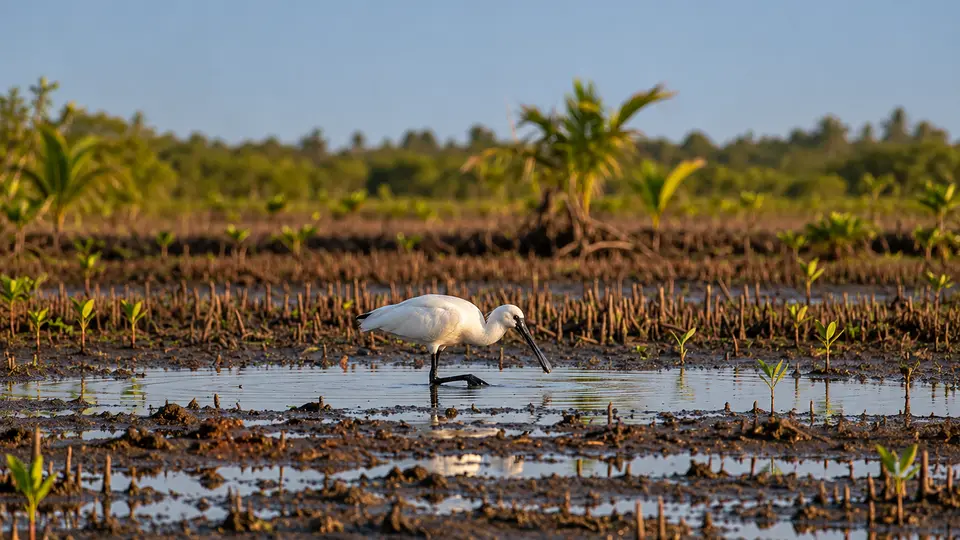
Coastal woodland edges and tree-lined settlements provide plausible crow-watching habitat, but attribution to this species requires local verification. A shoreline sighting of a large black crow is not sufficient to establish identity.
Destinations describe the species' habitat, not guaranteed cruise stops. Some animals require an optional inland excursion or are found in restricted reserves.

Fun facts about the Large-billed crow

  • The scientific epithet macrorhynchos refers to its large bill.
  • Several crows formerly grouped under this name are now separated by some authorities.
  • Food caching lets an individual store surplus items for later use.
  • The bill is useful for probing and manipulating food as well as tearing it.

Best time to see the Large-billed crow

Where securely identified, resident birds can be observed throughout the year. Vietnam's regional weather differences make a single national coastal viewing season misleading. Establishing which crow taxon occurs at the intended locality is more important than choosing a supposed species-wide peak month. In the northern parts of Vietnam, nesting typically occurs from March to July, influenced by local monsoon patterns and food availability. In contrast, southern populations may breed earlier or have a more extended season, adjusting to regional climatic nuances.

Large-billed crow: season matrix by destination

Travel and observation windows vary by region. Highlighted months are an orientation for planning, not confirmed sightings or a guarantee of access.

Vietnam

No defensible species-specific Vietnamese shore window is supplied because local occurrence depends on taxonomic treatment, and coastal weather varies greatly by region.

JanFebMarAprMayJunJulAugSepOctNovDec
Cruise ships in Vietnam

Where the Large-billed crow lives

Across its accepted range, it uses forest, woodland edges, cultivated landscapes and settlements, including some coastal districts. Mature trees provide nesting and roosting sites. Vietnamese records require taxonomic care because similar black crows may be treated as separate species. In coastal areas of Vietnam, they frequently exploit mangroves, intertidal flats, and cultivated rice paddies adjacent to human settlements. Their flexibility allows them to thrive in fragmented landscapes and modified environments, often seen near port facilities.

What the Large-billed crow eats

It is an omnivore, taking invertebrates, fruit, seeds, carrion and small vertebrates, including eggs or nestlings when available. Human refuse may supplement natural foods near settlements. Its strong bill allows it to manipulate a wide variety of items. They are opportunistic foragers, readily consuming crabs and other marine invertebrates along shorelines, as well as discarded fish scraps from human activities. Their powerful bill is also effective for cracking open hard-shelled items and digging in soft soil.

Species at a glance

Common name
Large-billed crow
Scientific name
Corvus macrorhynchos
Animal group
Birds
Size
46–59 cm long
Weight
Not reliably established
Lifespan
Not reliably established
Status
Least Concern
Identification
A heavy arched bill and steep forehead support identification, but separating it from eastern jungle crow may require voice, locality and the taxonomic treatment being followed. Beyond bill shape, the large-billed crow often exhibits a slightly shaggier throat plumage compared to some other crow species. Subtle variations in body size and the degree of glossiness in their black feathers can also assist in distinguishing them in the field.

Large-billed crow: frequently asked questions

Where can I see the Large-billed crow?
Vietnam. Watch from public paths without baiting birds or approaching nests. Keep food and loose belongings secured around inquisitive crows, and record distant calls or photographs rather than forcing a close encounter. Listen for their distinctive, often harsh 'kaaar-kaaar' calls that echo through coastal forests and villages, a key auditory clue to their presence. While observing from a distance, notice their confident gait as they forage on the ground, often flicking leaves or turning over small stones.
When is the best time to see the Large-billed crow?
Where securely identified, resident birds can be observed throughout the year. Vietnam's regional weather differences make a single national coastal viewing season misleading. Establishing which crow taxon occurs at the intended locality is more important than choosing a supposed species-wide peak month. In the northern parts of Vietnam, nesting typically occurs from March to July, influenced by local monsoon patterns and food availability. In contrast, southern populations may breed earlier or have a more extended season, adjusting to regional climatic nuances.
How big does the Large-billed crow get?
46–59 cm long. Adult weight: Not reliably established. Size varies with age, sex and population.
How should I behave around the Large-billed crow?
Watch from public paths without baiting birds or approaching nests. Keep food and loose belongings secured around inquisitive crows, and record distant calls or photographs rather than forcing a close encounter. Listen for their distinctive, often harsh 'kaaar-kaaar' calls that echo through coastal forests and villages, a key auditory clue to their presence. While observing from a distance, notice their confident gait as they forage on the ground, often flicking leaves or turning over small stones.
What does the Large-billed crow eat?
It is an omnivore, taking invertebrates, fruit, seeds, carrion and small vertebrates, including eggs or nestlings when available. Human refuse may supplement natural foods near settlements. Its strong bill allows it to manipulate a wide variety of items. They are opportunistic foragers, readily consuming crabs and other marine invertebrates along shorelines, as well as discarded fish scraps from human activities. Their powerful bill is also effective for cracking open hard-shelled items and digging in soft soil.
Are wildlife sightings guaranteed on an adventure cruise?
No. Animals move freely and routes, weather, access restrictions and local conditions influence every outing. Confirm the actual itinerary and shore program before booking.

Compare wildlife in the same destinations

Explore other birds recorded in these destinations. Similar surroundings do not mean the animals share the same habits or viewing season.

Species comparison by animal group and destination
Large-billed crowLarge-billed crowBlack-faced spoonbillBlack-faced spoonbillBrahminy kiteBrahminy kite
Animal groupBirdsAnimal groupBirdsAnimal groupBirds
DestinationsVietnamDestinationsVietnamDestinationsIndonesia, Thailand, Vietnam
All wildlife destinations
Plan your trip

Find your next wildlife adventure

Compare destinations, shore programs and dates with the animals and habitats you would love to see.

  • Naturalist-led shore excursions
  • Responsible wildlife watching
  • Small expedition ships

Newsletter

Take Blue Rides with you

Adventure cruise offers, last-minute deals and trip inspiration.

Free, unsubscribe anytime. Details: Privacy Policy

Partner with Blue Rides

Affiliate Program

Recommend adventure cruises and earn commission on every confirmed booking.

Share. Track. Earn.

Your footage, our stage

Send us your videos or pictures.

Captured remarkable nature or wildlife on your journey? Share it with us, we may feature it on Blue Rides.