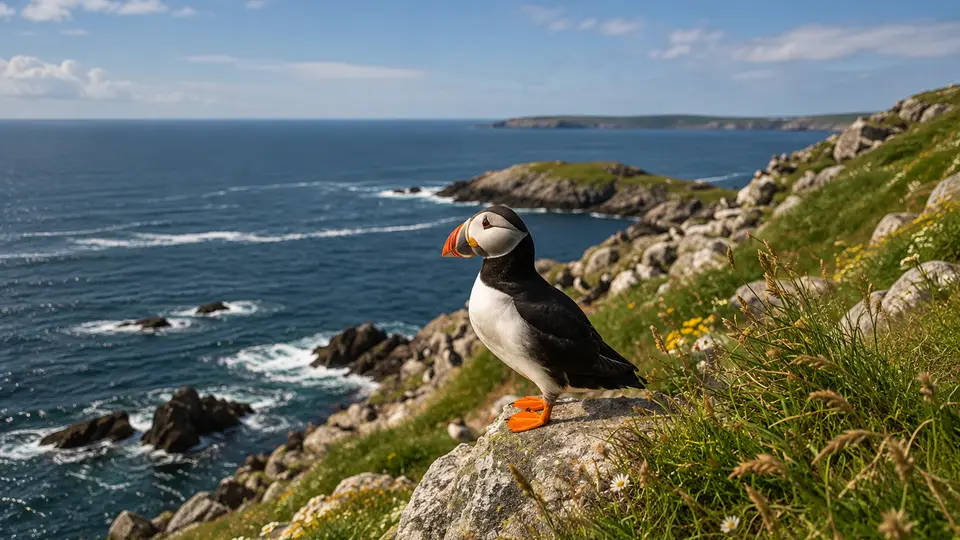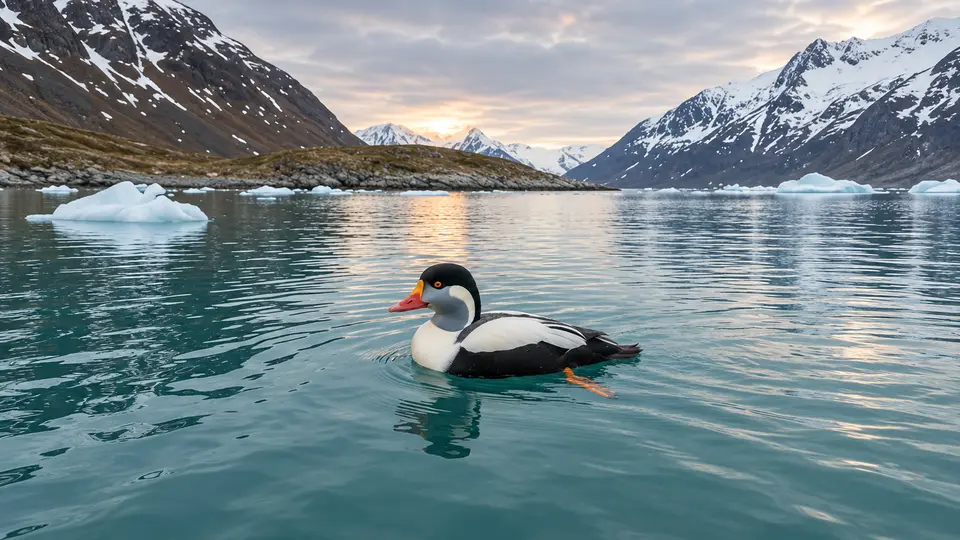
King Eider in its natural habitat, AI illustration

King EiderSomateria spectabilisWhere and when to see them

King Eider at a glance

The king eider is a northern sea duck whose breeding male combines a pale blue crown, greenish cheeks and a striking orange bill shield. Females are mottled brown and much less conspicuous. It breeds across Arctic tundra and spends much of the remaining year at sea. Coastal flocks can be watched from land in suitable northern regions, but its distribution is strongly seasonal and many important areas are remote.

Behaviour & reproduction

Size
50-70 cm long
Weight
1.2-2.1 kg
Lifespan
Not reliably established
Status
Least Concern

Outside the breeding period, king eiders often gather in flocks, sometimes alongside common eiders. They obtain food beneath the sea surface and rest or preen in groups between feeding bouts. During breeding, pairs move onto tundra wetlands, where females incubate ground nests lined with down. Males leave nesting areas earlier than females. Seasonal movements connect inland breeding habitats with coastal moulting and wintering grounds, sometimes over substantial distances. Males undertake a post-breeding moult migration to specific coastal areas, often well before females and juveniles. Their remarkable diving capabilities allow them to exploit benthic food sources at depths often exceeding 20 meters.

Top wildlife locations

Norway wildlife habitat

Norway

Northern coastal bays and harbours, particularly in Finnmark, can offer shore views of wintering eiders. King eiders may be scarce within mixed flocks, and reaching suitable northern viewpoints requires dedicated travel.

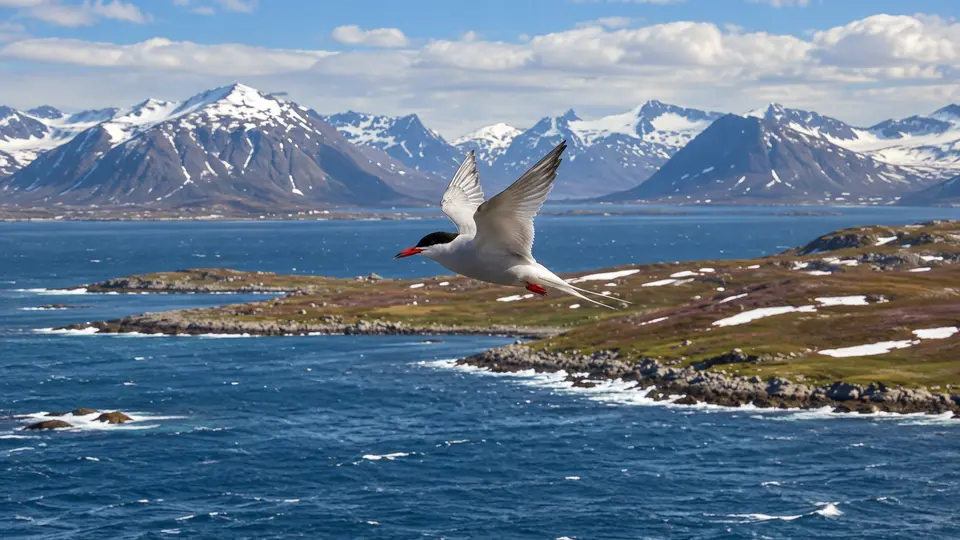
Arctic wildlife habitat

Arctic

Accessible tundra coasts, sheltered bays and adjacent freshwater wetlands provide possible viewing habitat. Much of the range is remote or inaccessible, and breeding birds may require permitted inland walks rather than standard coastal stops.

Destinations describe the species' habitat, not guaranteed cruise stops. Some animals require an optional inland excursion or are found in restricted reserves.

Fun facts about the King Eider

  • The adult male's orange frontal shield enlarges its distinctive head profile.
  • Females line their nests with down plucked from their own bodies.
  • Breeding grounds may lie well inland despite its sea-duck identity.
  • Males usually depart breeding areas before females finish raising young.

Best time to see the King Eider

In northern Norway, late winter and early spring can offer useful coastal observation opportunities before birds disperse toward breeding areas. Across the wider Arctic, June to August is a practical access window. These regional periods differ, and many breeding birds are away from coastal viewpoints. In the Barents Sea region, large wintering flocks can be observed from coastal viewpoints during colder months, prior to their spring migration. Arctic expedition cruises during the summer often provide opportunities to see scattered individuals or pairs on tundra wetlands.

King Eider: season matrix by destination

Travel and observation windows vary by region. Highlighted months are an orientation for planning, not confirmed sightings or a guarantee of access.

Norway

A useful late-winter and early-spring coastal window; flock locations, weather and ice conditions vary annually.

JanFebMarAprMayJunJulAugSepOctNovDec
Cruise ships in Norway

Arctic

These months represent a broad Arctic access window, not confirmed presence throughout the region; local distribution and travel permissions must be checked.

JanFebMarAprMayJunJulAugSepOctNovDec
Cruise ships in Arctic

Where the King Eider lives

Breeding habitat consists of Arctic tundra with freshwater ponds, lakes and marshy ground. Outside breeding, birds favor marine coastal waters, banks and ice-edge environments where food is accessible. Sheltered bays and harbours can provide shore viewpoints, although substantial numbers also remain far offshore. They are highly dependent on sea ice for foraging and resting outside the breeding season. During winter, they can be found in shallow coastal waters near pack ice or in polynyas.

What the King Eider eats

At sea, king eiders eat bottom-dwelling invertebrates such as molluscs, crustaceans, echinoderms and marine worms. During the breeding season, their diet can include freshwater invertebrates and some plant material. Food availability and water depth influence where coastal feeding flocks gather. Winter diet predominantly consists of bivalves, especially mussels and clams, which they retrieve by diving to considerable depths. Juveniles may consume a higher proportion of crustaceans than adults.

Species at a glance

Common name
King Eider
Scientific name
Somateria spectabilis
Animal group
Birds
Size
50-70 cm long
Weight
1.2-2.1 kg
Lifespan
Not reliably established
Status
Least Concern
Identification
The male king eider has an orange frontal shield and blue-grey crown unlike a male common eider, while females have a shorter, rounder head profile and upturned-looking bill gape. Both sexes possess a distinct wedge-shaped bill profile, which is a key identification feature. The male's vibrant head pattern and orange bill shield make it unmistakable, even from a distance.

King Eider: frequently asked questions

Where can I see the King Eider?
Norway, Arctic. Scan sheltered bays with a telescope from a stable shore position. Avoid flushing resting flocks, keep away from icy harbour edges, and never approach tundra nests. Females among common eiders require especially careful identification. From expedition ship decks, scanning ice edges and open leads in pack ice can reveal feeding or resting flocks. Binoculars are essential for distant sightings, and a telescope is ideal for identifying individuals from shore.
When is the best time to see the King Eider?
In northern Norway, late winter and early spring can offer useful coastal observation opportunities before birds disperse toward breeding areas. Across the wider Arctic, June to August is a practical access window. These regional periods differ, and many breeding birds are away from coastal viewpoints. In the Barents Sea region, large wintering flocks can be observed from coastal viewpoints during colder months, prior to their spring migration. Arctic expedition cruises during the summer often provide opportunities to see scattered individuals or pairs on tundra wetlands.
How big does the King Eider get?
50-70 cm long. Adult weight: 1.2-2.1 kg. Size varies with age, sex and population.
How should I behave around the King Eider?
Scan sheltered bays with a telescope from a stable shore position. Avoid flushing resting flocks, keep away from icy harbour edges, and never approach tundra nests. Females among common eiders require especially careful identification. From expedition ship decks, scanning ice edges and open leads in pack ice can reveal feeding or resting flocks. Binoculars are essential for distant sightings, and a telescope is ideal for identifying individuals from shore.
What does the King Eider eat?
At sea, king eiders eat bottom-dwelling invertebrates such as molluscs, crustaceans, echinoderms and marine worms. During the breeding season, their diet can include freshwater invertebrates and some plant material. Food availability and water depth influence where coastal feeding flocks gather. Winter diet predominantly consists of bivalves, especially mussels and clams, which they retrieve by diving to considerable depths. Juveniles may consume a higher proportion of crustaceans than adults.
Are wildlife sightings guaranteed on an adventure cruise?
No. Animals move freely and routes, weather, access restrictions and local conditions influence every outing. Confirm the actual itinerary and shore program before booking.

Compare wildlife in the same destinations

Explore other birds recorded in these destinations. Similar surroundings do not mean the animals share the same habits or viewing season.

Species comparison by animal group and destination
King EiderKing EiderArctic TernArctic TernAtlantic PuffinAtlantic Puffin
Animal groupBirdsAnimal groupBirdsAnimal groupBirds
DestinationsNorway, ArcticDestinationsAlaska, Norway, ArcticDestinationsNew England, Norway, Scotland, Arctic
All wildlife destinations
Plan your trip

Find your next wildlife adventure

Compare destinations, shore programs and dates with the animals and habitats you would love to see.

  • Naturalist-led shore excursions
  • Responsible wildlife watching
  • Small expedition ships

Newsletter

Take Blue Rides with you

Adventure cruise offers, last-minute deals and trip inspiration.

Free, unsubscribe anytime. Details: Privacy Policy

Partner with Blue Rides

Affiliate Program

Recommend adventure cruises and earn commission on every confirmed booking.

Share. Track. Earn.

Your footage, our stage

Send us your videos or pictures.

Captured remarkable nature or wildlife on your journey? Share it with us, we may feature it on Blue Rides.