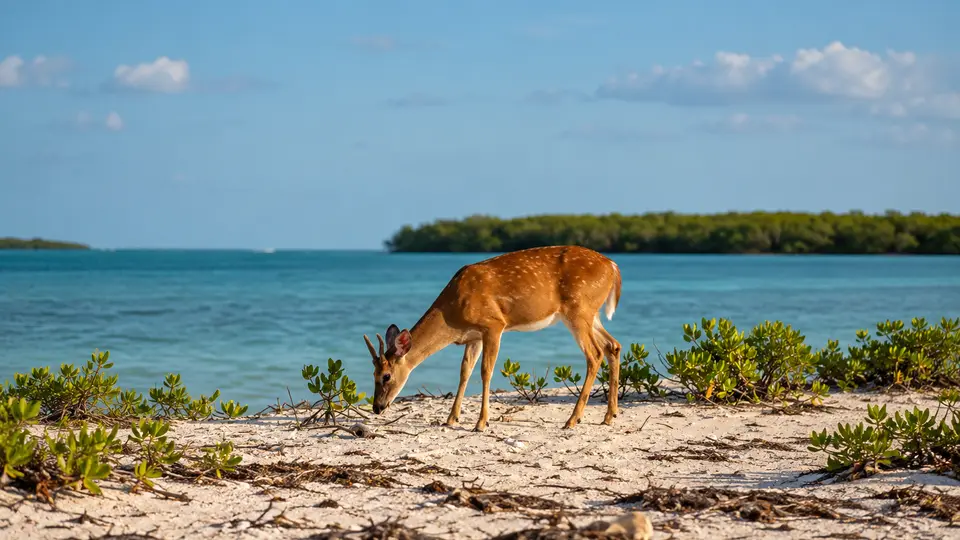
Key Deer in its natural habitat, AI illustration

Key DeerOdocoileus virginianus claviumWhere and when to see them

Key Deer at a glance

The Key deer is a small island subspecies of white-tailed deer restricted to the lower Florida Keys. Its compact size reflects a long history in a limited island environment, but it is not a separate deer species. Freshwater availability, habitat fragmentation and vehicle collisions strongly influence its survival. Protection has prevented its disappearance, yet a confident animal beside a road should not be mistaken for a population free from serious threats.

Behaviour & reproduction

Size
61-81 cm at shoulder
Weight
20-34 kg
Lifespan
Not reliably established
Status
Assessment varies

Key deer browse and move through island vegetation, often becoming most active around dawn and dusk. They can swim between islands, although roads and development constrain many daily movements. Females commonly remain in small social groups, while adult males become more competitive during the rut. Animals accustomed to people may approach closely, but feeding changes natural behaviour and draws them toward traffic, dogs and other hazards around developed areas. Key deer are excellent swimmers and will readily cross channels between islands to forage or escape danger. They exhibit a distinct social structure where related females often form small family groups. Males are largely solitary outside of the rut, though young bucks may form bachelor groups.

Top wildlife locations

Florida wildlife habitat

Florida

Lower Keys coastal hammocks, pine rocklands and wetland margins offer land-based viewing habitat, particularly around Big Pine Key. A dedicated road excursion is usually required; do not stop unsafely or enter private property.
Destinations describe the species' habitat, not guaranteed cruise stops. Some animals require an optional inland excursion or are found in restricted reserves.

Fun facts about the Key Deer

  • It is an island subspecies of white-tailed deer.
  • Individuals can swim between islands.
  • Males grow and shed antlers annually.
  • Freshwater sources are a critical resource despite its coastal distribution.

Best time to see the Key Deer

Key deer are resident and can be observed year-round where access is permitted. November to April generally offers cooler walking weather and fewer biting insects. Daily timing matters more than a migration season, while storms, heat and freshwater conditions can alter local activity. The fawning season typically runs from April to June, when observers might spot young fawns with their mothers. The rut, or breeding season, generally occurs in September and October, leading to increased male activity and competition. During hot periods, deer may become more crepuscular, resting in shaded areas during the day.

Key Deer: season matrix by destination

Travel and observation windows vary by region. Highlighted months are an orientation for planning, not confirmed sightings or a guarantee of access.

Florida

These months offer generally comfortable travel conditions; the deer are resident, and local access or storm impacts may affect opportunities.

JanFebMarAprMayJunJulAugSepOctNovDec
Cruise ships in Florida

Where the Key Deer lives

They use a mosaic of pine rockland, hardwood hammock, mangrove margins and freshwater wetlands. Access to drinking water is especially important in this saline island landscape. Coastal habitat alone is insufficient if freshwater, shelter and safe movement routes are missing or fragmented. They require continuous freshwater access for drinking, often finding it in limestone depressions or artificial sources. Despite their name, Key deer do not inhabit every island in the Florida Keys, but are concentrated in the Big Pine Key and No Name Key region. Their habitat is under constant threat from sea level rise and increased human development.

What the Key Deer eats

Key deer eat leaves, shoots, flowers and fruit from many native plants. Mangroves and other salt-tolerant vegetation contribute to their diet, alongside plants in pinelands and hammocks. They are browsers rather than lawn specialists, and human food can disrupt nutrition and increase dangerous habituation. Their diet includes leaves, twigs, and fruits from over 150 plant species found in the Keys. Preferred food items include red mangrove, white mangrove, black mangrove, thatch palm berries, and various pineland herbs. Human food, including deer corn, is detrimental to their digestive system and contributes to nutrient deficiencies.

Species at a glance

Common name
Key Deer
Scientific name
Odocoileus virginianus clavium
Animal group
Mammals
Size
61-81 cm at shoulder
Weight
20-34 kg
Lifespan
Not reliably established
Status
Assessment varies
Identification
The Key deer resembles other white-tailed deer, including the white underside of its raised tail, but is markedly smaller and naturally restricted to the lower Florida Keys. Adult males (bucks) typically grow antlers between April and September, shedding them in late winter. A distinguishing feature is their average size, with adult males standing about 24-30 inches at the shoulder and weighing 60-80 pounds, while females are slightly smaller. Key deer also have a distinct reddish-brown coat that can appear paler in summer.

Key Deer: frequently asked questions

Where can I see the Key Deer?
Florida. Watch from a safe, legal stopping place or established trail without feeding or touching deer. Drive slowly, particularly near dusk. Give females with fawns and antlered males extra space, and keep dogs securely controlled. Visitors should always maintain a distance of at least 150 feet from Key deer to avoid disturbing them. Observing deer at dawn and dusk often yields the best views as they move to feed and drink. Avoid making loud noises or sudden movements that could startle the deer.
When is the best time to see the Key Deer?
Key deer are resident and can be observed year-round where access is permitted. November to April generally offers cooler walking weather and fewer biting insects. Daily timing matters more than a migration season, while storms, heat and freshwater conditions can alter local activity. The fawning season typically runs from April to June, when observers might spot young fawns with their mothers. The rut, or breeding season, generally occurs in September and October, leading to increased male activity and competition. During hot periods, deer may become more crepuscular, resting in shaded areas during the day.
How big does the Key Deer get?
61-81 cm at shoulder. Adult weight: 20-34 kg. Size varies with age, sex and population.
How should I behave around the Key Deer?
Watch from a safe, legal stopping place or established trail without feeding or touching deer. Drive slowly, particularly near dusk. Give females with fawns and antlered males extra space, and keep dogs securely controlled. Visitors should always maintain a distance of at least 150 feet from Key deer to avoid disturbing them. Observing deer at dawn and dusk often yields the best views as they move to feed and drink. Avoid making loud noises or sudden movements that could startle the deer.
What does the Key Deer eat?
Key deer eat leaves, shoots, flowers and fruit from many native plants. Mangroves and other salt-tolerant vegetation contribute to their diet, alongside plants in pinelands and hammocks. They are browsers rather than lawn specialists, and human food can disrupt nutrition and increase dangerous habituation. Their diet includes leaves, twigs, and fruits from over 150 plant species found in the Keys. Preferred food items include red mangrove, white mangrove, black mangrove, thatch palm berries, and various pineland herbs. Human food, including deer corn, is detrimental to their digestive system and contributes to nutrient deficiencies.
Are wildlife sightings guaranteed on an adventure cruise?
No. Animals move freely and routes, weather, access restrictions and local conditions influence every outing. Confirm the actual itinerary and shore program before booking.

Compare wildlife in the same destinations

Explore other mammals recorded in these destinations. Similar surroundings do not mean the animals share the same habits or viewing season.

Species comparison by animal group and destination
Key DeerKey DeerBobcatBobcatCommon Bottlenose DolphinCommon Bottlenose Dolphin
Animal groupMammalsAnimal groupMammalsAnimal groupMammals
DestinationsFloridaDestinationsFloridaDestinationsCosta Rica, Florida, Galapagos, Mexico, Cape Verde, Croatia, Greece, Portugal, Scotland, Seychelles, Turkey, Maldives, Australia, New Zealand
All wildlife destinations
Plan your trip

Find your next wildlife adventure

Compare destinations, shore programs and dates with the animals and habitats you would love to see.

  • Naturalist-led shore excursions
  • Responsible wildlife watching
  • Small expedition ships

Newsletter

Take Blue Rides with you

Adventure cruise offers, last-minute deals and trip inspiration.

Free, unsubscribe anytime. Details: Privacy Policy

Partner with Blue Rides

Affiliate Program

Recommend adventure cruises and earn commission on every confirmed booking.

Share. Track. Earn.

Your footage, our stage

Send us your videos or pictures.

Captured remarkable nature or wildlife on your journey? Share it with us, we may feature it on Blue Rides.