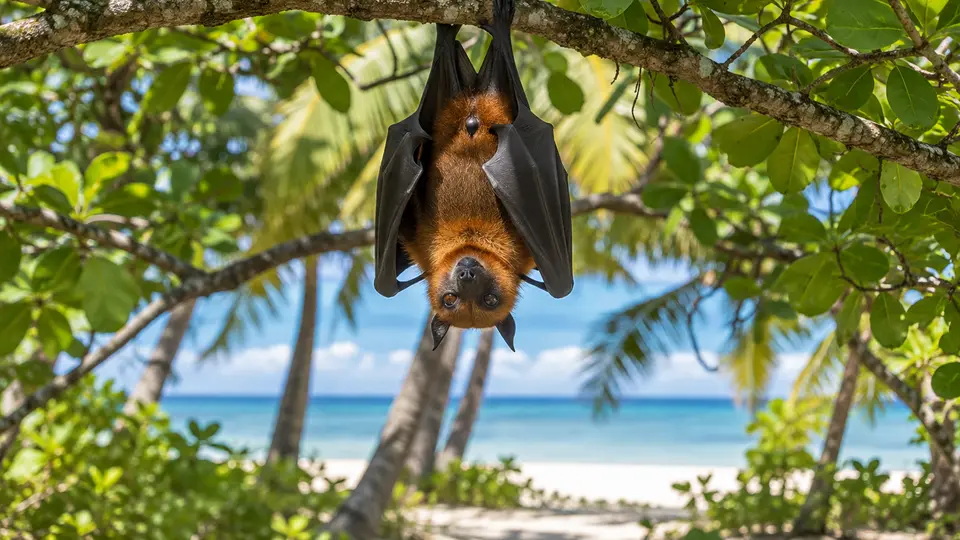
Indian flying fox in its natural habitat, AI illustration

Indian flying fox: where and when to see them

Pteropus medius

Indian flying fox at a glance

The Indian flying fox is a large fruit bat with a doglike face, prominent eyes and broad membranous wings. Its range includes the Indian subcontinent and the Maldives, where island populations depend on trees for both food and daytime shelter. Older references often use Pteropus giganteus. Although conspicuous when flying across an evening sky, these bats are wild mammals whose ecological value is best appreciated without feeding, handling or disturbing them.

Behaviour & reproduction

Size
20–30 cm body length; 1.2–1.5 m wingspan
Weight
0.6–1.6 kg
Lifespan
Not reliably established
Status
Least Concern

Flying foxes spend daylight hours hanging from branches, sometimes in noisy communal roosts. They fan their wings in heat, groom carefully and shift position in response to sun or disturbance. Around dusk they leave to search for fruit and flowers, navigating chiefly with vision and smell rather than the ultrasonic echolocation associated with many smaller bats. Females usually rear one pup, carrying it when it is very young. Roost sites are often selected for their height and proximity to water, offering protection and thermoregulation benefits. These bats exhibit complex social structures within their colonies, including communal care and elaborate vocalizations, especially during disputes or mating.

Top wildlife locations

Maldives wildlife habitat

Maldives

Vegetated island shores, village gardens and mature tree cover offer plausible evening viewpoints. Presence varies between islands, and roost trees may be on private land; an inland expedition is unnecessary.

Adventure cruises in Maldives
Destinations describe the species' habitat, not guaranteed cruise stops. Some animals require an optional inland excursion or are found in restricted reserves.

Fun facts about the Indian flying fox

  • Pteropus giganteus is an older scientific name frequently encountered in references.
  • Its wings are supported by greatly elongated finger bones.
  • It relies primarily on vision and smell to locate food.
  • Fruit feeding can disperse seeds, while visits to flowers can move pollen.

Best time to see the Indian flying fox

Resident bats may be observed throughout the year where roost trees remain occupied. The Maldives' generally drier months make evening walks more convenient, but fruiting patterns and local tree cover influence activity. This travel window should not be treated as a fixed breeding season. While resident, local fruit availability drives seasonal movements between islands, with peak activity often correlating with major fruiting seasons. The dry season offers clear skies and calm waters, facilitating evening boat excursions for observation near feeding sites.

Indian flying fox: season matrix by destination

Travel and observation windows vary by region. Highlighted months are an orientation for planning, not confirmed sightings or a guarantee of access.

Maldives

These generally drier travel months suit outdoor watching; bats are resident, and local fruiting and roost occupancy matter more than season.

JanFebMarAprMayJunJulAugSepOctNovDec
Cruise ships in Maldives

Where the Indian flying fox lives

Tree-rich islands, gardens, woodland remnants and settlements with mature fruiting or roost trees can support this species. Large trees are particularly important daytime refuges. On small islands, vegetation loss or repeated disturbance may remove a substantial share of available habitat. Coastal forests, mangroves, and cultivated areas provide critical foraging grounds, particularly where large fruit trees are abundant. They are highly adaptable to human-modified landscapes as long as suitable roosting and feeding resources are available.

What the Indian flying fox eats

Fruit, nectar and flowers supply most food. Bats chew soft fruit to extract juice and may discard fibrous pulp, while flower visits can transfer pollen. Seeds carried or dropped away from parent trees contribute to plant dispersal across suitable island habitat. Figs, mangoes, and other fleshy fruits are dietary staples, but they also consume leaves and bark from certain plants for additional nutrients. Their efficient seed dispersal capabilities make them vital ecosystem engineers for island reforestation.

Species at a glance

Common name
Indian flying fox
Scientific name
Pteropus medius
Animal group
Mammals
Size
20–30 cm body length; 1.2–1.5 m wingspan
Weight
0.6–1.6 kg
Lifespan
Not reliably established
Status
Least Concern
Identification
Unlike the smaller short-nosed fruit bats, the Indian flying fox has a very large wingspan, a long muzzle and lacks conspicuous pale edging around the ears. Adults typically weigh between 0.6 to 1.6 kilograms (1.3 to 3.5 pounds) and can have a wingspan reaching up to 1.5 meters (5 feet). Their uniformly dark brown to black fur, often with a paler mantle, distinguishes them further from other bat species in the region.

Indian flying fox: frequently asked questions

Where can I see the Indian flying fox?
Maldives. Watch evening flights from paths or the shore, keeping clear of roost trees. Never touch bats, including grounded individuals; ask local wildlife personnel for help and seek prompt medical advice after any bite or scratch. When viewing from a distance, note that large colonies often comprise hundreds to thousands of individuals, creating a significant spectacle at dusk. Binoculars can enhance observations of individual behaviors and interactions without disturbing the animals.
When is the best time to see the Indian flying fox?
Resident bats may be observed throughout the year where roost trees remain occupied. The Maldives' generally drier months make evening walks more convenient, but fruiting patterns and local tree cover influence activity. This travel window should not be treated as a fixed breeding season. While resident, local fruit availability drives seasonal movements between islands, with peak activity often correlating with major fruiting seasons. The dry season offers clear skies and calm waters, facilitating evening boat excursions for observation near feeding sites.
How big does the Indian flying fox get?
20–30 cm body length; 1.2–1.5 m wingspan. Adult weight: 0.6–1.6 kg. Size varies with age, sex and population.
How should I behave around the Indian flying fox?
Watch evening flights from paths or the shore, keeping clear of roost trees. Never touch bats, including grounded individuals; ask local wildlife personnel for help and seek prompt medical advice after any bite or scratch. When viewing from a distance, note that large colonies often comprise hundreds to thousands of individuals, creating a significant spectacle at dusk. Binoculars can enhance observations of individual behaviors and interactions without disturbing the animals.
What does the Indian flying fox eat?
Fruit, nectar and flowers supply most food. Bats chew soft fruit to extract juice and may discard fibrous pulp, while flower visits can transfer pollen. Seeds carried or dropped away from parent trees contribute to plant dispersal across suitable island habitat. Figs, mangoes, and other fleshy fruits are dietary staples, but they also consume leaves and bark from certain plants for additional nutrients. Their efficient seed dispersal capabilities make them vital ecosystem engineers for island reforestation.
Are wildlife sightings guaranteed on an adventure cruise?
No. Animals move freely and routes, weather, access restrictions and local conditions influence every outing. Confirm the actual itinerary and shore program before booking.

Compare wildlife in the same destinations

Explore other mammals recorded in these destinations. Similar surroundings do not mean the animals share the same habits or viewing season.

Species comparison by animal group and destination
Indian flying foxIndian flying foxBlue WhaleBlue WhaleCommon Bottlenose DolphinCommon Bottlenose Dolphin
Animal groupMammalsAnimal groupMammalsAnimal groupMammals
DestinationsMaldivesDestinationsMexico, Norway, Portugal, Antarctica, Arctic, Maldives, New ZealandDestinationsCosta Rica, Florida, Galapagos, Mexico, Cape Verde, Croatia, Greece, Portugal, Scotland, Seychelles, Turkey, Maldives, Australia, New Zealand
All wildlife destinations
Plan your trip

Find your next wildlife adventure

Compare destinations, shore programs and dates with the animals and habitats you would love to see.

  • Naturalist-led shore excursions
  • Responsible wildlife watching
  • Small expedition ships

Newsletter

Take Blue Rides with you

Adventure cruise offers, last-minute deals and trip inspiration.

Free, unsubscribe anytime. Details: Privacy Policy

Partner with Blue Rides

Affiliate Program

Recommend adventure cruises and earn commission on every confirmed booking.

Share. Track. Earn.

Your footage, our stage

Send us your videos or pictures.

Captured beautiful landscapes or wildlife? Share your videos and pictures with us, we may feature them on Blue Rides.