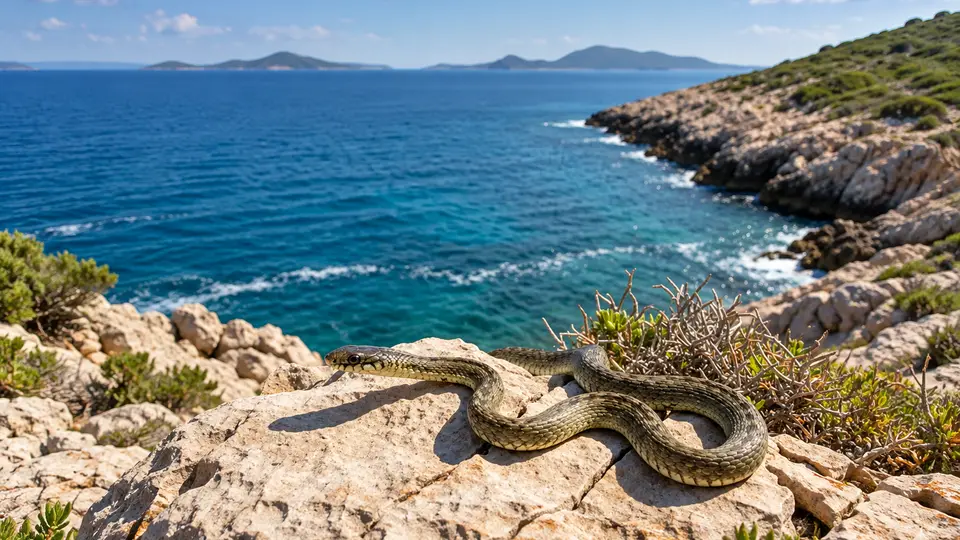
Balkan Whip Snake in its natural habitat, AI illustration
Size80-110 cm longLifespanNot reliably establishedStatusLeast Concern

Balkan Whip Snake: where and when to see them

Hierophis gemonensis

Balkan Whip Snake at a glance

The Balkan whip snake is a slender, fast-moving, nonvenomous snake native to parts of southeastern Europe. In Croatia it is associated particularly with warm Adriatic landscapes, where stony ground and tangled vegetation provide hunting cover and shelter. Its understated grey-brown colouring can make it difficult to notice until it moves. Despite the dramatic name, it poses little danger when left alone and contributes to local food webs as both predator and prey.

Behaviour & reproduction

Size
80-110 cm long
Weight
Not reliably established
Lifespan
Not reliably established
Status
Least Concern

This primarily daytime hunter moves actively through low vegetation, rocky margins and open ground in search of prey. It can climb shrubs and walls, but often escapes rapidly into crevices or dense cover when approached. Seasonal inactivity occurs during cold weather. If cornered or grabbed, it may strike and bite defensively, which is a reason to give it an escape route rather than attempt a closer inspection. This snake is known for its speed and agility, moving swiftly through its environment when foraging or escaping. It can demonstrate remarkable ability to blend into its surroundings, despite its active nature.

Top wildlife locations

Croatia wildlife habitat

Croatia

Adriatic coastal scrub, rocky paths and old field walls provide plausible habitat, sometimes near towns. Encounters are incidental; quieter suitable terrain may require a short inland excursion rather than beach observation.

Adventure cruises in Croatia
Destinations describe the species' habitat, not guaranteed cruise stops. Some animals require an optional inland excursion or are found in restricted reserves.

Fun facts about the Balkan Whip Snake

  • It is an egg-laying snake.
  • Its long tail contributes to its whip-like appearance.
  • It can climb low shrubs as well as move across the ground.
  • Dry-stone walls can provide both shelter and hunting habitat.

Best time to see the Balkan Whip Snake

Late spring and early summer usually offer suitable temperatures for daytime activity, with another useful period in early autumn. Extreme summer heat can shift activity toward cooler hours. Cold-season encounters are less likely because snakes spend extended periods sheltered and inactive. During peak summer heat, observation becomes more challenging as individuals often retreat to shaded refugia or become crepuscular. Early morning warmth after a cool night can prompt basking behavior, making observation possible.

Balkan Whip Snake: season matrix by destination

Travel and observation windows vary by region. Highlighted months are an orientation for planning, not confirmed sightings or a guarantee of access.

Croatia

These months commonly provide moderate activity temperatures, but weather and elevation matter and no particular route can promise snakes.

JanFebMarAprMayJunJulAugSepOctNovDec
Cruise ships in Croatia

Where the Balkan Whip Snake lives

Typical habitats include dry scrub, rocky slopes, open woodland, field margins and traditional stone walls. Coastal karst landscapes offer abundant sheltering crevices. Suitable habitat can occur near villages, although heavily trafficked roads and intensive development fragment its living space. The species is well-adapted to the Mediterranean climate, often found at lower to mid-altitudes, typically below 1,500 meters. Its presence is often indicative of healthy, undisturbed semi-natural environments.

What the Balkan Whip Snake eats

It feeds chiefly on small vertebrates, especially lizards, with small mammals and other prey taken opportunistically. Young snakes may consume proportionally smaller prey. Active searching and quick pursuit suit the patchwork of warm rocks, vegetation and hiding places it inhabits. Prey items are typically swallowed headfirst, often after being constricted or simply overpowered. This agile predator utilizes its keen eyesight to locate movement among the rocks and vegetation.

Species at a glance

Common name
Balkan Whip Snake
Scientific name
Hierophis gemonensis
Animal group
Reptiles
Size
80-110 cm long
Weight
Not reliably established
Lifespan
Not reliably established
Status
Least Concern
Identification
Its pale, dark-flecked front body grading into a relatively plain grey-brown rear helps separate it from the boldly patterned or uniformly black western whip snake. The head scales are relatively large and often exhibit a pale cream or yellow-orange coloration, contrasting with the darker body. Juveniles typically display a more pronounced and distinct pattern of dark spots along the body.

Balkan Whip Snake: frequently asked questions

Where can I see the Balkan Whip Snake?
Croatia. Watch from a path and allow the snake to leave freely. Never handle or corner it, and avoid placing hands in stone-wall crevices. Wear closed footwear when walking through rocky scrub. Maintain a respectful distance to avoid disturbing its natural behavior, which can include basking or active hunting. Binoculars can enhance viewing without causing stress to the animal or compromising safety.
When is the best time to see the Balkan Whip Snake?
Late spring and early summer usually offer suitable temperatures for daytime activity, with another useful period in early autumn. Extreme summer heat can shift activity toward cooler hours. Cold-season encounters are less likely because snakes spend extended periods sheltered and inactive. During peak summer heat, observation becomes more challenging as individuals often retreat to shaded refugia or become crepuscular. Early morning warmth after a cool night can prompt basking behavior, making observation possible.
How big does the Balkan Whip Snake get?
80-110 cm long. Adult weight: Not reliably established. Size varies with age, sex and population.
How should I behave around the Balkan Whip Snake?
Watch from a path and allow the snake to leave freely. Never handle or corner it, and avoid placing hands in stone-wall crevices. Wear closed footwear when walking through rocky scrub. Maintain a respectful distance to avoid disturbing its natural behavior, which can include basking or active hunting. Binoculars can enhance viewing without causing stress to the animal or compromising safety.
What does the Balkan Whip Snake eat?
It feeds chiefly on small vertebrates, especially lizards, with small mammals and other prey taken opportunistically. Young snakes may consume proportionally smaller prey. Active searching and quick pursuit suit the patchwork of warm rocks, vegetation and hiding places it inhabits. Prey items are typically swallowed headfirst, often after being constricted or simply overpowered. This agile predator utilizes its keen eyesight to locate movement among the rocks and vegetation.
Are wildlife sightings guaranteed on an adventure cruise?
No. Animals move freely and routes, weather, access restrictions and local conditions influence every outing. Confirm the actual itinerary and shore programme before booking.

Compare wildlife in the same destinations

Explore other reptiles recorded in these destinations. Similar surroundings do not mean the animals share the same habits or viewing season.

Species comparison by animal group and destination
Balkan Whip SnakeBalkan Whip SnakeDalmatian Wall LizardDalmatian Wall LizardEuropean Glass LizardEuropean Glass Lizard
Animal groupReptilesAnimal groupReptilesAnimal groupReptiles
DestinationsCroatiaDestinationsCroatiaDestinationsCroatia
All wildlife destinations
Plan your trip

Find your next wildlife adventure

Compare destinations, shore programmes and dates with the animals and habitats you would love to see.

  • Naturalist-led shore excursions
  • Responsible wildlife watching
  • Small expedition ships

Newsletter

Take Blue Rides with you

Adventure cruise offers, last-minute deals and trip inspiration.

Free, unsubscribe anytime. Details: Privacy Policy

Partner with Blue Rides

Affiliate Program

Recommend adventure cruises and earn commission on every confirmed booking.

Share. Track. Earn.