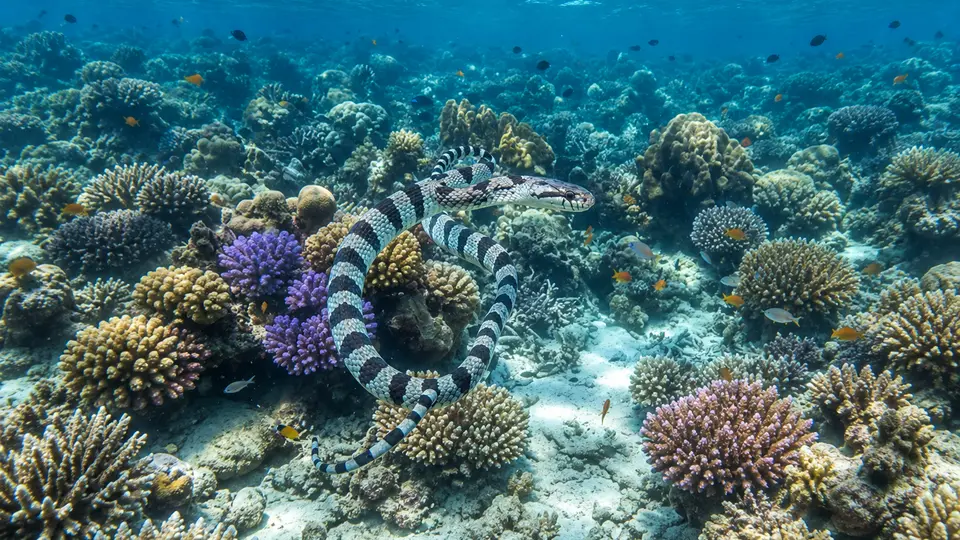
Banded sea krait in its natural habitatAI-modified

Banded sea kraitLaticauda colubrinaWhere and when to see them

Banded sea krait at a glance

The banded sea krait, also called the yellow-lipped sea krait, is an amphibious marine snake of the tropical Indo-Pacific. It obtains food at sea but returns to land to rest, digest, shed its skin and reproduce. Bold dark bands, a flattened tail and yellow around the snout are characteristic. It is highly venomous, so any shore observation must remain distant and must never involve handling or blocking its movement.

Behaviour & reproduction

Size
0.8–1.5 m (2.6–4.9 ft) total length
Weight
Up to 2 kg (4.4 lb)
Lifespan
Not reliably established
Status
Least Concern

Sea kraits regularly move between marine feeding areas and terrestrial shelters, sometimes returning to familiar coastal refuges. On land they can climb uneven rocks and enter narrow crevices despite their paddle-shaped tails. Several individuals may share a sheltered resting place. Females lay eggs on land rather than giving birth at sea. Activity often increases around dusk or at night, although resting or travelling animals can sometimes be visible by day. Banded sea kraits are primarily nocturnal or crepuscular, spending daylight hours resting in their terrestrial refuges. They are exceptional swimmers, using their flattened tail to propel themselves efficiently through water. Despite being highly venomous, they are generally docile and will only bite if provoked or cornered.

Top wildlife locations

Indonesia wildlife habitatAI-modified

Indonesia

Rocky island shores and sheltered coastal crevices may provide distant land-based views. Occupied refuges can be inaccessible or protected, and ordinary beach stops should not be presented as reliable encounter sites.

Vietnam wildlife habitatAI-modified

Vietnam

Suitable offshore island shores and rocky coastal refuges may offer occasional land-based observations within its range. Encounters are uncommon for general visitors, and some potential habitat is inaccessible or subject to restrictions.

Destinations describe the species' habitat, not guaranteed cruise stops. Some animals require an optional inland excursion or are found in restricted reserves.

Fun facts about the Banded sea krait

  • It lays eggs on land despite obtaining its food at sea.
  • Females generally grow larger than males.
  • Its broad belly scales help it move over land.
  • Individuals can return repeatedly to familiar terrestrial shelters.

Best time to see the Banded sea krait

There is no dependable region-wide season for shore encounters. Local rainfall, sea conditions, shelter availability and access rules matter more than a national tourism calendar. Choose safe coastal walking conditions, but do not interpret a favorable travel month as evidence of snake presence. Peak krait activity can sometimes coincide with the breeding seasons of its primary prey, leading to increased sightings. Understanding local tidal patterns can be more useful for predicting sightings than generalized seasonal advice. Warmer sea temperatures generally correlate with increased metabolic activity and foraging, which might indirectly influence terrestrial movements.

Banded sea krait: season matrix by destination

Travel and observation windows vary by region. Highlighted months are an orientation for planning, not confirmed sightings or a guarantee of access.

Indonesia

Indonesia spans different monsoon regimes; no specified island or validated shore-observation season supports a single month window.

JanFebMarAprMayJunJulAugSepOctNovDec
Cruise ships in Indonesia

Vietnam

Local occurrence, access and monsoon exposure vary; a nationwide travel season would not establish a credible shore encounter window.

JanFebMarAprMayJunJulAugSepOctNovDec
Cruise ships in Vietnam

Where the Banded sea krait lives

Tropical island shores, rocky coastal margins and sheltered crevices near productive shallow seas provide essential land habitat. Suitable egg-laying refuges must remain protected from inundation. A coastline within the broad range does not automatically offer accessible or regularly occupied resting sites. Coastal proximity to fringing reefs and seagrass beds often indicates rich foraging grounds. Its preference for specific microhabitats on land, such as elevated, dry rock ledges, further influences its distribution. While widely distributed across the Indo-Pacific, specific populations show genetic isolation.

What the Banded sea krait eats

Eels are its principal prey, captured during marine foraging trips and swallowed whole. Females and males can take different prey sizes because females grow larger. Shore observers are more likely to see a resting or travelling snake than feeding behavior. Moray eels and conger eels are particularly favored prey items. Although primarily an eel specialist, occasional smaller fish or crustaceans may supplement its diet. The snake's venom is potent, specifically adapted to quickly immobilize its agile prey.

Species at a glance

Common name
Banded sea krait
Scientific name
Laticauda colubrina
Animal group
Reptiles
Size
0.8–1.5 m (2.6–4.9 ft) total length
Weight
Up to 2 kg (4.4 lb)
Lifespan
Not reliably established
Status
Least Concern
Identification
Yellow lips and snout distinguish this species from the blue-lipped sea krait, while its flattened paddle tail separates it from similarly banded terrestrial snakes. The distinct black bands against a pale yellow or cream body are consistently uniform from head to tail. The tail is laterally compressed, resembling a paddle or oar, an adaptation for swimming. Unlike venomous terrestrial snakes, its small, fixed fangs are located towards the front of the upper jaw.

Banded sea krait: frequently asked questions

Where can I see the Banded sea krait?
Indonesia, Vietnam. Remain several metres away and let the snake cross freely. Never touch it, enter occupied crevices or step between it and shelter; wear closed footwear on rocky shores and seek urgent medical care after any bite. Keep a respectful distance and avoid blocking its path to the sea or its land refuge. If spotted on deck, alert the crew and do not attempt to handle or move the snake yourself. Nighttime observation from a distance, with a flashlight, can reveal active individuals moving between land and sea.
When is the best time to see the Banded sea krait?
There is no dependable region-wide season for shore encounters. Local rainfall, sea conditions, shelter availability and access rules matter more than a national tourism calendar. Choose safe coastal walking conditions, but do not interpret a favorable travel month as evidence of snake presence. Peak krait activity can sometimes coincide with the breeding seasons of its primary prey, leading to increased sightings. Understanding local tidal patterns can be more useful for predicting sightings than generalized seasonal advice. Warmer sea temperatures generally correlate with increased metabolic activity and foraging, which might indirectly influence terrestrial movements.
How big does the Banded sea krait get?
0.8–1.5 m (2.6–4.9 ft) total length. Adult weight: Up to 2 kg (4.4 lb). Size varies with age, sex and population.
How should I behave around the Banded sea krait?
Remain several metres away and let the snake cross freely. Never touch it, enter occupied crevices or step between it and shelter; wear closed footwear on rocky shores and seek urgent medical care after any bite. Keep a respectful distance and avoid blocking its path to the sea or its land refuge. If spotted on deck, alert the crew and do not attempt to handle or move the snake yourself. Nighttime observation from a distance, with a flashlight, can reveal active individuals moving between land and sea.
What does the Banded sea krait eat?
Eels are its principal prey, captured during marine foraging trips and swallowed whole. Females and males can take different prey sizes because females grow larger. Shore observers are more likely to see a resting or travelling snake than feeding behavior. Moray eels and conger eels are particularly favored prey items. Although primarily an eel specialist, occasional smaller fish or crustaceans may supplement its diet. The snake's venom is potent, specifically adapted to quickly immobilize its agile prey.
Are wildlife sightings guaranteed on an adventure cruise?
No. Animals move freely and routes, weather, access restrictions and local conditions influence every outing. Confirm the actual itinerary and shore program before booking.

Compare wildlife in the same destinations

Explore other reptiles recorded in these destinations. Similar surroundings do not mean the animals share the same habits or viewing season.

Species comparison by animal group and destination
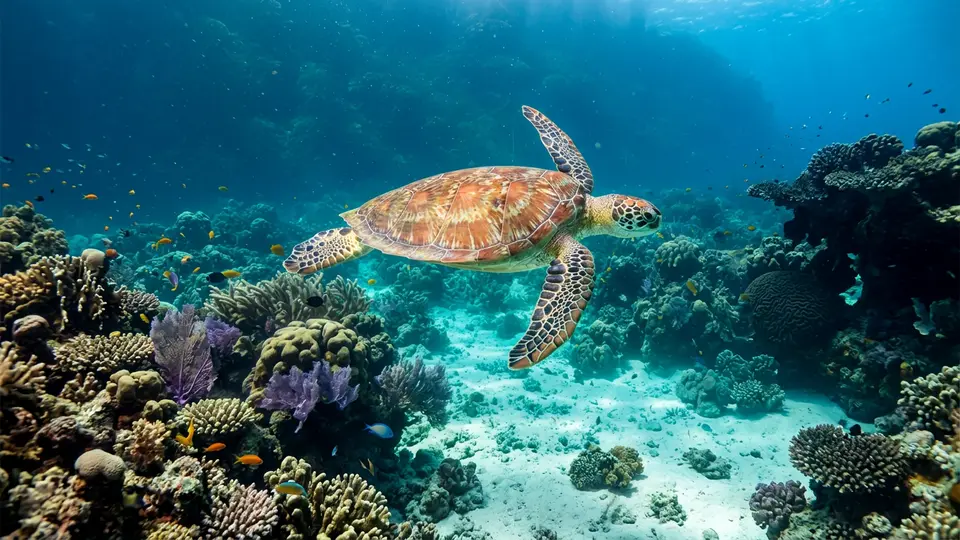
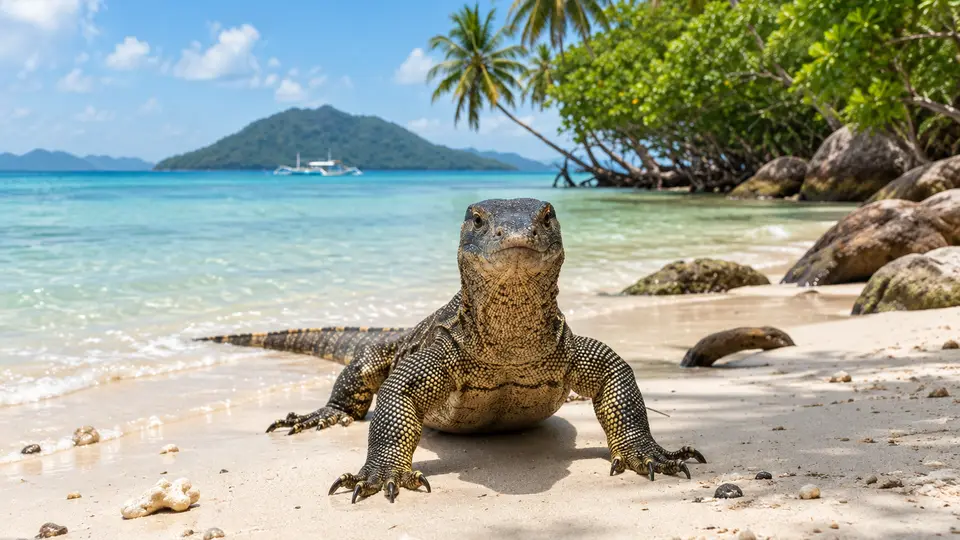
Banded sea kraitAI-modifiedBanded sea kraitAsian water monitorAI-modifiedAsian water monitorGreen Sea TurtleAI-modifiedGreen Sea Turtle
Animal groupReptilesAnimal groupReptilesAnimal groupReptiles
DestinationsIndonesia, VietnamDestinationsIndonesiaDestinationsCosta Rica, Florida, Galapagos, Mexico, Cape Verde, Egypt, Greece, Seychelles, Turkey, Indonesia, Maldives, Thailand, Vietnam, Australia, Fiji, Polynesia
Scientific nameLaticauda colubrinaScientific nameScientific name
All wildlife destinations
AI-modified
Plan your trip

Find your next wildlife adventure

Compare destinations, shore programs and dates with the animals and habitats you would love to see.

  • Naturalist-led shore excursions
  • Responsible wildlife watching
  • Small expedition ships