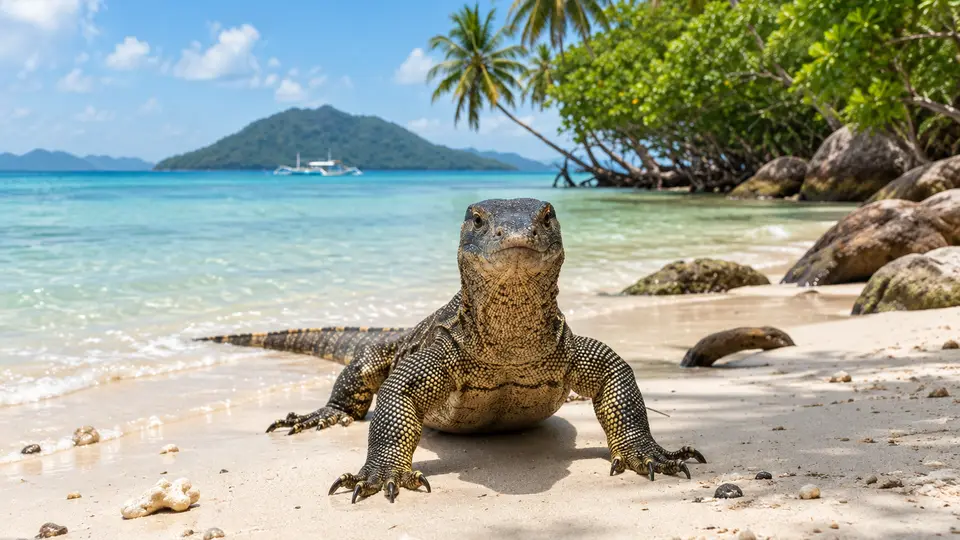
Asian water monitor in its natural habitatAI-modified

Asian water monitorVaranus salvatorWhere and when to see them

Asian water monitor at a glance

The Asian water monitor is a powerful, adaptable lizard found across much of South and Southeast Asia. Its muscular tail, strong claws and forked tongue equip it for a life around wetlands and productive human landscapes. Dark scales are often marked with yellow spots or bands, especially in younger animals. Indonesian populations belong to a geographically complex group, so not every large monitor encountered on an Indonesian island is this species.

Behaviour & reproduction

Size
1.5–2 m (4.9–6.6 ft) total length
Weight
5–20 kg (11–44 lb)
Lifespan
15.7 years (captivity)
Status
Least Concern

Water monitors usually forage alone, investigating banks, debris and vegetation with repeated tongue flicks. They bask to raise body temperature and retreat to shade, burrows or water when conditions become unsuitable. Although capable climbers, large adults spend much of their time on the ground or near water. Males may wrestle during competition. A cornered monitor can lash its tail, scratch or bite, but an animal with an escape route generally avoids close human contact. Water monitors are excellent swimmers and can remain submerged for extended periods, using their powerful, rudder-like tails for propulsion. They are also known to occasionally enter brackish and saltwater environments, though freshwater systems are preferred for foraging.

Top wildlife locations

Indonesia wildlife habitatAI-modified

Indonesia

Accessible mangrove boardwalks, coastal lagoon margins and lowland river paths offer plausible viewing habitat within its island range. Confirm local identification, since many Indonesian islands support different monitors; some suitable wetlands require an inland excursion.
Destinations describe the species' habitat, not guaranteed cruise stops. Some animals require an optional inland excursion or are found in restricted reserves.

Fun facts about the Asian water monitor

  • Its forked tongue delivers chemical information to a sensory organ in the roof of the mouth.
  • The flattened tail provides propulsion when swimming.
  • Young animals generally show clearer yellow patterning than large adults.
  • Competing males can rear upright and grapple with their forelimbs.

Best time to see the Asian water monitor

Monitors may be active throughout the year in suitable Indonesian lowlands. Morning warmth often encourages basking before the hottest hours. Travel conditions vary substantially between islands; a locally drier period may improve access to wetland paths without representing a special biological season. During the rainy season, increased water levels can make foraging more efficient and expand their usable habitat. Breeding typically coincides with warmer months, though specific timing can vary regionally across Indonesia.

Asian water monitor: season matrix by destination

Travel and observation windows vary by region. Highlighted months are an orientation for planning, not confirmed sightings or a guarantee of access.

Indonesia

Indonesia spans several rainfall regimes and monitor distributions; no single countrywide shore-observation window is sufficiently reliable.

JanFebMarAprMayJunJulAugSepOctNovDec
Cruise ships in Indonesia

Where the Asian water monitor lives

Typical habitat includes mangroves, riversides, marshes, coastal lagoons and lowland forest near water. Some populations also use drainage canals, farms and urban wetlands. Distribution within Indonesia is island-specific, and other monitor species replace or overlap with it in parts of the archipelago. The Asian water monitor often colonizes new habitats readily, including disturbed areas, demonstrating a high degree of adaptability. While widespread, their presence is linked to the availability of permanent water sources, even in urban environments.

What the Asian water monitor eats

An opportunistic carnivore and scavenger, it eats fish, crabs, molluscs, frogs, reptiles, birds, eggs and carrion. Prey availability shapes local diets. Food waste may attract monitors near settlements, but deliberate feeding can create dangerous associations between people and food. Juvenile water monitors consume a higher proportion of insects and smaller invertebrates, gradually shifting to larger prey as they grow. Their acute sense of smell is crucial for locating both live prey and distant carrion, especially in dense vegetation.

Species at a glance

Common name
Asian water monitor
Scientific name
Varanus salvator
Animal group
Reptiles
Size
1.5–2 m (4.9–6.6 ft) total length
Weight
5–20 kg (11–44 lb)
Lifespan
15.7 years (captivity)
Status
Least Concern
Identification
Its long, laterally compressed tail and dark, often yellow-spotted body distinguish it from the bulkier, more uniformly coloured Komodo dragon, although Indonesian monitor identification also requires location. Adults can reach impressive sizes, often exceeding 2 meters (6.5 feet) in total length, making them one of the largest lizard species. Their body scales are typically keeled, and the nostrils are positioned towards the tip of the snout, which aids in distinguishing them from some other monitor species.

Asian water monitor: frequently asked questions

Where can I see the Asian water monitor?
Indonesia. Watch from an established bank-side path and leave a clear route to water or cover. Never feed, corner or touch a monitor. Keep children back, especially where animals have become accustomed to discarded food. When viewing from a boat, maintain a respectful distance to avoid startling animals, which may cause them to flee into the water. Look for them basking on fallen logs or low branches overhanging rivers and estuaries during sunny periods.
When is the best time to see the Asian water monitor?
Monitors may be active throughout the year in suitable Indonesian lowlands. Morning warmth often encourages basking before the hottest hours. Travel conditions vary substantially between islands; a locally drier period may improve access to wetland paths without representing a special biological season. During the rainy season, increased water levels can make foraging more efficient and expand their usable habitat. Breeding typically coincides with warmer months, though specific timing can vary regionally across Indonesia.
How big does the Asian water monitor get?
1.5–2 m (4.9–6.6 ft) total length. Adult weight: 5–20 kg (11–44 lb). Size varies with age, sex and population.
How should I behave around the Asian water monitor?
Watch from an established bank-side path and leave a clear route to water or cover. Never feed, corner or touch a monitor. Keep children back, especially where animals have become accustomed to discarded food. When viewing from a boat, maintain a respectful distance to avoid startling animals, which may cause them to flee into the water. Look for them basking on fallen logs or low branches overhanging rivers and estuaries during sunny periods.
What does the Asian water monitor eat?
An opportunistic carnivore and scavenger, it eats fish, crabs, molluscs, frogs, reptiles, birds, eggs and carrion. Prey availability shapes local diets. Food waste may attract monitors near settlements, but deliberate feeding can create dangerous associations between people and food. Juvenile water monitors consume a higher proportion of insects and smaller invertebrates, gradually shifting to larger prey as they grow. Their acute sense of smell is crucial for locating both live prey and distant carrion, especially in dense vegetation.
Are wildlife sightings guaranteed on an adventure cruise?
No. Animals move freely and routes, weather, access restrictions and local conditions influence every outing. Confirm the actual itinerary and shore program before booking.

Compare wildlife in the same destinations

Explore other reptiles recorded in these destinations. Similar surroundings do not mean the animals share the same habits or viewing season.

Species comparison by animal group and destination
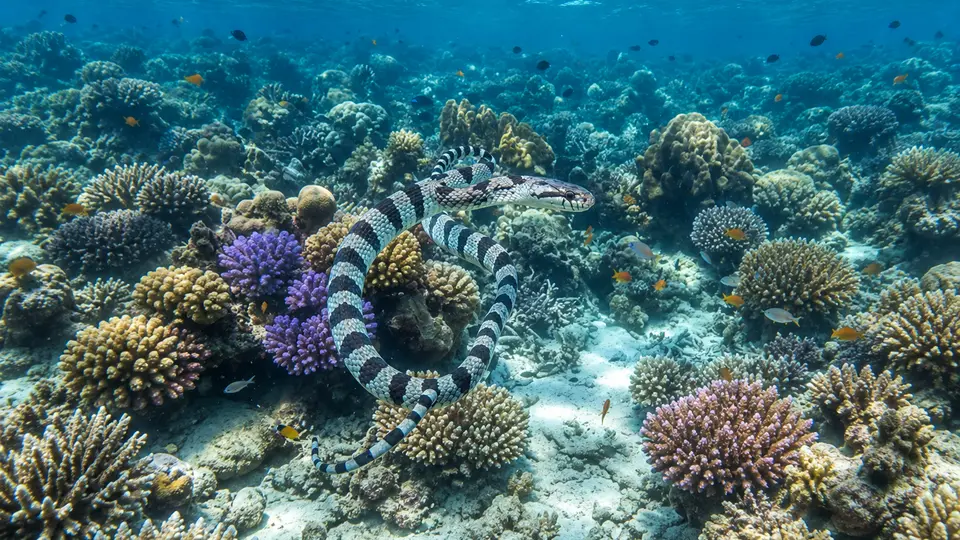
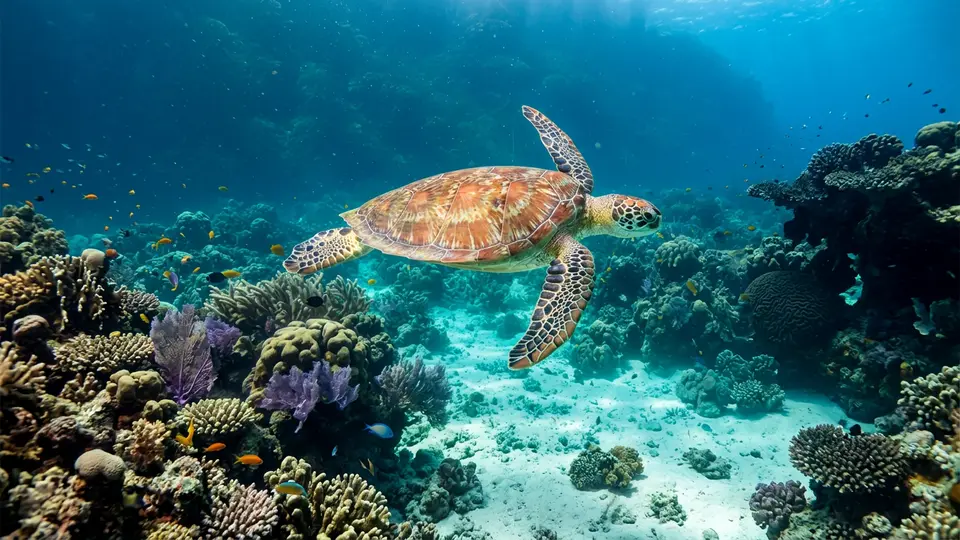
Asian water monitorAI-modifiedAsian water monitorBanded sea kraitAI-modifiedBanded sea kraitGreen Sea TurtleAI-modifiedGreen Sea Turtle
Animal groupReptilesAnimal groupReptilesAnimal groupReptiles
DestinationsIndonesiaDestinationsIndonesia, VietnamDestinationsCosta Rica, Florida, Galapagos, Mexico, Cape Verde, Egypt, Greece, Seychelles, Turkey, Indonesia, Maldives, Thailand, Vietnam, Australia, Fiji, Polynesia
Scientific nameVaranus salvatorScientific nameScientific name
All wildlife destinations
AI-modified
Plan your trip

Find your next wildlife adventure

Compare destinations, shore programs and dates with the animals and habitats you would love to see.

  • Naturalist-led shore excursions
  • Responsible wildlife watching
  • Small expedition ships