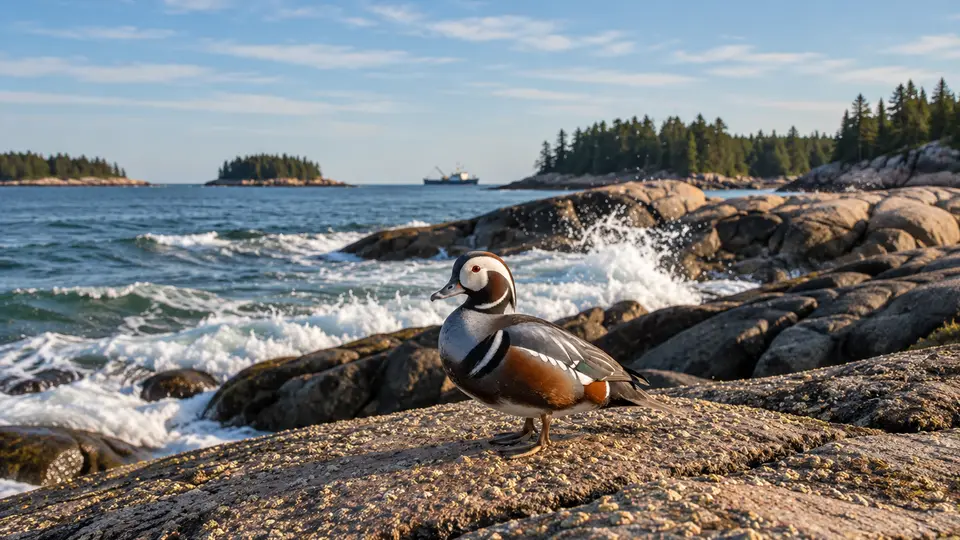
Harlequin Duck in its natural habitat, AI illustration
Size38–46 cm body lengthLifespanNot reliably establishedStatusLeast Concern

Harlequin Duck: where and when to see them

Histrionicus histrionicus

Harlequin Duck at a glance

The harlequin duck is a compact sea duck famous for the male's intricate slate-blue, chestnut and white plumage. Females are brown with distinctive white facial markings. Unusually, it links two energetic environments: fast-flowing freshwater breeding streams and wave-battered winter coasts. Alaska holds part of its Pacific range, while New England receives birds from the much smaller eastern North American population, whose regional conservation history differs from the global picture.

Behaviour & reproduction

Size
38–46 cm body length
Weight
0.5–0.8 kg
Lifespan
Not reliably established
Status
Least Concern

Harlequins manoeuvre confidently among breaking waves and turbulent river currents, feeding in places many ducks avoid. Pairs often form on coastal wintering grounds, and established partners may reunite in later seasons. Females incubate and rear broods beside breeding streams, while males depart earlier for coastal moulting areas. Outside breeding, small groups rest on low rocks between feeding bouts, frequently returning to familiar stretches of shoreline year after year. Their dives are short, typically lasting only a few seconds, as they forage for invertebrates in turbulent waters. Males perform elaborate courtship displays, including head bobbing and rapid swimming maneuvers, to attract mates on the wintering grounds. While generally social in winter, breeding pairs become territorial, defending their chosen stretch of river from other harlequins.

Top wildlife locations

Alaska wildlife habitat

Alaska

Rocky coastal points and surf-washed shores offer plausible deck or land-based viewing. Breeding habitat lies along fast rivers and may require an inland excursion; exposed coastal sites can be weather-inaccessible.

Adventure cruises in Alaska
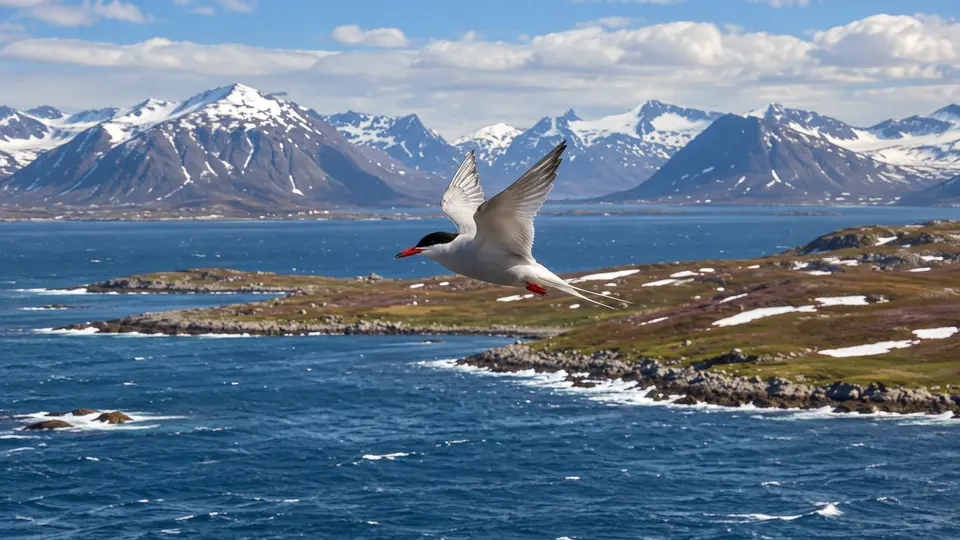
New England wildlife habitat

New England

Exposed rocky headlands and offshore ledges support wintering birds that can be scanned from public coastal paths. Distribution is localized, and storm conditions can make otherwise accessible viewpoints unsafe.

Adventure cruises in New England

Destinations describe the species' habitat, not guaranteed cruise stops. Some animals require an optional inland excursion or are found in restricted reserves.

Fun facts about the Harlequin Duck

  • The scientific name refers to an actor or theatrical performer.
  • Pairs can reunite across multiple breeding seasons.
  • Ducklings grow up beside fast-flowing freshwater streams.
  • Adults often show strong fidelity to particular winter shorelines.

Best time to see the Harlequin Duck

New England viewing is strongest in the colder months, when birds occupy rocky coastal wintering grounds. Alaska offers coastal opportunities during several seasons, with late summer onward bringing returning birds and moulting groups. Inland breeding-stream observation requires a separate, carefully managed excursion. In Alaska, prime viewing for migrating and wintering birds extends into early spring, with large aggregations appearing before dispersal. Summer in Alaska offers opportunities to observe adult males on coastal moulting grounds while females are on breeding rivers. Consider visiting northern Japan or the Russian Far East during winter for additional harlequin duck viewing experiences within their pacific range.

Harlequin Duck: season matrix by destination

Travel and observation windows vary by region. Highlighted months are an orientation for planning, not confirmed sightings or a guarantee of access.

Alaska

A practical Alaska travel window, not the full coastal occurrence season; local numbers change as birds move between rivers and the sea.

JanFebMarAprMayJunJulAugSepOctNovDec
Cruise ships in Alaska

New England

This broadly matches coastal winter occupancy, with arrival and departure dates varying by site and year.

JanFebMarAprMayJunJulAugSepOctNovDec
Cruise ships in New England

Where the Harlequin Duck lives

Breeding habitat consists of clear, fast rivers and streams with rocky beds, often in forested or mountainous country. Outside breeding, exposed rocky coasts, reefs and wave-washed headlands are characteristic. Sheltered muddy estuaries are generally less suitable than surf-rich shorelines. They are highly dependent on these specific pristine habitats, making them sensitive to habitat degradation. Nesting sites are often concealed in dense vegetation near the water's edge or in rock crevices, providing protection for the clutch. Harlequins are strongly philopatric, often returning to the same breeding and wintering sites annually.

What the Harlequin Duck eats

On breeding streams, harlequins eat aquatic insect larvae and other freshwater invertebrates. Along marine shores they take small crustaceans, molluscs and other bottom-associated prey. Their food changes with the move between river and coast, rather than remaining identical throughout the year. In their marine environment, they also consume barnacles, small crabs, and isopods, using their agile bills to dislodge prey from rocky substrates. Specialized feeding behaviors include diving and dabbling in swift currents, using their strong feet for propulsion and stability. During the breeding season, chicks are fed primarily on aquatic insect larvae, requiring a high protein diet for rapid growth.

Species at a glance

Common name
Harlequin Duck
Scientific name
Histrionicus histrionicus
Animal group
Birds
Size
38–46 cm body length
Weight
0.5–0.8 kg
Lifespan
Not reliably established
Status
Least Concern
Identification
Males have unique bold white stripes on blue-grey and chestnut plumage, while females differ from female scoters by their small size and distinct round white ear spot. Juveniles resemble females but typically have duller plumage and less distinct white markings, gradually acquiring adult coloration over their first year. The female's white ear spot is typically quite prominent, contrasting with her darker brown head. In flight, their relatively short, pointed wings and rapid wingbeats are distinctive, though they are often seen on the water.

Harlequin Duck: frequently asked questions

Where can I see the Harlequin Duck?
Alaska, New England. Use a telescope from a secure rocky-coast viewpoint, staying above wave reach. Do not approach resting flocks or force them off rocks. Along breeding streams, remain on established paths and give females with broods ample space. When viewing from shore, look for them navigating turbulent waters near wave-splashed rocks, where they are often seen bobbing with the surf. On cruises, keep an eye out for small groups resting on kelp beds or low-lying islets during low tide. Binoculars are essential to distinguish key identification features and observe their unique feeding behaviors from a safe distance.
When is the best time to see the Harlequin Duck?
New England viewing is strongest in the colder months, when birds occupy rocky coastal wintering grounds. Alaska offers coastal opportunities during several seasons, with late summer onward bringing returning birds and moulting groups. Inland breeding-stream observation requires a separate, carefully managed excursion. In Alaska, prime viewing for migrating and wintering birds extends into early spring, with large aggregations appearing before dispersal. Summer in Alaska offers opportunities to observe adult males on coastal moulting grounds while females are on breeding rivers. Consider visiting northern Japan or the Russian Far East during winter for additional harlequin duck viewing experiences within their pacific range.
How big does the Harlequin Duck get?
38–46 cm body length. Adult weight: 0.5–0.8 kg. Size varies with age, sex and population.
How should I behave around the Harlequin Duck?
Use a telescope from a secure rocky-coast viewpoint, staying above wave reach. Do not approach resting flocks or force them off rocks. Along breeding streams, remain on established paths and give females with broods ample space. When viewing from shore, look for them navigating turbulent waters near wave-splashed rocks, where they are often seen bobbing with the surf. On cruises, keep an eye out for small groups resting on kelp beds or low-lying islets during low tide. Binoculars are essential to distinguish key identification features and observe their unique feeding behaviors from a safe distance.
What does the Harlequin Duck eat?
On breeding streams, harlequins eat aquatic insect larvae and other freshwater invertebrates. Along marine shores they take small crustaceans, molluscs and other bottom-associated prey. Their food changes with the move between river and coast, rather than remaining identical throughout the year. In their marine environment, they also consume barnacles, small crabs, and isopods, using their agile bills to dislodge prey from rocky substrates. Specialized feeding behaviors include diving and dabbling in swift currents, using their strong feet for propulsion and stability. During the breeding season, chicks are fed primarily on aquatic insect larvae, requiring a high protein diet for rapid growth.
Are wildlife sightings guaranteed on an adventure cruise?
No. Animals move freely and routes, weather, access restrictions and local conditions influence every outing. Confirm the actual itinerary and shore programme before booking.

Compare wildlife in the same destinations

Explore other birds recorded in these destinations. Similar surroundings do not mean the animals share the same habits or viewing season.

Species comparison by animal group and destination
Harlequin DuckHarlequin DuckArctic TernArctic TernAtlantic PuffinAtlantic Puffin
Animal groupBirdsAnimal groupBirdsAnimal groupBirds
DestinationsAlaska, New EnglandDestinationsAlaska, Norway, ArcticDestinationsNew England, Norway, Scotland, Arctic
All wildlife destinations
Plan your trip

Find your next wildlife adventure

Compare destinations, shore programmes and dates with the animals and habitats you would love to see.

  • Naturalist-led shore excursions
  • Responsible wildlife watching
  • Small expedition ships

Newsletter

Take Blue Rides with you

Adventure cruise offers, last-minute deals and trip inspiration.

Free, unsubscribe anytime. Details: Privacy Policy

Partner with Blue Rides

Affiliate Program

Recommend adventure cruises and earn commission on every confirmed booking.

Share. Track. Earn.
