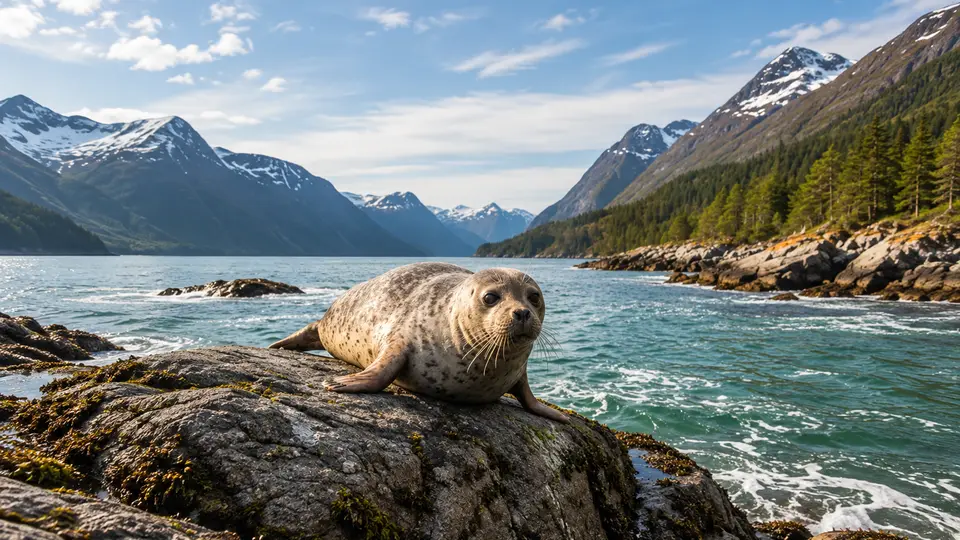
Harbour Seal in its natural habitat, AI illustration

Harbour SealPhoca vitulinaWhere and when to see them

Harbour Seal at a glance

Also called the common seal, the harbour seal inhabits sheltered and exposed coasts around Norway and Scotland. Its rounded face and spotted coat distinguish it from the larger grey seal when viewed carefully. The word common is not a reliable guide to local abundance: some populations have declined substantially. Resting seals depend on predictable, undisturbed haul-outs, where even well-intentioned visitors can interrupt essential rest or nursing.

Behaviour & reproduction

Size
1.2–1.9 m body length
Weight
60–150 kg
Lifespan
20–35 years
Status
Least Concern

Harbour seals divide their time between feeding at sea and resting on coastal rocks, sandbanks or beaches. They may gather closely ashore without forming the territorial breeding colonies typical of some other seals. Mothers nurse pups for a short period, and pups enter the water early in life. During moult, more time ashore supports skin warmth and hair replacement. Sudden group movement often signals disturbance rather than play. Pups are born with a soft natal coat and are capable of swimming within hours of birth, reflecting their readiness for a semi-aquatic life. Their social structure is generally less complex than other seal species, often forming loose aggregations rather than highly organized colonies.

Top wildlife locations

Norway wildlife habitat

Norway

Coastal skerries, sheltered bays and tidal rocks provide haul-out habitat visible from mainland viewpoints or distant decks. Many occupied rocks are inaccessible or protected; viewing does not require landing beside seals.

Scotland wildlife habitat

Scotland

Sea-loch shores, estuary viewpoints and sheltered island coasts offer potential distant viewing. Some haul-outs are inaccessible across tidal ground; remain on safe established paths rather than attempting a closer approach.

Destinations describe the species' habitat, not guaranteed cruise stops. Some animals require an optional inland excursion or are found in restricted reserves.

Fun facts about the Harbour Seal

  • Harbour seal pups can swim within hours of birth.
  • Females generally live longer than males.
  • Males produce breeding calls while in the water.
  • Resting seals sometimes hold both head and hind flippers raised in a curved posture.

Best time to see the Harbour Seal

Summer often brings pupping and moulting activity to northern European haul-outs, making careful distant observation especially important. Seals remain present year-round in many districts. Consult local tide information and site guidance rather than assuming every beach is productive at low tide. While present year-round, summer viewing during pupping and moulting offers unique opportunities to observe social interactions ashore. Successful observation often depends on understanding local tidal patterns, as seals frequently haul out at low tide.

Harbour Seal: season matrix by destination

Travel and observation windows vary by region. Highlighted months are an orientation for planning, not confirmed sightings or a guarantee of access.

Norway

These months favour daylight and coastal access; local pupping and moult timing vary, and seals also occur outside this window.

JanFebMarAprMayJunJulAugSepOctNovDec
Cruise ships in Norway

Scotland

A broad practical shore-observation window; year-round presence occurs locally, with tides and disturbance strongly affecting visibility.

JanFebMarAprMayJunJulAugSepOctNovDec
Cruise ships in Scotland

Where the Harbour Seal lives

Sheltered sea lochs, archipelagos, estuaries and sandy tidal channels offer feeding areas beside suitable haul-outs. Rocky skerries are particularly characteristic in Norway and western Scotland. Access to quiet resting places matters as much as the apparent extent of surrounding coastal water. They demonstrate strong site fidelity, often returning to the same haul-out sites year after year, sometimes across generations. These coastal areas provide crucial refuge from predators and strong currents, and are often located near good foraging grounds.

What the Harbour Seal eats

These opportunistic predators eat locally available fish, including sand eels, herring, flatfish and members of the cod family. Squid and crustaceans supplement the menu. Individuals can develop repeated foraging routes, but diets differ among colonies and change as prey availability shifts. Despite their varied diet, they are efficient hunters, often consuming their prey underwater. Seal scat analysis is a common method used to study the specific fish and invertebrate species consumed in different regions.

Species at a glance

Common name
Harbour Seal
Scientific name
Phoca vitulina
Animal group
Mammals
Size
1.2–1.9 m body length
Weight
60–150 kg
Lifespan
20–35 years
Status
Least Concern
Identification
A short, concave muzzle, rounded head and closely set V-shaped nostrils distinguish harbour seals from the longer-faced grey seal. Their pelage varies from light grey to dark brown, often with individual speckles that can aid in distinguishing them. Unlike grey seals, harbour seals typically hold their head and neck in a more upright, banana-like posture when resting ashore.

Harbour Seal: frequently asked questions

Where can I see the Harbour Seal?
Norway, Scotland. Watch through binoculars without causing seals to raise their heads repeatedly or move toward water. Keep dogs leashed and never approach a pup. Use designated viewpoints where available, and leave immediately if your presence changes the group's behaviour. Maintain a respectful distance at all times, ideally using a spotting scope for detailed views without disturbing the animals. From an adventure cruise, observing seals hauled out on distant skerries requires powerful binoculars and a steady hand.
When is the best time to see the Harbour Seal?
Summer often brings pupping and moulting activity to northern European haul-outs, making careful distant observation especially important. Seals remain present year-round in many districts. Consult local tide information and site guidance rather than assuming every beach is productive at low tide. While present year-round, summer viewing during pupping and moulting offers unique opportunities to observe social interactions ashore. Successful observation often depends on understanding local tidal patterns, as seals frequently haul out at low tide.
How big does the Harbour Seal get?
1.2–1.9 m body length. Adult weight: 60–150 kg. Size varies with age, sex and population.
How should I behave around the Harbour Seal?
Watch through binoculars without causing seals to raise their heads repeatedly or move toward water. Keep dogs leashed and never approach a pup. Use designated viewpoints where available, and leave immediately if your presence changes the group's behaviour. Maintain a respectful distance at all times, ideally using a spotting scope for detailed views without disturbing the animals. From an adventure cruise, observing seals hauled out on distant skerries requires powerful binoculars and a steady hand.
What does the Harbour Seal eat?
These opportunistic predators eat locally available fish, including sand eels, herring, flatfish and members of the cod family. Squid and crustaceans supplement the menu. Individuals can develop repeated foraging routes, but diets differ among colonies and change as prey availability shifts. Despite their varied diet, they are efficient hunters, often consuming their prey underwater. Seal scat analysis is a common method used to study the specific fish and invertebrate species consumed in different regions.
Are wildlife sightings guaranteed on an adventure cruise?
No. Animals move freely and routes, weather, access restrictions and local conditions influence every outing. Confirm the actual itinerary and shore program before booking.

Compare wildlife in the same destinations

Explore other mammals recorded in these destinations. Similar surroundings do not mean the animals share the same habits or viewing season.

Species comparison by animal group and destination
Harbour SealHarbour SealArctic FoxArctic FoxBearded SealBearded Seal
Animal groupMammalsAnimal groupMammalsAnimal groupMammals
DestinationsNorway, ScotlandDestinationsNorway, ArcticDestinationsNorway, Arctic
All wildlife destinations
Plan your trip

Find your next wildlife adventure

Compare destinations, shore programs and dates with the animals and habitats you would love to see.

  • Naturalist-led shore excursions
  • Responsible wildlife watching
  • Small expedition ships

Newsletter

Take Blue Rides with you

Adventure cruise offers, last-minute deals and trip inspiration.

Free, unsubscribe anytime. Details: Privacy Policy

Partner with Blue Rides

Affiliate Program

Recommend adventure cruises and earn commission on every confirmed booking.

Share. Track. Earn.

Your footage, our stage

Send us your videos or pictures.

Captured remarkable nature or wildlife on your journey? Share it with us, we may feature it on Blue Rides.