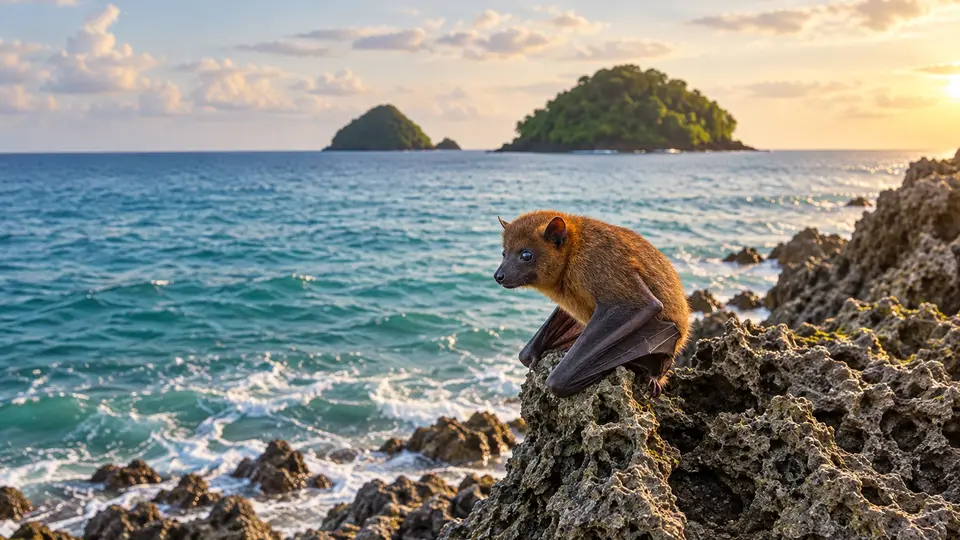
Fiji monkey-faced bat in its natural habitat, AI illustration
SizeNot reliably establishedLifespanNot reliably establishedStatusCritically Endangered

Fiji monkey-faced bat: where and when to see them

Mirimiri acrodonta

Fiji monkey-faced bat at a glance

The Fijian monkey-faced bat is a little-known fruit bat confined, on current confirmed evidence, to Taveuni. Also called the Fiji flying fox, it represents the same species as that separate catalog key. Its unusual face and evolutionary distinctiveness have attracted conservation attention, but basic population information remains limited. Native upland forest is central to its survival, and a small geographic range leaves it exposed to habitat deterioration and severe storms.

Behaviour & reproduction

Size
Not reliably established
Weight
Not reliably established
Lifespan
Not reliably established
Status
Critically Endangered

Evidence suggests a nocturnal forest bat whose activities are much less conspicuous than those of common flying foxes around villages. Researchers have only fragmentary information about its roosting habits, social organisation, reproduction and movements between feeding areas. It should not be portrayed as forming readily visited coastal camps. Because reliable observations are scarce, apparent absence from a forest walk says little about whether animals remain in the surrounding canopy. Studies suggest these bats exhibit solitary or small-group roosting, often in tree hollows or dense foliage, making them particularly difficult to locate. They are likely important pollinators for certain nocturnal flowering plants within their forest ecosystem.

Top wildlife locations

Fiji wildlife habitat

Fiji

The relevant habitat lies in Taveuni’s upland forest, not coastal viewing areas. An inland excursion would be required, with access potentially restricted; this exceptionally rare species is not expected on standard shore landings.

Adventure cruises in Fiji
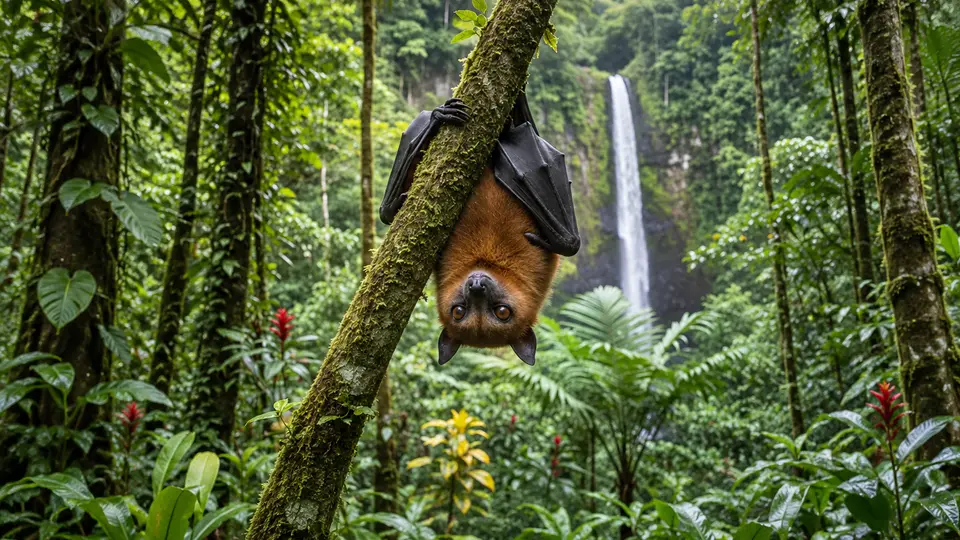
Destinations describe the species' habitat, not guaranteed cruise stops. Some animals require an optional inland excursion or are found in restricted reserves.

Fun facts about the Fiji monkey-faced bat

  • The species was scientifically described in 1978.
  • Genetic and anatomical work led to its placement in the separate genus Mirimiri.
  • Its accepted range is far smaller than that of several other Pacific fruit bats.
  • Its common name describes facial appearance, not a relationship to monkeys.

Best time to see the Fiji monkey-faced bat

No evidence-based viewing season is available. Upland Taveuni can be wet and difficult to access throughout the year, regardless of coastal holiday conditions. Any legitimate forest visit should depend on current local advice and permissions, without an expectation of seeing this bat. Due to its nocturnal, forest-dwelling nature and limited range, there is no specific time of year that offers enhanced viewing opportunities. Weather conditions on Taveuni are generally consistent with a tropical rainforest climate, with high humidity and precipitation year-round.

Fiji monkey-faced bat: season matrix by destination

Travel and observation windows vary by region. Highlighted months are an orientation for planning, not confirmed sightings or a guarantee of access.

Fiji

No supported seasonal observation window exists; island travel conditions do not establish when this poorly known bat might be visible.

JanFebMarAprMayJunJulAugSepOctNovDec
Cruise ships in Fiji

Where the Fiji monkey-faced bat lives

Known habitat is wet upland forest on Taveuni, including montane environments where clouds and heavy rainfall are frequent. Forest structure and food availability are likely important, but habitat requirements remain incompletely resolved. Coastal viewpoints do not provide a realistic species-specific observation setting. The species appears to prefer primary forest with mature trees, suggesting a reliance on specific old-growth features. Its localized distribution to Taveuni implies specific insular ecological factors or historical biogeography play a role.

What the Fiji monkey-faced bat eats

Fruit is believed to be a principal dietary component, consistent with its membership in the fruit-bat family. Detailed field evidence identifying preferred plants is limited. Claims about particular orchard crops, flower species or seasonal feeding aggregations would exceed current knowledge. Observations indicate it consumes soft fruits, likely including figs and other forest fruits that are high in sugars. This bat also likely contributes to seed dispersal for the forest plants it consumes.

Species at a glance

Common name
Fiji monkey-faced bat
Scientific name
Mirimiri acrodonta
Animal group
Mammals
Size
Not reliably established
Weight
Not reliably established
Lifespan
Not reliably established
Status
Critically Endangered
Identification
Orange-toned eyes and specialised facial and dental characters distinguish Mirimiri from Pteropus flying foxes, but reliable identification is generally beyond a brief distant view. The Fijian monkey-faced bat has a distinctive short, broad snout unlike the longer muzzles of Pteropus species. Its smaller size, typically under 200g, also helps differentiate it from the larger flying foxes.

Fiji monkey-faced bat: frequently asked questions

Where can I see the Fiji monkey-faced bat?
Fiji. Use only authorised inland trails and avoid searching for roosts or sharing sensitive coordinates. Never handle bats or illuminate resting animals. A distant flying silhouette is insufficient to distinguish this species from Fiji’s other fruit bats. Researchers often use acoustic detectors or mist nets for surveying this elusive species, which are not methods suitable for tourist observation. Avoid attempting to attract bats with calls or lights, as this can disturb their natural foraging or roosting patterns.
When is the best time to see the Fiji monkey-faced bat?
No evidence-based viewing season is available. Upland Taveuni can be wet and difficult to access throughout the year, regardless of coastal holiday conditions. Any legitimate forest visit should depend on current local advice and permissions, without an expectation of seeing this bat. Due to its nocturnal, forest-dwelling nature and limited range, there is no specific time of year that offers enhanced viewing opportunities. Weather conditions on Taveuni are generally consistent with a tropical rainforest climate, with high humidity and precipitation year-round.
How big does the Fiji monkey-faced bat get?
Not reliably established. Adult weight: Not reliably established. Size varies with age, sex and population.
How should I behave around the Fiji monkey-faced bat?
Use only authorised inland trails and avoid searching for roosts or sharing sensitive coordinates. Never handle bats or illuminate resting animals. A distant flying silhouette is insufficient to distinguish this species from Fiji’s other fruit bats. Researchers often use acoustic detectors or mist nets for surveying this elusive species, which are not methods suitable for tourist observation. Avoid attempting to attract bats with calls or lights, as this can disturb their natural foraging or roosting patterns.
What does the Fiji monkey-faced bat eat?
Fruit is believed to be a principal dietary component, consistent with its membership in the fruit-bat family. Detailed field evidence identifying preferred plants is limited. Claims about particular orchard crops, flower species or seasonal feeding aggregations would exceed current knowledge. Observations indicate it consumes soft fruits, likely including figs and other forest fruits that are high in sugars. This bat also likely contributes to seed dispersal for the forest plants it consumes.
Are wildlife sightings guaranteed on an adventure cruise?
No. Animals move freely and routes, weather, access restrictions and local conditions influence every outing. Confirm the actual itinerary and shore programme before booking.

Compare wildlife in the same destinations

Explore other mammals recorded in these destinations. Similar surroundings do not mean the animals share the same habits or viewing season.

Species comparison by animal group and destination
Fiji monkey-faced batFiji monkey-faced batFiji flying foxFiji flying foxHumpback WhaleHumpback Whale
Animal groupMammalsAnimal groupMammalsAnimal groupMammals
DestinationsFijiDestinationsFijiDestinationsAlaska, Costa Rica, Mexico, New England, Cape Verde, Norway, Portugal, Scotland, Seychelles, Antarctica, Arctic, Australia, Fiji, New Zealand, Polynesia
All wildlife destinations
Plan your trip

Find your next wildlife adventure

Compare destinations, shore programmes and dates with the animals and habitats you would love to see.

  • Naturalist-led shore excursions
  • Responsible wildlife watching
  • Small expedition ships

Newsletter

Take Blue Rides with you

Adventure cruise offers, last-minute deals and trip inspiration.

Free, unsubscribe anytime. Details: Privacy Policy

Partner with Blue Rides

Affiliate Program

Recommend adventure cruises and earn commission on every confirmed booking.

Share. Track. Earn.