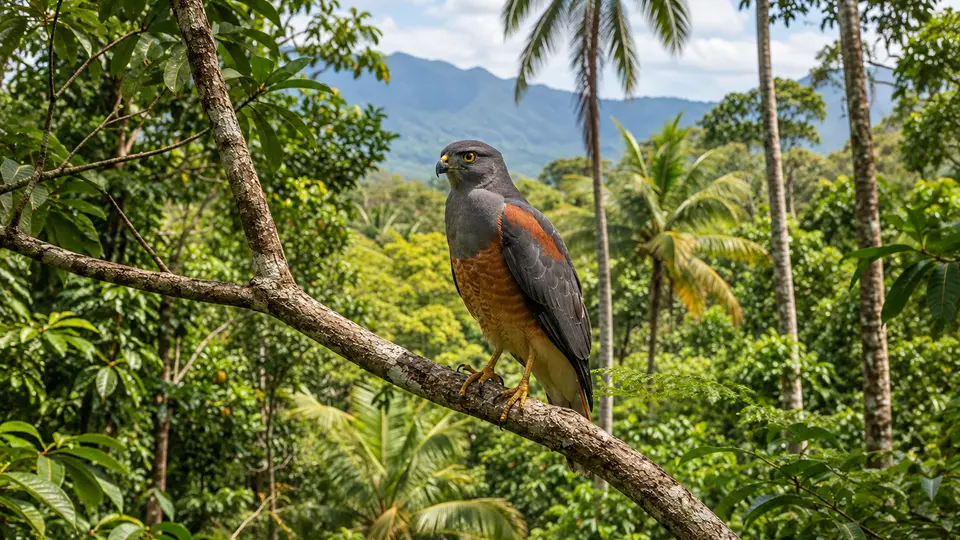
Fiji goshawk in its natural habitat, AI illustration

Fiji goshawk: where and when to see them

Accipiter rufitorques

Fiji goshawk at a glance

The Fiji goshawk is an endemic bird of prey found across several of Fiji’s larger islands. Adults combine blue-grey upperparts with warm rufous colouring around the neck and underparts, giving the species its scientific name. Unlike many island specialists, it can use modified landscapes as well as native forest. Nevertheless, it remains a wild predator whose presence depends on prey and suitable cover, and individual birds can be difficult to locate despite their broad habitat tolerance.

Behaviour & reproduction

Size
30–40 cm long
Weight
Not reliably established
Lifespan
Not reliably established
Status
Least Concern

A Fiji goshawk may watch from a concealed perch before launching a rapid attack, or move through trees while searching for prey. It also crosses clearings and sometimes circles above the canopy, providing brief opportunities for observation. Pairs defend nesting territories and build stick nests in trees. Like other small forest hawks, it can be surprisingly inconspicuous when perched, with a sudden burst of movement revealing a bird that had been nearby unnoticed. Courtship displays involve aerial acrobatics and calling, especially high above the nesting territory. These goshawks are known for their fierce defense of nests, aggressively chasing off potential threats including much larger birds or even humans.

Top wildlife locations

Fiji wildlife habitat

Fiji

Wooded coastal villages, forest edges and mature gardens on occupied islands provide plausible viewing habitat. An inland forest excursion may improve opportunities, but birds are mobile and no particular shore stop guarantees a sighting.

Adventure cruises in Fiji
Destinations describe the species' habitat, not guaranteed cruise stops. Some animals require an optional inland excursion or are found in restricted reserves.

Fun facts about the Fiji goshawk

  • The species occurs naturally only in Fiji.
  • Its scientific epithet rufitorques refers to its reddish neck colouring.
  • Females are larger than males.
  • Juveniles are browner and more heavily marked than adults.

Best time to see the Fiji goshawk

The species is resident, so there is no migration-based viewing season. May to October often provides comfortable walking conditions and useful visibility along forest edges. Breeding activity can vary locally, and nests should never be used as guaranteed observation targets. Breeding typically occurs between September and January, though young birds can be seen fledging later in the season. Viewing opportunities improve in drier months when undergrowth is less dense and birds are more active in searching for food.

Fiji goshawk: season matrix by destination

Travel and observation windows vary by region. Highlighted months are an orientation for planning, not confirmed sightings or a guarantee of access.

Fiji

A practical walking and travel window for a resident species, not a defined migration or breeding season.

JanFebMarAprMayJunJulAugSepOctNovDec
Cruise ships in Fiji

Where the Fiji goshawk lives

It occupies native forest, secondary woodland, plantations, wooded farmland and some gardens. Coastal forest edges can be suitable where trees and prey remain available. It also ranges inland and into upland habitats, so it is not restricted to shorelines or low elevations. Though adaptable, the species shows a preference for areas with scattered trees or forest patches rather than continuous dense forest or open grasslands. It is the most common raptor throughout the main Fijian islands, indicating its broad ecological tolerance.

What the Fiji goshawk eats

The diet includes birds, lizards, large insects and small mammals. Hunting opportunities vary with habitat, from forest birds to prey found around cultivated areas. Its relatively short wings and long tail help it manoeuvre when pursuing animals through vegetation. It is an opportunistic hunter, preying on a wide variety of animals found within its diverse habitats. Occasionally, it will also take small birds from feeders or chickens in villages, showcasing its adaptability to human modified landscapes.

Species at a glance

Common name
Fiji goshawk
Scientific name
Accipiter rufitorques
Animal group
Birds
Size
30–40 cm long
Weight
Not reliably established
Lifespan
Not reliably established
Status
Least Concern
Identification
The adult’s grey upperparts, rufous collar and long barred tail distinguish it from the larger, darker swamp harrier, which usually hunts with more buoyant, open-country flight. Juveniles are distinguishable by their browner upperparts and streaked underparts, lacking the adult's rufous collar. Its relatively short, broad wings and long tail give it a characteristic silhouette in flight, distinct from other raptors in the region.

Fiji goshawk: frequently asked questions

Where can I see the Fiji goshawk?
Fiji. Scan exposed branches and canopy gaps from quiet coastal paths or gardens. Keep away from occupied nests, avoid playback, and retreat if birds alarm-call or repeatedly circle overhead; defensive behaviour indicates that you are too close. Listen for its sharp, high-pitched call, often a rapid 'kek-kek-kek', which can help locate individuals even when concealed. Binoculars are essential for observing details of perched birds and for tracking their swift flight.
When is the best time to see the Fiji goshawk?
The species is resident, so there is no migration-based viewing season. May to October often provides comfortable walking conditions and useful visibility along forest edges. Breeding activity can vary locally, and nests should never be used as guaranteed observation targets. Breeding typically occurs between September and January, though young birds can be seen fledging later in the season. Viewing opportunities improve in drier months when undergrowth is less dense and birds are more active in searching for food.
How big does the Fiji goshawk get?
30–40 cm long. Adult weight: Not reliably established. Size varies with age, sex and population.
How should I behave around the Fiji goshawk?
Scan exposed branches and canopy gaps from quiet coastal paths or gardens. Keep away from occupied nests, avoid playback, and retreat if birds alarm-call or repeatedly circle overhead; defensive behaviour indicates that you are too close. Listen for its sharp, high-pitched call, often a rapid 'kek-kek-kek', which can help locate individuals even when concealed. Binoculars are essential for observing details of perched birds and for tracking their swift flight.
What does the Fiji goshawk eat?
The diet includes birds, lizards, large insects and small mammals. Hunting opportunities vary with habitat, from forest birds to prey found around cultivated areas. Its relatively short wings and long tail help it manoeuvre when pursuing animals through vegetation. It is an opportunistic hunter, preying on a wide variety of animals found within its diverse habitats. Occasionally, it will also take small birds from feeders or chickens in villages, showcasing its adaptability to human modified landscapes.
Are wildlife sightings guaranteed on an adventure cruise?
No. Animals move freely and routes, weather, access restrictions and local conditions influence every outing. Confirm the actual itinerary and shore program before booking.

Compare wildlife in the same destinations

Explore other birds recorded in these destinations. Similar surroundings do not mean the animals share the same habits or viewing season.

Species comparison by animal group and destination
Fiji goshawkFiji goshawkBarking imperial pigeonBarking imperial pigeonBrown BoobyBrown Booby
Animal groupBirdsAnimal groupBirdsAnimal groupBirds
DestinationsFijiDestinationsFijiDestinationsCosta Rica, Cape Verde, Egypt, Fiji, Polynesia
All wildlife destinations
Plan your trip

Find your next wildlife adventure

Compare destinations, shore programs and dates with the animals and habitats you would love to see.

  • Naturalist-led shore excursions
  • Responsible wildlife watching
  • Small expedition ships

Newsletter

Take Blue Rides with you

Adventure cruise offers, last-minute deals and trip inspiration.

Free, unsubscribe anytime. Details: Privacy Policy

Partner with Blue Rides

Affiliate Program

Recommend adventure cruises and earn commission on every confirmed booking.

Share. Track. Earn.

Your footage, our stage

Send us your videos or pictures.

Captured beautiful landscapes or wildlife? Share your videos and pictures with us, we may feature them on Blue Rides.