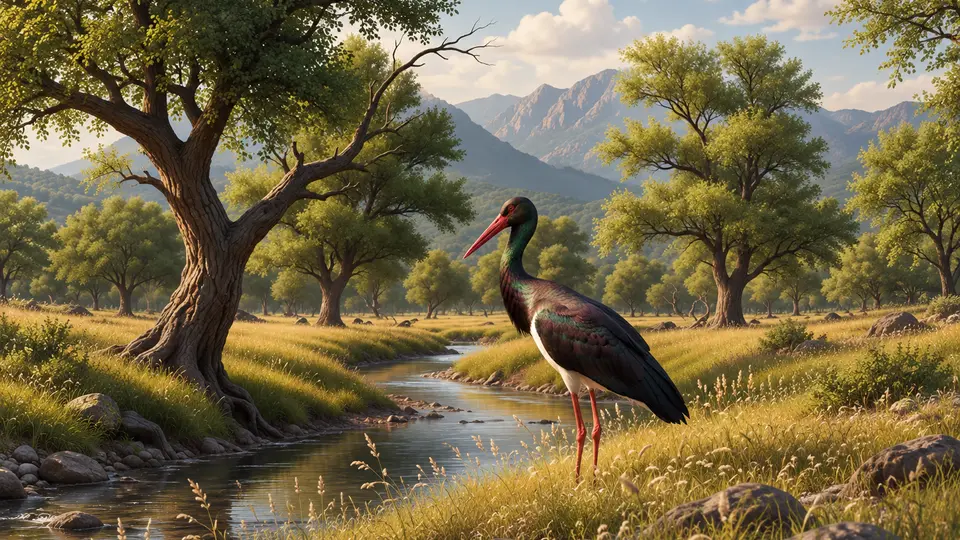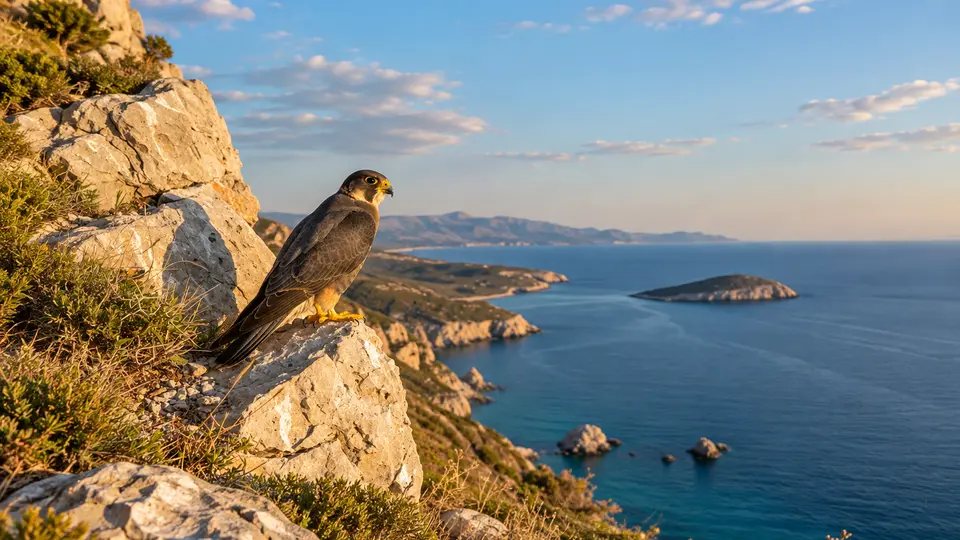
Eleonora's Falcon in its natural habitat, AI illustration

Eleonora's Falcon: where and when to see them

Falco eleonorae

Eleonora's Falcon at a glance

Eleonora's falcon is a slender, long-winged raptor that breeds mainly on Mediterranean islands and coastal cliffs. Its unusually late breeding schedule allows growing chicks to be fed with small birds migrating south in late summer and autumn. Adults occur in pale and dark plumage forms. After breeding, most migrate toward Madagascar and surrounding regions. Although globally assessed as Least Concern, colonies remain vulnerable to disturbance, introduced predators and changes in food availability.

Behaviour & reproduction

Size
36-42 cm long; wingspan 87-104 cm
Weight
350-460 g
Lifespan
Not reliably established
Status
Least Concern

These falcons often nest in loose colonies on rocky islands, using ledges, cavities or sheltered ground among rocks. Before the main chick-rearing period, they spend considerable time catching insects, sometimes far from the colony. Later, adults intercept migrating birds over the sea and carry prey back to their young. Flight is agile and buoyant, with rapid turns during pursuit. Wind conditions can strongly influence hunting success and how conspicuous birds are from coastal viewpoints. Courtship displays, including aerial acrobatics and calling, can be observed around breeding sites in spring. These communal nesters often forage together, forming large hunting parties to intercept migrating birds. Their hunting strategy involves flying out over the sea, sometimes several kilometers from shore, to capture tired passerines during their trans-Mediterranean journey.

Top wildlife locations

Greece wildlife habitat

Greece

Aegean island headlands and distant views toward rocky sea cliffs provide plausible shore or deck opportunities. Many nesting islets are inaccessible or protected, and no colony landing should be assumed available.

Adventure cruises in Greece
Turkey wildlife habitat

Turkey

Aegean coastal headlands and offshore rocky islands offer potential distant viewing, but breeding distribution is localized. Colonies may be inaccessible or restricted, and many coastal visits will produce no falcons.

Adventure cruises in Turkey

Destinations describe the species' habitat, not guaranteed cruise stops. Some animals require an optional inland excursion or are found in restricted reserves.

Fun facts about the Eleonora's Falcon

  • Both pale and dark adults occur within the same species.
  • Its breeding season coincides with autumn songbird migration.
  • The species is named for Eleonora of Arborea, a medieval Sardinian ruler.
  • Tracking has revealed migration routes that can cross mainland Africa rather than simply follow coasts.

Best time to see the Eleonora's Falcon

May through October broadly covers Mediterranean presence, with coastal activity often especially conspicuous in late summer and early autumn. Breeding is later than in many European falcons. Observation should rely on distant public viewpoints or passing decks, not entry into nesting colonies. Prime viewing opportunities occur in late summer and early autumn when adults are actively hunting migratory birds to feed their young. These falcons are long-distance migrants themselves, wintering primarily in Madagascar and eastern Africa after their breeding season in the Mediterranean. Early morning or late afternoon often provide the best light for observation and increased activity near colonies.

Eleonora's Falcon: season matrix by destination

Travel and observation windows vary by region. Highlighted months are an orientation for planning, not confirmed sightings or a guarantee of access.

Greece

This broadly matches Mediterranean occupancy; late-summer activity depends on local colonies, migration and wind rather than tourism season.

JanFebMarAprMayJunJulAugSepOctNovDec
Cruise ships in Greece

Turkey

These months reflect broad seasonal presence in the eastern Mediterranean, not confirmed occurrence at every Turkish coastal destination.

JanFebMarAprMayJunJulAugSepOctNovDec
Cruise ships in Turkey

Where the Eleonora's Falcon lives

Breeding habitat consists chiefly of quiet sea cliffs, rocky islets and offshore islands with protected nesting recesses. Feeding areas extend over adjacent seas and sometimes inland over insect-rich landscapes. Many colonies occupy inaccessible or seasonally restricted terrain unsuitable for visitor landings. The majority of the global population breeds on Aegean islands, with significant concentrations also found along the coasts of North Africa and other Mediterranean nations. Nest sites are typically chosen on sheer cliffs providing protection from predators and good access to hunting grounds. While many colonies are coastal, some smaller groups can be found on inland rock faces or canyons in close proximity to the sea.

What the Eleonora's Falcon eats

Large flying insects are important outside the main chick-rearing period. During late summer and autumn, migrating songbirds become major prey at breeding colonies. The balance varies with season, weather and location, reflecting a hunting strategy closely tied to temporary concentrations of food. Prey delivered to chicks consists almost exclusively of small passerine birds, making it one of the few raptors to specialize in migratory songbirds. Falcons often store surplus insects or small birds at the colony for later consumption, especially during periods of high abundance. They exhibit a unique breeding strategy timed to coincide with the peak autumn migration of passerines across the Mediterranean.

Species at a glance

Common name
Eleonora's Falcon
Scientific name
Falco eleonorae
Animal group
Birds
Size
36-42 cm long; wingspan 87-104 cm
Weight
350-460 g
Lifespan
Not reliably established
Status
Least Concern
Identification
Long narrow wings, a notably long tail and pale or wholly dark plumage distinguish it from the stockier peregrine, while pale birds lack the hobby's prominent red trousers. Two distinct morphs exist: a dark morph that is uniformly sooty brown or black, and a more common pale morph with dark upperparts and lighter, streaked underparts. The flight silhouette is slender and elegant, characterized by pointed wingtips that often appear to be angled slightly backwards. Juveniles often show more distinct streaking on the breast and belly compared to adults, and can be distinguished by their paler cere and legs.

Eleonora's Falcon: frequently asked questions

Where can I see the Eleonora's Falcon?
Greece, Turkey. Scan island cliffs from distant shore viewpoints or a vessel's deck. Never approach nest recesses, use playback or enter restricted islets; alarm calls or repeated circling indicate that observers may be too close. Binoculars or a spotting scope are essential for detailed observation of these often-distant cliff-nesting birds. Look for distinctive flight patterns as they patrol coastlines or circle above their colonies, often visible from cruise ship decks or coastal trails. Their breeding cycle, specifically adapted to autumn migration, means that observing active nests is most rewarding in September and October.
When is the best time to see the Eleonora's Falcon?
May through October broadly covers Mediterranean presence, with coastal activity often especially conspicuous in late summer and early autumn. Breeding is later than in many European falcons. Observation should rely on distant public viewpoints or passing decks, not entry into nesting colonies. Prime viewing opportunities occur in late summer and early autumn when adults are actively hunting migratory birds to feed their young. These falcons are long-distance migrants themselves, wintering primarily in Madagascar and eastern Africa after their breeding season in the Mediterranean. Early morning or late afternoon often provide the best light for observation and increased activity near colonies.
How big does the Eleonora's Falcon get?
36-42 cm long; wingspan 87-104 cm. Adult weight: 350-460 g. Size varies with age, sex and population.
How should I behave around the Eleonora's Falcon?
Scan island cliffs from distant shore viewpoints or a vessel's deck. Never approach nest recesses, use playback or enter restricted islets; alarm calls or repeated circling indicate that observers may be too close. Binoculars or a spotting scope are essential for detailed observation of these often-distant cliff-nesting birds. Look for distinctive flight patterns as they patrol coastlines or circle above their colonies, often visible from cruise ship decks or coastal trails. Their breeding cycle, specifically adapted to autumn migration, means that observing active nests is most rewarding in September and October.
What does the Eleonora's Falcon eat?
Large flying insects are important outside the main chick-rearing period. During late summer and autumn, migrating songbirds become major prey at breeding colonies. The balance varies with season, weather and location, reflecting a hunting strategy closely tied to temporary concentrations of food. Prey delivered to chicks consists almost exclusively of small passerine birds, making it one of the few raptors to specialize in migratory songbirds. Falcons often store surplus insects or small birds at the colony for later consumption, especially during periods of high abundance. They exhibit a unique breeding strategy timed to coincide with the peak autumn migration of passerines across the Mediterranean.
Are wildlife sightings guaranteed on an adventure cruise?
No. Animals move freely and routes, weather, access restrictions and local conditions influence every outing. Confirm the actual itinerary and shore program before booking.

Compare wildlife in the same destinations

Explore other birds recorded in these destinations. Similar surroundings do not mean the animals share the same habits or viewing season.

Species comparison by animal group and destination
Eleonora's FalconEleonora's FalconAudouin's GullAudouin's GullBlack StorkBlack Stork
Animal groupBirdsAnimal groupBirdsAnimal groupBirds
DestinationsGreece, TurkeyDestinationsCroatia, Greece, Portugal, TurkeyDestinationsPortugal, Turkey
All wildlife destinations
Plan your trip

Find your next wildlife adventure

Compare destinations, shore programs and dates with the animals and habitats you would love to see.

  • Naturalist-led shore excursions
  • Responsible wildlife watching
  • Small expedition ships

Newsletter

Take Blue Rides with you

Adventure cruise offers, last-minute deals and trip inspiration.

Free, unsubscribe anytime. Details: Privacy Policy

Partner with Blue Rides

Affiliate Program

Recommend adventure cruises and earn commission on every confirmed booking.

Share. Track. Earn.

Your footage, our stage

Send us your videos or pictures.

Captured beautiful landscapes or wildlife? Share your videos and pictures with us, we may feature them on Blue Rides.