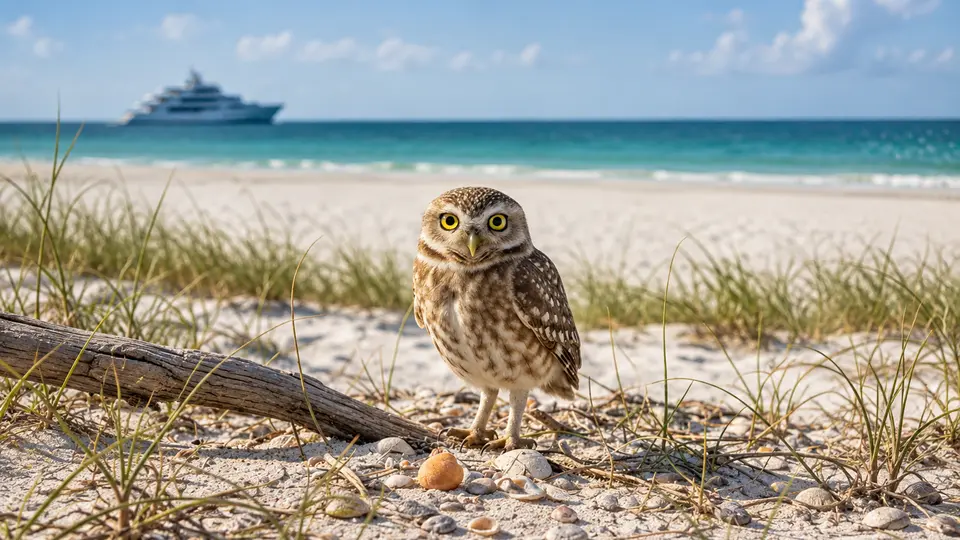
Burrowing Owl in its natural habitat, AI illustration

Burrowing OwlAthene cuniculariaWhere and when to see them

Burrowing Owl at a glance

The burrowing owl is a small, long-legged owl of open landscapes, unusual for spending much of its time on the ground. Florida's resident population belongs to a distinctive subspecies that commonly excavates its own burrows in sandy soil. Birds may occupy vacant lots, pastures and other human-modified spaces, but apparent tolerance of people does not make their nests resilient. Development, vehicles, mowing and disturbance can destroy occupied burrows or reduce nearby feeding habitat.

Behaviour & reproduction

Size
19-25 cm long
Weight
120-250 g
Lifespan
Not reliably established
Status
Least Concern

Burrowing owls often stand upright beside a burrow entrance or on a low post, scanning for both prey and danger. They hunt by running, hopping or making short flights, with activity extending through daylight and twilight as well as night. Alarmed birds bob and retreat underground. During nesting, adults deliver food to the burrow and guard the surrounding area, while older chicks gather near the entrance before becoming independent. Owls may line their burrows with various materials, including mammal dung, which is thought to help regulate temperature and deter predators. They often exhibit a head-bobbing motion when curious or alert, constantly assessing their surroundings.

Top wildlife locations

Florida wildlife habitat

Florida

Managed viewing areas in open residential grassland or dry prairie provide suitable habitat. An inland excursion is usually required; beaches are not typical viewing sites, and occupied burrows may have protective access restrictions.
Destinations describe the species' habitat, not guaranteed cruise stops. Some animals require an optional inland excursion or are found in restricted reserves.

Fun facts about the Burrowing Owl

  • Florida burrowing owls often dig their own burrows.
  • Young birds can produce a defensive hiss resembling a rattlesnake's warning.
  • Unlike many owls, they are frequently visible in daylight.
  • Adults sometimes place animal dung near burrows, attracting insects that can become prey.

Best time to see the Burrowing Owl

Florida birds can be observed throughout the year because the local population is resident. Late winter and spring may bring more visible activity around nesting areas, but also require greater restraint. Cooler morning and evening periods are often more comfortable for patient, distant viewing. In Florida, nesting typically occurs from February to July, with peak activity in March and April. Observing during these months offers a chance to see adult owls bringing food to their young and fledglings emerging from burrows.

Burrowing Owl: season matrix by destination

Travel and observation windows vary by region. Highlighted months are an orientation for planning, not confirmed sightings or a guarantee of access.

Florida

Cooler months suit land-based observation; birds are resident, and nesting activity increases sensitivity rather than guaranteeing easier sightings.

JanFebMarAprMayJunJulAugSepOctNovDec
Cruise ships in Florida

Where the Burrowing Owl lives

Short grass, sparse vegetation and well-drained soils are essential features. In Florida, suitable places include dry prairie, pasture, airfield margins and some residential landscapes. These are primarily inland or terrestrial habitats, not beaches, mangrove creeks or densely wooded coastal wetlands. They readily adapt to disturbed habitats, often colonizing agricultural lands, golf courses, and urban vacant lots. Nests are typically found in abandoned mammal burrows, especially those of gophers or ground squirrels, but owls may also excavate their own.

What the Burrowing Owl eats

Large insects make up much of the diet, alongside small mammals, lizards, frogs and other manageable vertebrates. Prey selection changes with local availability and season. Beetles, grasshoppers and crickets are frequent foods, and small prey may be captured while the owl runs across open ground. Insects are often caught on the ground or in low flight, while larger prey like rodents might be ambushed from a low perch. They are opportunistic predators, and their diet can include scorpions and small snakes depending on local availability.

Species at a glance

Common name
Burrowing Owl
Scientific name
Athene cunicularia
Animal group
Birds
Size
19-25 cm long
Weight
120-250 g
Lifespan
Not reliably established
Status
Least Concern
Identification
Its long bare-looking legs, ground-level burrow association and lack of ear tufts distinguish it from Florida's stockier, tree-associated small owls. Their bright yellow eyes and white eyebrows give them a distinctive, intense stare. The overall plumage is sandy brown with white spotting and barring, providing excellent camouflage against dry, grassy backgrounds.

Burrowing Owl: frequently asked questions

Where can I see the Burrowing Owl?
Florida. Observe from a marked public viewing area or roadside position that does not obstruct traffic. Never approach or stand on a burrow, use playback, or allow dogs near nesting owls and their chicks. Use binoculars or a spotting scope for close-up views without disturbing the birds, as they are sensitive to human presence. During nesting season, respect a generous buffer zone around burrows to prevent stress to adults and chicks.
When is the best time to see the Burrowing Owl?
Florida birds can be observed throughout the year because the local population is resident. Late winter and spring may bring more visible activity around nesting areas, but also require greater restraint. Cooler morning and evening periods are often more comfortable for patient, distant viewing. In Florida, nesting typically occurs from February to July, with peak activity in March and April. Observing during these months offers a chance to see adult owls bringing food to their young and fledglings emerging from burrows.
How big does the Burrowing Owl get?
19-25 cm long. Adult weight: 120-250 g. Size varies with age, sex and population.
How should I behave around the Burrowing Owl?
Observe from a marked public viewing area or roadside position that does not obstruct traffic. Never approach or stand on a burrow, use playback, or allow dogs near nesting owls and their chicks. Use binoculars or a spotting scope for close-up views without disturbing the birds, as they are sensitive to human presence. During nesting season, respect a generous buffer zone around burrows to prevent stress to adults and chicks.
What does the Burrowing Owl eat?
Large insects make up much of the diet, alongside small mammals, lizards, frogs and other manageable vertebrates. Prey selection changes with local availability and season. Beetles, grasshoppers and crickets are frequent foods, and small prey may be captured while the owl runs across open ground. Insects are often caught on the ground or in low flight, while larger prey like rodents might be ambushed from a low perch. They are opportunistic predators, and their diet can include scorpions and small snakes depending on local availability.
Are wildlife sightings guaranteed on an adventure cruise?
No. Animals move freely and routes, weather, access restrictions and local conditions influence every outing. Confirm the actual itinerary and shore program before booking.

Compare wildlife in the same destinations

Explore other birds recorded in these destinations. Similar surroundings do not mean the animals share the same habits or viewing season.

Species comparison by animal group and destination
Burrowing OwlBurrowing OwlAnhingaAnhingaBald EagleBald Eagle
Animal groupBirdsAnimal groupBirdsAnimal groupBirds
DestinationsFloridaDestinationsFloridaDestinationsAlaska, Florida, New England
All wildlife destinations
Plan your trip

Find your next wildlife adventure

Compare destinations, shore programs and dates with the animals and habitats you would love to see.

  • Naturalist-led shore excursions
  • Responsible wildlife watching
  • Small expedition ships

Newsletter

Take Blue Rides with you

Adventure cruise offers, last-minute deals and trip inspiration.

Free, unsubscribe anytime. Details: Privacy Policy

Partner with Blue Rides

Affiliate Program

Recommend adventure cruises and earn commission on every confirmed booking.

Share. Track. Earn.

Your footage, our stage

Send us your videos or pictures.

Captured remarkable nature or wildlife on your journey? Share it with us, we may feature it on Blue Rides.