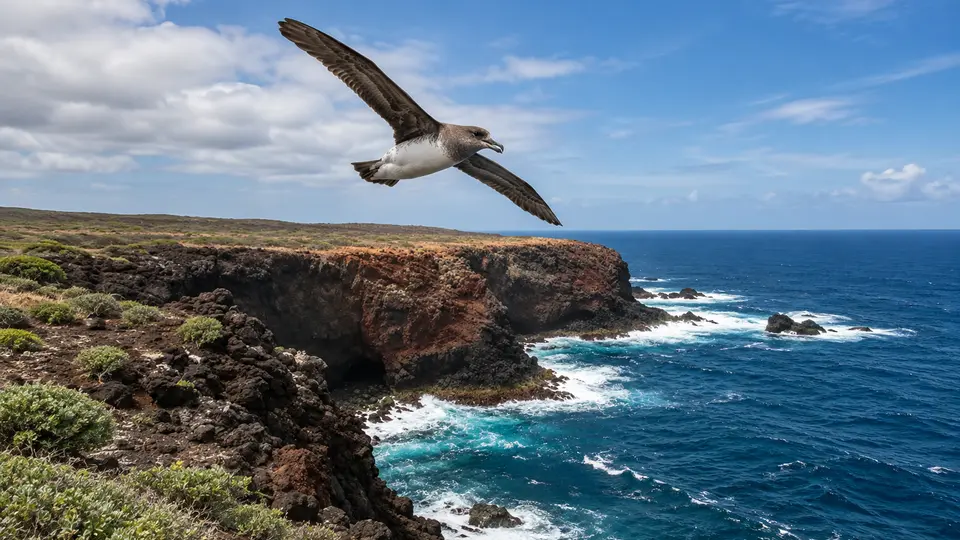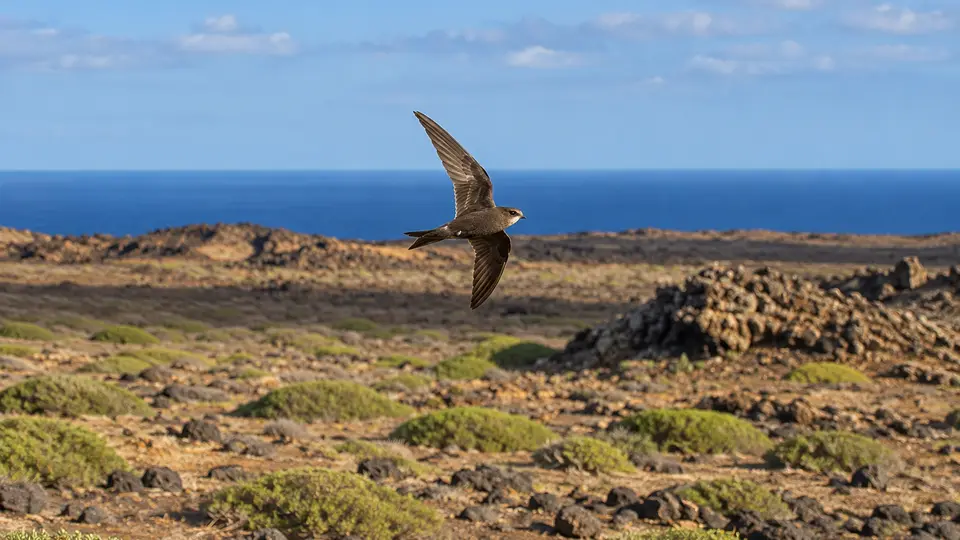
Alexander's Swift in its natural habitat, AI illustration

Alexander's SwiftApus alexandriWhere and when to see them

Alexander's Swift at a glance

Alexander’s swift is a small, dark aerial insectivore endemic to Cape Verde. It spends much of its visible life sweeping through the sky above rugged volcanic terrain, settlements and feeding areas. Also called the Cape Verde swift, it is among the archipelago’s distinctive resident birds. Its restricted geographic range makes local habitat conditions important, even though it can cover considerable distances in flight while searching for concentrations of airborne insects.

Behaviour & reproduction

Size
13 cm long
Weight
Not reliably established
Lifespan
Not reliably established
Status
Least Concern

These swifts forage on the wing, often gathering in loose groups where insects concentrate. Rapid wingbeats alternate with glides as birds circle cliffs or pass over valleys and towns. They nest in sheltered cavities and rock crevices rather than constructing exposed nests on branches. Adults return to these protected spaces to attend eggs and young. Numbers overhead can change quickly with wind, cloud cover and insect availability, leaving a previously busy viewpoint suddenly quiet. These swifts spend almost their entire lives in the air, only landing to breed. During the breeding season, pairs will engage in aerial pursuits and displays around nesting sites. They are known to engage in 'screaming parties,' where groups of swifts fly rapidly and noisily together, often at dusk or dawn around colonies.

Top wildlife locations

Cape Verde wildlife habitat

Cape Verde

Coastal cliffs and valley mouths can provide overhead views, while inland excursions broaden access to rugged feeding and nesting landscapes. Nest cavities are often inaccessible, and birds may be absent from otherwise suitable viewpoints.
Destinations describe the species' habitat, not guaranteed cruise stops. Some animals require an optional inland excursion or are found in restricted reserves.

Fun facts about the Alexander's Swift

  • It is endemic to the Cape Verde archipelago.
  • Cape Verde swift is an alternative English name.
  • It catches food while flying rather than landing to collect prey.
  • Protected rock cavities provide nesting sites in volcanic landscapes.

Best time to see the Alexander's Swift

As a resident endemic, Alexander’s swift may be encountered throughout the year. November to June offers a broadly practical period for Cape Verde land visits, although persistent winds can complicate viewing. Local insect activity is a better guide than assuming a single archipelago-wide breeding peak. Breeding generally occurs from March to June, corresponding with the peak insect availability after the dry season. Migration is not observed as they are a resident species throughout the archipelago. Local guides can often provide up-to-date information on recent sightings and insect activity patterns.

Alexander's Swift: season matrix by destination

Travel and observation windows vary by region. Highlighted months are an orientation for planning, not confirmed sightings or a guarantee of access.

Cape Verde

These months provide a practical land-travel window; the species is resident, and weather-dependent feeding activity does not establish a fixed sighting season.

JanFebMarAprMayJunJulAugSepOctNovDec
Cruise ships in Cape Verde

Where the Alexander's Swift lives

Rocky cliffs, ravines and mountainous volcanic landscapes provide nesting opportunities, while feeding birds range over settlements, farmland and open country. Coastal observation is possible where cliffs and valleys meet the sea. Breeding cavities may be high, concealed or entirely inaccessible. Breeding colonies are typically small and often found on inaccessible sea cliffs and inland ravines. While primarily a highland species, they will forage widely at lower elevations including coastal areas. They often return to the same nesting sites year after year, demonstrating strong site fidelity.

What the Alexander's Swift eats

The diet consists of small flying insects and other airborne arthropods captured in flight. Birds track concentrations of prey above varied landscapes rather than feeding on the ground. Food availability changes with weather and rainfall-driven insect emergence across the islands. Prey items include a variety of small dipterans, hymenopterans, and coleopterans. Their foraging strategy involves continuously hawking for prey in the air, allowing them to exploit transient insect swarms. Unlike some other swift species, they do not typically form large feeding aggregations far from breeding colonies.

Species at a glance

Common name
Alexander's Swift
Scientific name
Apus alexandri
Animal group
Birds
Size
13 cm long
Weight
Not reliably established
Lifespan
Not reliably established
Status
Least Concern
Identification
Its small size, compact proportions and relatively short, shallowly forked tail help distinguish it from larger common and pallid swifts, although distant birds can be difficult. Its plumage is uniformly sooty brown, appearing almost black against a bright sky, with a slightly paler throat patch that is often difficult to see. The wing shape is distinctly sickle-like, typical of swifts, but appears more robust and less attenuated than larger species. Compared to the Common Swift, its tail fork is less pronounced, appearing almost square-ended in flight, and it has shorter wings relative to its body size.

Alexander's Swift: frequently asked questions

Where can I see the Alexander's Swift?
Cape Verde. Watch from stable public viewpoints below cliffs or beside open valleys. Use binoculars rather than approaching nesting crevices, and avoid cliff edges while tracking fast-moving birds. Do not use playback to draw birds toward hazardous positions. Shore excursions to volcanic highlands or deep valleys offer the best chances for close observation, especially near known nesting areas. Look for their characteristic flight pattern against the sky above rocky outcrops or along the edges of cultivated fields. Observing these swifts requires patience, as their rapid, erratic flight can make them challenging to follow.
When is the best time to see the Alexander's Swift?
As a resident endemic, Alexander’s swift may be encountered throughout the year. November to June offers a broadly practical period for Cape Verde land visits, although persistent winds can complicate viewing. Local insect activity is a better guide than assuming a single archipelago-wide breeding peak. Breeding generally occurs from March to June, corresponding with the peak insect availability after the dry season. Migration is not observed as they are a resident species throughout the archipelago. Local guides can often provide up-to-date information on recent sightings and insect activity patterns.
How big does the Alexander's Swift get?
13 cm long. Adult weight: Not reliably established. Size varies with age, sex and population.
How should I behave around the Alexander's Swift?
Watch from stable public viewpoints below cliffs or beside open valleys. Use binoculars rather than approaching nesting crevices, and avoid cliff edges while tracking fast-moving birds. Do not use playback to draw birds toward hazardous positions. Shore excursions to volcanic highlands or deep valleys offer the best chances for close observation, especially near known nesting areas. Look for their characteristic flight pattern against the sky above rocky outcrops or along the edges of cultivated fields. Observing these swifts requires patience, as their rapid, erratic flight can make them challenging to follow.
What does the Alexander's Swift eat?
The diet consists of small flying insects and other airborne arthropods captured in flight. Birds track concentrations of prey above varied landscapes rather than feeding on the ground. Food availability changes with weather and rainfall-driven insect emergence across the islands. Prey items include a variety of small dipterans, hymenopterans, and coleopterans. Their foraging strategy involves continuously hawking for prey in the air, allowing them to exploit transient insect swarms. Unlike some other swift species, they do not typically form large feeding aggregations far from breeding colonies.
Are wildlife sightings guaranteed on an adventure cruise?
No. Animals move freely and routes, weather, access restrictions and local conditions influence every outing. Confirm the actual itinerary and shore program before booking.

Compare wildlife in the same destinations

Explore other birds recorded in these destinations. Similar surroundings do not mean the animals share the same habits or viewing season.

Species comparison by animal group and destination
Alexander's SwiftAlexander's SwiftBar-tailed LarkBar-tailed LarkBoyd's ShearwaterBoyd's Shearwater
Animal groupBirdsAnimal groupBirdsAnimal groupBirds
DestinationsCape VerdeDestinationsCape VerdeDestinationsCape Verde
All wildlife destinations
Plan your trip

Find your next wildlife adventure

Compare destinations, shore programs and dates with the animals and habitats you would love to see.

  • Naturalist-led shore excursions
  • Responsible wildlife watching
  • Small expedition ships

Newsletter

Take Blue Rides with you

Adventure cruise offers, last-minute deals and trip inspiration.

Free, unsubscribe anytime. Details: Privacy Policy

Partner with Blue Rides

Affiliate Program

Recommend adventure cruises and earn commission on every confirmed booking.

Share. Track. Earn.

Your footage, our stage

Send us your videos or pictures.

Captured remarkable nature or wildlife on your journey? Share it with us, we may feature it on Blue Rides.