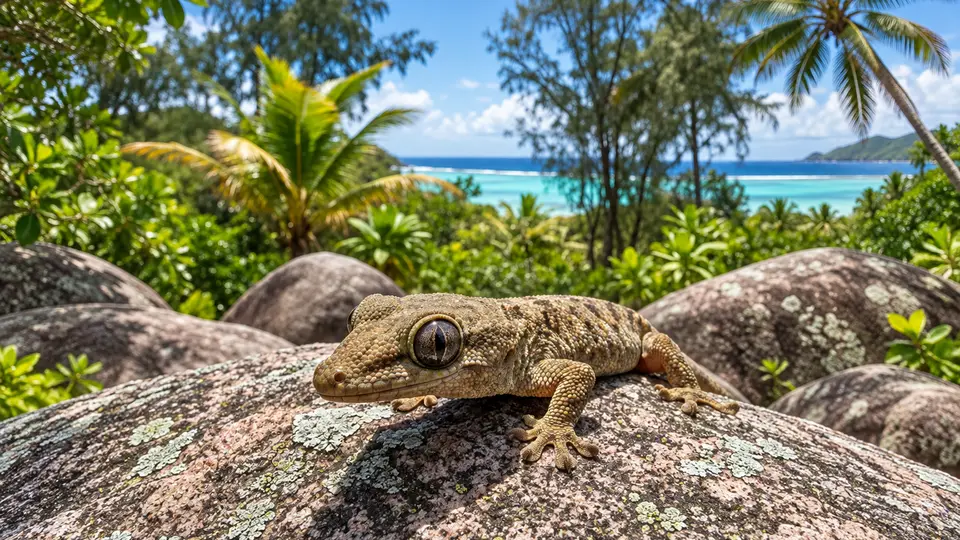
Seychelles Bronze Gecko in its natural habitat, AI illustration
SizeAbout 15-20 cm total lengthLifespanNot reliably establishedStatusLeast Concern

Seychelles Bronze Gecko: where and when to see them

Ailuronyx seychellensis

Seychelles Bronze Gecko at a glance

The Seychelles bronze gecko is an endemic tree-dwelling reptile of the granitic Seychelles. Its muted bronze, grey or brown colouring is less conspicuous than that of the islands’ bright green day geckos. Broad adhesive toes help it move over trunks and other steep surfaces. It belongs to a small radiation of Seychelles geckos whose members differ markedly in size, and its survival depends on retaining suitable vegetation and shelter within its limited island range.

Behaviour & reproduction

Size
About 15-20 cm total length
Weight
Not reliably established
Lifespan
Not reliably established
Status
Least Concern

Bronze geckos forage on vegetation and use bark crevices, leaf bases and other protected spaces as shelter. They can be active by day as well as around dusk and after dark, so detection depends partly on weather and the availability of cover. Individuals often remain motionless against a trunk before moving abruptly away. Like other geckos, they use their tongues to clean their eyes, which are protected by a transparent covering rather than movable eyelids. Bronze geckos exhibit a 'sit-and-wait' predatory strategy, remaining still until suitable prey passes within striking distance. They are primarily nocturnal or crepuscular, but their diurnal activity can increase in cooler, overcast conditions or in heavily shaded environments.

Top wildlife locations

Seychelles wildlife habitat

Seychelles

Wooded trails and gardens on granitic islands can offer views on trunks and palm foliage. A short inland excursion is often more appropriate than beach watching, and small, camouflaged geckos are easily overlooked.

Adventure cruises in Seychelles
Destinations describe the species' habitat, not guaranteed cruise stops. Some animals require an optional inland excursion or are found in restricted reserves.

Fun facts about the Seychelles Bronze Gecko

  • It occurs naturally only in Seychelles.
  • Its genus also includes a dwarf species and a giant species.
  • Adhesive toe structures allow it to climb steep plant surfaces.
  • Its eyes are cleaned with its tongue rather than by blinking.

Best time to see the Seychelles Bronze Gecko

Observation is possible throughout the year where suitable wooded habitat is accessible. April to May and October to November often provide relatively calm travel conditions in Seychelles. These are practical visiting windows, not a defined breeding season or a promise of greater gecko abundance. While observation is possible year-round, the slightly cooler and drier periods outside the main rainy season might offer marginally better conditions for spotting them as they may be more active. Their activity patterns are also influenced by lunar cycles, with more sightings possible during darker nights.

Seychelles Bronze Gecko: season matrix by destination

Travel and observation windows vary by region. Highlighted months are an orientation for planning, not confirmed sightings or a guarantee of access.

Seychelles

These comparatively calm travel periods support land excursions; the gecko is resident year-round, and no narrow observation peak is established.

JanFebMarAprMayJunJulAugSepOctNovDec
Cruise ships in Seychelles

Where the Seychelles Bronze Gecko lives

This gecko occupies wooded habitats on granitic islands, including palm-rich forest, secondary vegetation and some gardens or plantations. Tree trunks, broad leaves and sheltered crevices provide feeding and resting surfaces. It is not a characteristic reptile of exposed sandy beaches. This species shows a preference for larger trees, particularly palms and takamaka, where they can find ample hiding spots and foraging opportunities. While not typically found on exposed beaches, they are sometimes encountered in the vegetation fringes immediately adjacent to the shoreline on suitable islands.

What the Seychelles Bronze Gecko eats

Small arthropods form an important part of its diet, including insects encountered on trunks and foliage. It also takes sugary plant foods such as nectar. This flexible feeding pattern allows it to exploit both animal prey and seasonally available floral resources. They are opportunistic feeders, consuming a variety of small invertebrates like crickets, moths, and spiders, which they actively hunt on tree surfaces and leaves. The consumption of nectar and other sugary plant secretions provides essential energy, especially when insect prey is scarce.

Species at a glance

Common name
Seychelles Bronze Gecko
Scientific name
Ailuronyx seychellensis
Animal group
Reptiles
Size
About 15-20 cm total length
Weight
Not reliably established
Lifespan
Not reliably established
Status
Least Concern
Identification
Muted bronze-brown colouring distinguishes it from Seychelles day geckos, while its intermediate size helps separate it from the smaller and giant species of Ailuronyx. A key identification feature is their overall stout body shape and a relatively short, thick tail, distinguishing them from the more slender species. The lack of prominent dorsal markings and their generally uniform bronze or coppery-brown coloration also aids in differentiating them from other gecko species in the Seychelles.

Seychelles Bronze Gecko: frequently asked questions

Where can I see the Seychelles Bronze Gecko?
Seychelles. Search trunks and palm foliage from established trails without peeling bark or moving animals. Avoid touching geckos, which can shed their tails when threatened, and keep any night lighting brief and directed away from their eyes. When searching for these geckos, pay close attention to vertical surfaces such as tree trunks and the undersides of large leaves, where they often rest camouflaged. Using a flashlight after dusk significantly increases the chances of spotting them, as their eye shine can be detected.
When is the best time to see the Seychelles Bronze Gecko?
Observation is possible throughout the year where suitable wooded habitat is accessible. April to May and October to November often provide relatively calm travel conditions in Seychelles. These are practical visiting windows, not a defined breeding season or a promise of greater gecko abundance. While observation is possible year-round, the slightly cooler and drier periods outside the main rainy season might offer marginally better conditions for spotting them as they may be more active. Their activity patterns are also influenced by lunar cycles, with more sightings possible during darker nights.
How big does the Seychelles Bronze Gecko get?
About 15-20 cm total length. Adult weight: Not reliably established. Size varies with age, sex and population.
How should I behave around the Seychelles Bronze Gecko?
Search trunks and palm foliage from established trails without peeling bark or moving animals. Avoid touching geckos, which can shed their tails when threatened, and keep any night lighting brief and directed away from their eyes. When searching for these geckos, pay close attention to vertical surfaces such as tree trunks and the undersides of large leaves, where they often rest camouflaged. Using a flashlight after dusk significantly increases the chances of spotting them, as their eye shine can be detected.
What does the Seychelles Bronze Gecko eat?
Small arthropods form an important part of its diet, including insects encountered on trunks and foliage. It also takes sugary plant foods such as nectar. This flexible feeding pattern allows it to exploit both animal prey and seasonally available floral resources. They are opportunistic feeders, consuming a variety of small invertebrates like crickets, moths, and spiders, which they actively hunt on tree surfaces and leaves. The consumption of nectar and other sugary plant secretions provides essential energy, especially when insect prey is scarce.
Are wildlife sightings guaranteed on an adventure cruise?
No. Animals move freely and routes, weather, access restrictions and local conditions influence every outing. Confirm the actual itinerary and shore programme before booking.

Compare wildlife in the same destinations

Explore other reptiles recorded in these destinations. Similar surroundings do not mean the animals share the same habits or viewing season.

Species comparison by animal group and destination
Seychelles Bronze GeckoSeychelles Bronze GeckoAldabra Giant TortoiseAldabra Giant TortoiseGreen Sea TurtleGreen Sea Turtle
Animal groupReptilesAnimal groupReptilesAnimal groupReptiles
DestinationsSeychellesDestinationsSeychellesDestinationsCosta Rica, Florida, Galapagos, Mexico, Cape Verde, Egypt, Greece, Seychelles, Turkey, Indonesia, Maldives, Thailand, Vietnam, Australia, Fiji, Polynesia
All wildlife destinations
Plan your trip

Find your next wildlife adventure

Compare destinations, shore programmes and dates with the animals and habitats you would love to see.

  • Naturalist-led shore excursions
  • Responsible wildlife watching
  • Small expedition ships

Newsletter

Take Blue Rides with you

Adventure cruise offers, last-minute deals and trip inspiration.

Free, unsubscribe anytime. Details: Privacy Policy

Partner with Blue Rides

Affiliate Program

Recommend adventure cruises and earn commission on every confirmed booking.

Share. Track. Earn.