
- A marine heatwave is defined as ≥5 consecutive days of SST exceeding the local 90th percentile climatological threshold (Hobday et al., 2016).
- MHW frequency increased by 54% between 1925 and 2016; Frölicher et al. (2018) projected a 41-fold increase in MHW days at 2°C of global warming relative to the pre-industrial baseline.
- The 2023–24 ocean thermal anomaly triggered the fourth global coral bleaching event, affecting 77% of the world's tropical reef areas.
In the summer of 2013, a vast pool of anomalously warm water materialised in the northeast Pacific Ocean. Nicknamed 'the Blob' by Washington state climatologist Nick Bond, it measured up to +2.5°C above normal across an area of several million square kilometres. Over the following two years, it drove mass mortality of seabirds and sea lions, collapsed salmon runs, triggered paralytic shellfish poisoning from harmful algal blooms, and restructured zooplankton communities from California to Alaska. The Blob was not a heatwave in the atmospheric sense — no extreme air temperatures were involved — but it met the rigorous scientific definition of a marine heatwave (MHW) established by Hobday et al. [1]: a coherent area of anomalously warm water, persisting for at least five consecutive days, with temperatures exceeding the 90th percentile of the climatological baseline for that location and time of year. The Blob was a preview. In 2023 and 2024, the global ocean set new temperature records almost every day from April through to the following northern-hemisphere summer, driving the fourth global coral bleaching event and restructuring marine ecosystems across every ocean basin. Frölicher et al. [4] had already modelled in 2018 what the data confirmed in practice: under high-emissions scenarios, the frequency and intensity of MHWs will escalate to the point where what we today call a marine heatwave will become the new normal baseline. This article examines the scientific framework for understanding MHWs, the landmark events that have shaped the field, and the consequences for the marine ecosystems that underpin global dive tourism.
Defining the Phenomenon: The Hobday Framework
What Makes a Marine Heatwave?
Prior to 2016, there was no consensus scientific definition of a marine heatwave — events were described qualitatively by various researchers using disparate metrics. Hobday et al. [1] resolved this by proposing a rigorous, threshold-based definition analogous to atmospheric heatwave definitions: an MHW is a period in which SST exceeds the 90th percentile of the climatological baseline (calculated over a standard 30-year reference period) for at least five consecutive days. Adjacent events separated by fewer than two days are considered continuous. This definition is climatology-relative, meaning it captures anomalous warmth relative to what organisms in a given location have historically experienced — recognising that a 'hot' temperature in the subpolar North Atlantic would be unremarkable in the tropics. The 90th-percentile threshold is deliberate: it captures events with genuine ecological significance while filtering out the routine variability of the seasonal cycle.
Categories I–IV: Intensity Classification
Hobday et al. [2] extended the original definition in 2018 with a four-category intensity classification system modelled on hurricane categories, facilitating public communication and historical comparison. Category I (Moderate) events exceed the 90th-percentile threshold but not twice the difference between that threshold and the climatological mean. Category II (Strong) events are twice this anomaly; Category III (Severe) three times; and Category IV (Extreme) four or more times. The 2011 Ningaloo MHW off Western Australia, which caused mass coral bleaching and killed 22% of Shark Bay's seagrass meadows, was classified as Category III. Parts of the 2023 Northeast Atlantic MHW reached Category IV — a classification without historical precedent in those waters.
Landmark Marine Heatwave Events
The Pacific Blob (2013–2015)
The Blob formed in the Gulf of Alaska in late 2013 as anomalous high-pressure blocking reduced wind-driven mixing and surface heat loss, allowing solar radiation to accumulate in a thickening, warm mixed layer. By spring 2014, the warm anomaly stretched from the Aleutian Islands to Baja California, covering an area larger than the contiguous United States. The ecological consequences were cascading: Pseudo-nitzschia diatom blooms — which produce the neurotoxin domoic acid — extended from California to Alaska, contaminating shellfish, seabirds, and marine mammals. Pacific sardine and anchovy populations collapsed under the dual pressure of warm, low-productivity water and disease. Hundreds of malnourished California sea lion pups stranded on beaches as mothers could not find prey. Straub et al. [5] documented the diverse seaweed mortality responses, including local extinction of kelp in parts of the northeast Pacific where it had grown for decades. The Blob then merged with the emerging 2015–16 El Niño, compounding thermal stress globally.
The 2023–24 Global Ocean Thermal Anomaly
Beginning in April 2023, global mean SST departed from the satellite altimetry record almost daily, reaching anomalies of +0.9°C above the 1982–2011 average — a value that would have been extraordinary in any single basin but was globally synchronous. The drivers included a developing El Niño, a reduction in aerosol loading following the 2022 eruption of Hunga-Tonga (which temporarily suppressed surface reflection), and the Saharan dust reduction that had already been modelled to increase Atlantic SSTs. The consequences for tropical reefs were without precedent in the observational record: NOAA Coral Reef Watch declared the fourth global bleaching event in February 2024, with bleaching documented across the Great Barrier Reef (for the fifth time since 2016), the Caribbean, the Red Sea, the Indian Ocean, and the Pacific. Oliver et al. [3] had documented the long-term trend toward increasing MHW days; 2023 compressed that trend into a single, accelerated demonstration.
Mechanisms Driving Marine Heatwaves
MHWs typically develop through a combination of reduced wind mixing (which would otherwise bring cooler subsurface water to the surface), suppressed cloud cover (increasing solar radiation reaching the surface), and anomalous atmospheric circulation patterns such as blocking high-pressure systems. In the tropics, MHWs are frequently associated with ENSO phases, the Madden-Julian Oscillation, and regional circulation anomalies. In the extratropics, meandering of the jet stream creates persistent high-pressure blocks that can maintain warm surface ocean conditions for weeks to months. Ocean–atmosphere feedbacks can reinforce MHWs: warm SSTs suppress atmospheric convection and evaporative cooling, helping to maintain the anomaly once established.
Climate Change as the Amplifier
Frölicher et al. [4] used a large ensemble of CMIP5 climate model simulations to project how global warming will alter MHW statistics. Their results are striking: relative to the pre-industrial baseline, the average global MHW will last 112 days and cover 21 million km² by 2100 under RCP8.5. At 2°C of warming, MHW days will increase globally by a factor of 41 compared to the pre-industrial baseline. Oliver et al. [3] confirmed the historical trend: MHW frequency increased by approximately 54% between 1925 and 2016, while average duration increased by 17%. Crucially, because the ocean is warming, the 90th-percentile threshold is itself rising — but observed SSTs are rising even faster, meaning the frequency of threshold-crossing events accelerates non-linearly.
Ecological Consequences for Divers
Coral Bleaching and Framework Mortality
Coral bleaching occurs when elevated SSTs (typically 1–2°C above summer maximum for more than a few weeks) cause the breakdown of the symbiotic relationship between corals and their intracellular algae (Symbiodiniaceae). Bleached corals expel their algae, lose their major energy source, and, if the thermal anomaly persists, die. Hughes et al. [6] documented how the 2016 bleaching on the Great Barrier Reef killed approximately 50% of shallow corals in the northern section — a mass mortality event without precedent in the reef's documented history. Their analysis showed that bleaching is now occurring at temperatures ~1°C lower than in the 1990s, because corals are being exposed before recovery from previous events is complete. MHWs, by delivering acute thermal stress on top of the slowly warming baseline, are the proximate trigger for most bleaching events.
Kelp Forests and Seagrass Meadows
Kelp forests are among the most productive and biodiverse ecosystems on Earth, and they are exquisitely temperature-sensitive. Most macroalgal species in cold-temperate kelp forests have upper thermal tolerance limits of 18–22°C, and MHW temperatures can exceed these thresholds by several degrees. Straub et al. [5] reviewed the spectrum of seaweed responses to MHWs — from resistance through partial mortality to local extinction — and documented regional kelp forest collapses in Western Australia (2011), southern California (2014–15), and Tasmania (ongoing). Seagrass meadows, which provide critical nursery habitat for reef fish, suffered mass die-offs in Shark Bay during the 2011 Ningaloo MHW and have not recovered to pre-event aerial extent. The loss of these foundational habitats cascades through the food web to affect the megafauna — whale sharks, manta rays, sea turtles — that draw divers to temperate and subtropical destinations.
Pelagic Ecosystem Disruption
MHWs stratify the upper ocean, suppressing nutrient upwelling and reducing phytoplankton productivity at the base of the food web. Zooplankton biomass declines, which in turn reduces prey availability for small schooling fish, which reduces prey for larger predators. For divers at productive open-ocean sites — the Galápagos, the Azores, Cocos Island, the Maldivian outer atolls — MHW conditions signal reduced abundance of everything from whale sharks and oceanic manta rays to the baitball fish aggregations that attract dolphins and billfish. Pelagic megafauna shift their distributions poleward or into deeper, cooler water during sustained MHWs, directly reducing dive encounter rates at established hotspots.
- Whale sharks: Aggregate around productive upwelling zones; these collapse during MHWs.
- Oceanic manta rays: Follow zooplankton patches; reduced productivity shifts their spatial distribution.
- Mola mola (ocean sunfish): Ascend to warm surface waters to thermoregulate after deep feeding — MHWs disrupt their vertical migration patterns.
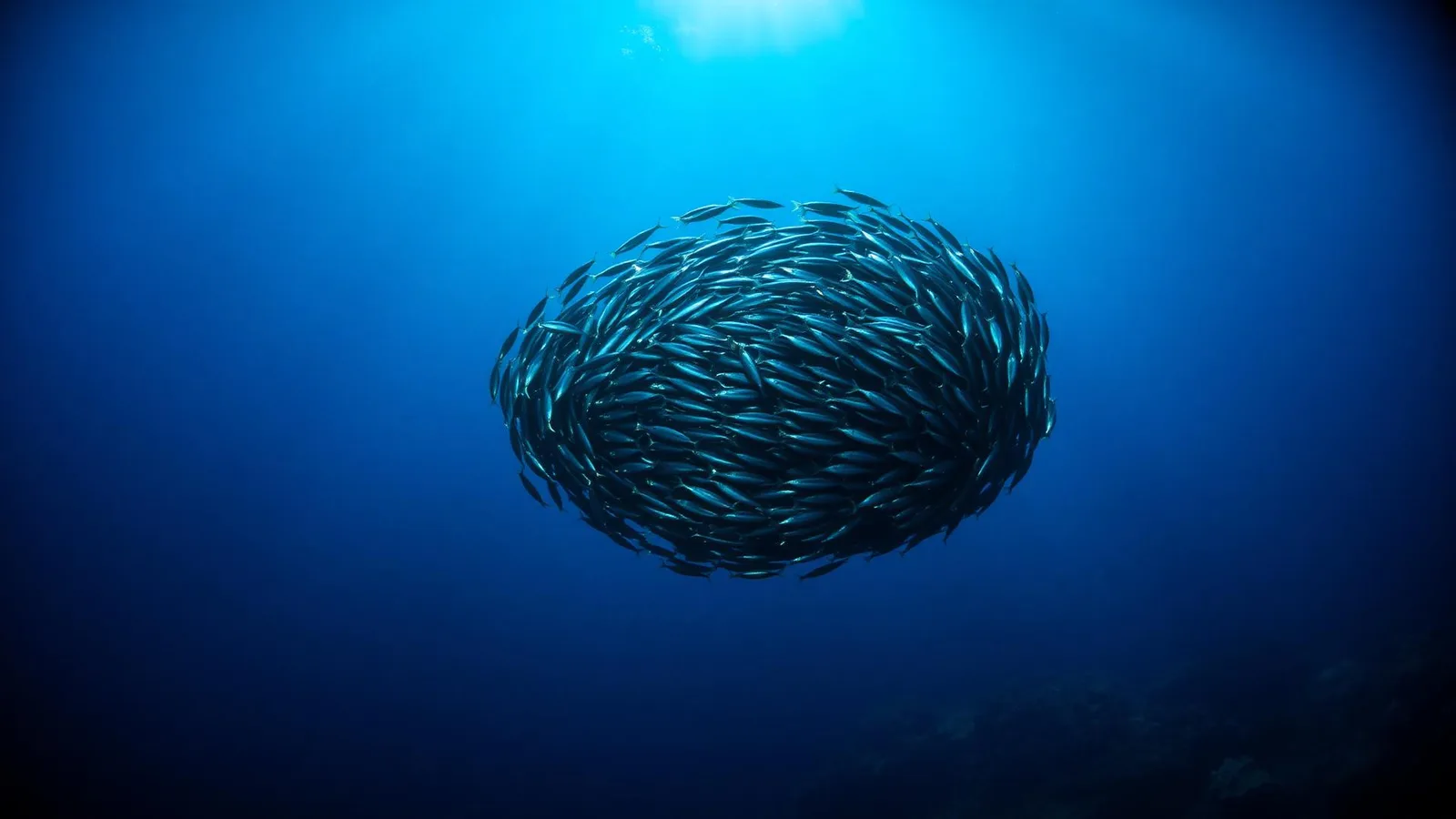
- Schooling pelagics (tuna, jack, amberjack): Compress into thinner oxygenated, thermally tolerable layers, sometimes creating spectacular surface aggregations above warm subsurface water — but signalling stressed ecosystems below.
Forecasting MHWs: Tools for Dive Trip Planning
NOAA Coral Reef Watch publishes Degree Heating Weeks (DHW) products in near-real-time at 5 km resolution globally. DHW integrates cumulative thermal anomaly over a 12-week window: one DHW equals one week of SST exceeding the climatological maximum monthly mean by 1°C. Bleaching typically begins at 4 DHW; widespread mortality is expected at 8+ DHW. The Australian Bureau of Meteorology and CSIRO issue MHW tracking products for the Australian region. Seasonal SST outlooks from NOAA and the European Centre for Medium-Range Weather Forecasts (ECMWF) provide 1–6 month probabilistic forecasts of above-normal SST, giving advance warning for trip planning.
Projections: The Hotter Ocean Ahead
The trajectory is unambiguous. Oliver et al. [3] showed that if 1.5°C of warming is achieved (Paris Agreement aspirational target), MHW frequency will be approximately five times higher than pre-industrial; at 2°C, 41 times higher; at 3.5°C, 90 times higher. In practical terms, this means that the ocean surface at most tropical reef locations will spend the majority of the year in 'MHW' conditions by the latter part of this century under high-emissions scenarios. At that point, the Hobday [1] threshold-based definition becomes paradoxical — an event cannot be anomalously warm relative to a baseline that is itself a marine heatwave. Frölicher et al. [4] termed this the 'permanent marine heatwave' state.
By 2100, under a high-emissions scenario, the global ocean will be in a permanent marine heatwave state relative to the late 20th century baseline — what we call extreme today will become the norm.— Frölicher, Fischer & Gruber, Nature, 2018 [4]
References
- [1] Hobday, A.J., Alexander, L.V., Perkins, S.E. et al. (2016). A hierarchical approach to defining marine heatwaves. Progress in Oceanography. doi:10.1016/j.pocean.2015.12.014
- [2] Hobday, A.J., Oliver, E.C.J., Sen Gupta, A. et al. (2018). Categorizing and naming marine heatwaves. Oceanography. doi:10.5670/oceanog.2018.205
- [3] Oliver, E.C.J. et al. (2021). Marine heatwaves. Annual Review of Marine Science. doi:10.1146/annurev-marine-032720-095144
- [4] Frölicher, T.L., Fischer, E.M., Gruber, N. (2018). Marine heatwaves under global warming. Nature. doi:10.1038/s41586-018-0383-9
- [5] Straub, S.C., Wernberg, T., Thomsen, M.S. et al. (2019). Resistance, extinction, and everything in between — the diverse responses of seaweeds to marine heatwaves. Frontiers in Marine Science. doi:10.3389/fmars.2019.00763
- [6] Hughes, T.P., Kerry, J.T., Álvarez-Noriega, M. et al. (2017). Global warming and recurrent mass bleaching of corals. Nature. doi:10.1038/nature21707
- [7] Kwiatkowski, L., Torres, O., Bopp, L. et al. (2020). Twenty-first century ocean warming, acidification, deoxygenation, and upper-ocean nutrient and primary production decline from CMIP6 model projections. Biogeosciences. doi:10.5194/bg-17-3439-2020
- [8] IPCC (2021). Climate Change 2021: The Physical Science Basis. WG I Contribution to the Sixth Assessment Report. Cambridge University Press.