
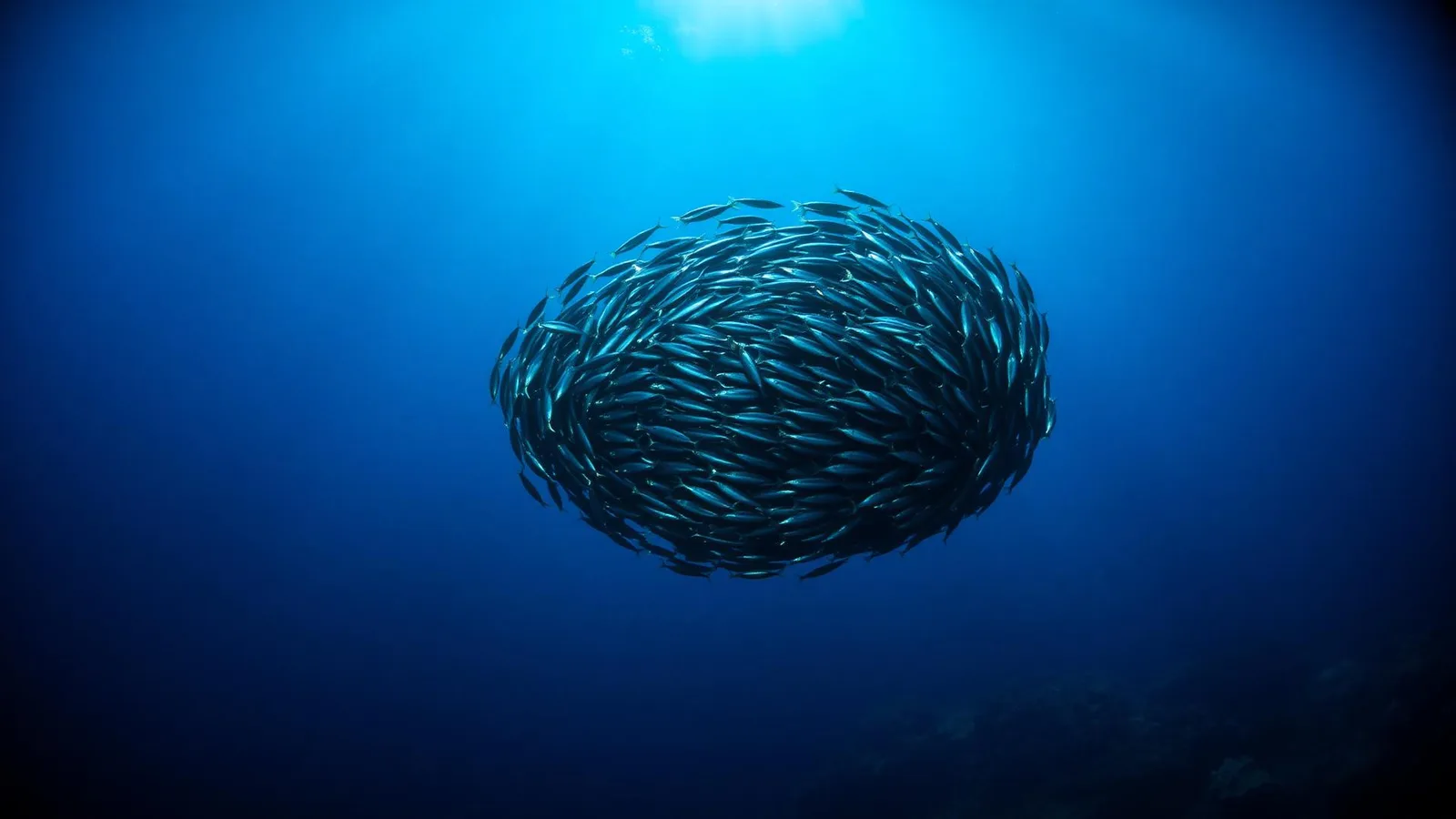
- Oceanic shark and ray populations have declined by 71% since 1970, primarily due to overfishing (Pacoureau et al., 2021).
- Clarke et al. (2006) estimated that 26–73 million sharks are killed annually for the fin trade.
- One-quarter of all chondrichthyan (shark, ray, chimaera) species are now threatened with extinction (Dulvy et al., 2014).
- 18 shark and ray species are listed on CITES Appendix II, requiring trade permits that verify legal and sustainable sourcing.
- Elasmobranch life-history traits — slow maturity, low fecundity, long gestation — make populations especially vulnerable to overexploitation.
- Fins from up to 73 species are present in the Hong Kong shark fin market, with scalloped hammerhead and blue shark most prevalent.
Shark finning — the practice of removing a shark's fins at sea and discarding the still-living body overboard — represents one of the most viscerally shocking practices in commercial fishing. But the problem extends far beyond finning alone. Sharks are caught in their millions as target species and as bycatch in longlines, gillnets, and purse seines worldwide. Their fins are traded in a global commodity market worth hundreds of millions of dollars annually, centred on the demand for shark fin soup (魚翅湯) in Chinese food culture. The combination of slow reproduction, high market value, and weak international regulation has driven oceanic shark populations to the edge of collapse within a single human lifetime — a crisis documented with unprecedented rigour by Pacoureau et al. in 2021.
A Half-Century of Decline: The Pacoureau et al. (2021) Finding
In January 2021, *Nature* published one of the most alarming assessments in the history of marine conservation. Pacoureau et al. synthesised population trend data for 31 species of oceanic sharks and rays — including the iconic oceanic whitetip (*Carcharhinus longimanus*), the silky shark (*Carcharhinus falciformis*), and the shortfin mako (*Isurus oxyrinchus*) — and calculated that their combined abundance had declined by 71.1% between 1970 and 2018 [1]. The drivers were unambiguous: fishing pressure was the dominant cause, operating through both targeted catch and bycatch. The study found that the risk of extinction has roughly doubled over the same period, with three-quarters of the 31 species assessed now qualifying as Endangered or Critically Endangered on IUCN Red List criteria.
The oceanic whitetip, once described by oceanographer Jacques Cousteau as 'the most dangerous of all sharks' because of its vast numbers in tropical open-ocean environments, has declined by approximately 98% in the Gulf of Mexico alone since the 1950s. The shortfin mako — the fastest shark in the ocean and a premier sport and commercial fishing target — was assessed as Endangered by the IUCN in 2018, with North Atlantic populations classified as Critically Endangered. These declines are not projections or models: they are reconstructed from fisheries observer data, catch records, and scientific survey data stretching back decades. They represent one of the fastest large-animal declines ever recorded.
The Global Fin Trade: Clarke et al. (2006)
Quantifying the scale of the shark fin trade has been methodologically challenging because shark fins are frequently traded under aggregated commodity codes that obscure species composition, and because substantial volumes move through informal channels. Clarke et al. (2006) addressed this challenge using a combination of trade statistics and genetic identification of fins in the Hong Kong shark fin market — then and now the world's largest — combined with Bayesian statistical methods to estimate total catch [2]. Their conclusion: between 26 and 73 million sharks were being killed annually for their fins, with a central estimate of approximately 38 million. The fins of at least 14 major shark species were identified, with scalloped hammerhead (*Sphyrna lewini*) and blue shark (*Prionace glauca*) fins most prevalent by volume.
The market mechanics of the fin trade have specific conservation consequences. Because fins are lightweight, non-perishable, and enormously valuable relative to shark body weight — a set of fins may be worth more than 10 times the value of the meat — they create an economic incentive to maximise the number of sharks caught rather than the weight of product landed. This is the economic logic that drives shark finning: rather than landing whole sharks, which require hold space proportional to their body mass, fishing vessels can fin sharks at sea and discard the bodies, dramatically increasing the number of animals processed per trip. In many jurisdictions, shark finning at sea remains legal or is only nominally prohibited, with enforcement rare.
IUCN Red List Status: The Dulvy et al. (2014) Assessment
The IUCN Red List provides the world's most authoritative assessment of species extinction risk. Dulvy et al. (2014) published the first comprehensive extinction risk assessment for all 1,041 known species of chondrichthyan fishes — sharks, rays, and chimaeras — using IUCN Red List criteria [3]. Their findings were stark: approximately 25% of chondrichthyan species are threatened with extinction (Vulnerable, Endangered, or Critically Endangered), making them among the most threatened of any major vertebrate group. A further 46% of species were classified as Data Deficient — meaning insufficient information existed to assess their status — which is itself a management concern, as data-deficient species cannot be subject to evidence-based catch limits.
The Dulvy et al. analysis found that the key drivers of threat were targeted fishing for fins and meat and incidental capture as bycatch — the same pathways identified by Pacoureau et al. seven years later [3]. Crucially, sharks and rays share life-history traits that make them exceptionally vulnerable to overfishing: most species take years to decades to reach sexual maturity, produce few offspring per reproductive cycle, and have gestation periods that rival or exceed those of humans in some cases. The whale shark (*Rhincodon typus*) may not reproduce until age 30 and can live to 150 years. These demographics mean that even modest levels of additional mortality can push populations below replacement rate and into decline.
CITES and International Trade Regulation
The Convention on International Trade in Endangered Species of Wild Fauna and Flora (CITES) provides the primary international legal framework for regulating wildlife trade. Under CITES, species listed on Appendix I are effectively banned from commercial international trade; species listed on Appendix II require that any international trade be accompanied by permits certifying that the trade is legal, traceable, and not detrimental to the survival of the species in the wild — a requirement known as a non-detriment finding (NDF). Appendix II listings do not ban trade but impose a regulatory and monitoring burden that, if effectively implemented, should prevent trade from driving unsustainable harvest.
The first shark species to receive CITES protection were the great white shark (*Carcharodon carcharias*) and the whale shark, listed on Appendix II in 2002 and 2003 respectively. The pace of listings accelerated dramatically at the 2013 (CoP16) and 2016 (CoP17) Conferences of the Parties, when oceanic whitetip, three species of hammerhead shark (*Sphyrna lewini*, *S. mokarran*, *S. zygaena*), porbeagle (*Lamna nasus*), and all manta ray species were listed. By the 2019 CoP18, the listings encompassed makos (*Isurus* spp.), wedgefish, guitarfish, and additional mobulid rays. As of 2024, more than 18 shark and ray species appear on Appendix II, covering the majority of commercially significant fin trade species by volume.
Challenges in Implementation and Compliance
CITES listings are only as effective as the compliance architecture that supports them, and for sharks the architecture remains weak. Non-detriment findings require robust stock assessments — which, for most shark species, do not exist. Range states that have never conducted shark stock assessments cannot credibly certify that exports are sustainable, yet trade continues. Genetic species identification in mixed fin consignments — the primary method for verifying that fins originate from permitted species — is expensive, requires specialist laboratory infrastructure, and is conducted at only a fraction of the thousands of annual fin shipments passing through international ports. The Hong Kong, Shanghai, and Guangzhou fin trading networks remain active despite increased regulation, with domestic trade within China operating outside CITES jurisdiction entirely.
Shark finning bans — which prohibit the removal of fins at sea and require that fins remain naturally attached to shark carcasses upon landing — have been adopted by the European Union, the United States, Brazil, Canada, and a growing number of other jurisdictions. The 'fins naturally attached' policy is considered more enforceable than ratio-based bans (which allow finning as long as fin weight does not exceed a certain proportion of carcass weight) because it requires no complex calculations at the dockside. However, the policy does not eliminate whole-shark fishing for the fin trade; it simply requires that carcasses be landed alongside fins, which increases vessel hold requirements but does not fundamentally alter the economics of fin-targeted fishing.
Consumer Campaigns and Demand Reduction
Alongside regulatory approaches, demand-reduction campaigns aimed at reducing consumption of shark fin soup in Chinese communities worldwide have achieved measurable results. Following high-profile campaigns by organisations including WildAid and WWF, featuring Chinese celebrities and athletes, surveys conducted in China in the mid-2010s documented significant declines in reported shark fin consumption among urban consumers. Import volumes of shark fins into Hong Kong peaked in the 2000s and have declined since, though attributing this to awareness campaigns versus changing economic conditions (the 2012 Chinese government austerity campaign, which discouraged extravagant restaurant dining by government officials, appears to have been a significant factor) is methodologically difficult.
The cultural significance of shark fin soup as a luxury ceremonial food — traditionally served at weddings, business banquets, and New Year celebrations — means that demand reduction is a multi-generational project rather than a quick policy win. Younger generations in China and among diaspora communities show lower attachment to the tradition, and several major hotel chains and airlines have eliminated shark fin from their menus. Yet demand persists in Southeast Asia, and the emergence of new middle-class markets in Vietnam, Thailand, and Indonesia represents a countervailing trend to reductions in China.
The Ecological Cost of Apex Predator Loss
Beyond the conservation status of shark species themselves, the removal of apex marine predators at the scale documented by Pacoureau et al. (2021) has profound ecological consequences [1]. Sharks occupy the top of marine food webs and regulate prey population size and behaviour through both direct predation and the so-called 'landscape of fear' effect — prey species alter their distribution and foraging behaviour in the presence of predator risk, which has cascading effects on vegetation, benthic communities, and nutrient cycling. The removal of large sharks has been documented to trigger trophic cascades in coral reef, seagrass, and open-ocean ecosystems: mesopredator release (the explosive growth of intermediate-level predators previously suppressed by sharks) can collapse prey populations at lower trophic levels and destabilise entire food webs.
Recovery timescales for shark populations are measured in decades to centuries. Worm et al. (2006) found that the recovery potential and stability of ocean ecosystems is directly proportional to their biodiversity — and a world without functional populations of oceanic sharks is a fundamentally impoverished and less stable ocean [4]. The regulatory progress achieved through CITES since 2002 is real and meaningful, but it is racing against a biological clock set by decades of overexploitation. Whether shark populations can recover fast enough to prevent irreversible ecological restructuring of open-ocean ecosystems depends on the speed and ambition of management responses in the next decade.
"Our analyses suggest that the global median of relative abundance for oceanic sharks and rays has declined by 71.1% since 1970, driven by an 18-fold increase in relative fishing pressure." — Pacoureau et al., Nature, 2021 [1]
References
- [1] Pacoureau N, Rigby CL, Kyne PM, et al. (2021). Half a century of global decline in oceanic sharks and rays. Nature. doi:10.1038/s41586-020-03173-9
- [2] Clarke SC, McAllister MK, Milner-Gulland EJ, et al. (2006). Global estimates of shark catches using trade records from commercial markets. Ecology Letters. doi:10.1111/j.1461-0248.2006.00968.x
- [3] Dulvy NK, Fowler SL, Musick JA, et al. (2014). Extinction risk and conservation of the world's sharks and rays. eLife. doi:10.7554/eLife.00590
- [4] Worm B, Barbier EB, Beaumont N, et al. (2006). Impacts of Biodiversity Loss on Ocean Ecosystem Services. Science. doi:10.1126/science.1132294
- [5] Worm B, Hilborn R, Baum JK, et al. (2009). Rebuilding Global Fisheries. Science. doi:10.1126/science.1173146
- [6] Kroodsma DA, Mayorga J, Hochberg T, et al. (2018). Tracking the global footprint of fisheries. Science. doi:10.1126/science.aao5646
- [7] Lewison RL, Freeman SA, Crowder LB (2004). Quantifying the effects of fisheries on threatened species: the impact of pelagic longlines on loggerhead and leatherback sea turtles. Ecology Letters. doi:10.1111/j.1461-0248.2004.00573.x
- [8] Pauly D, Christensen V, Guénette S, et al. (2002). Towards sustainability in world fisheries. Nature. doi:10.1038/nature01017