
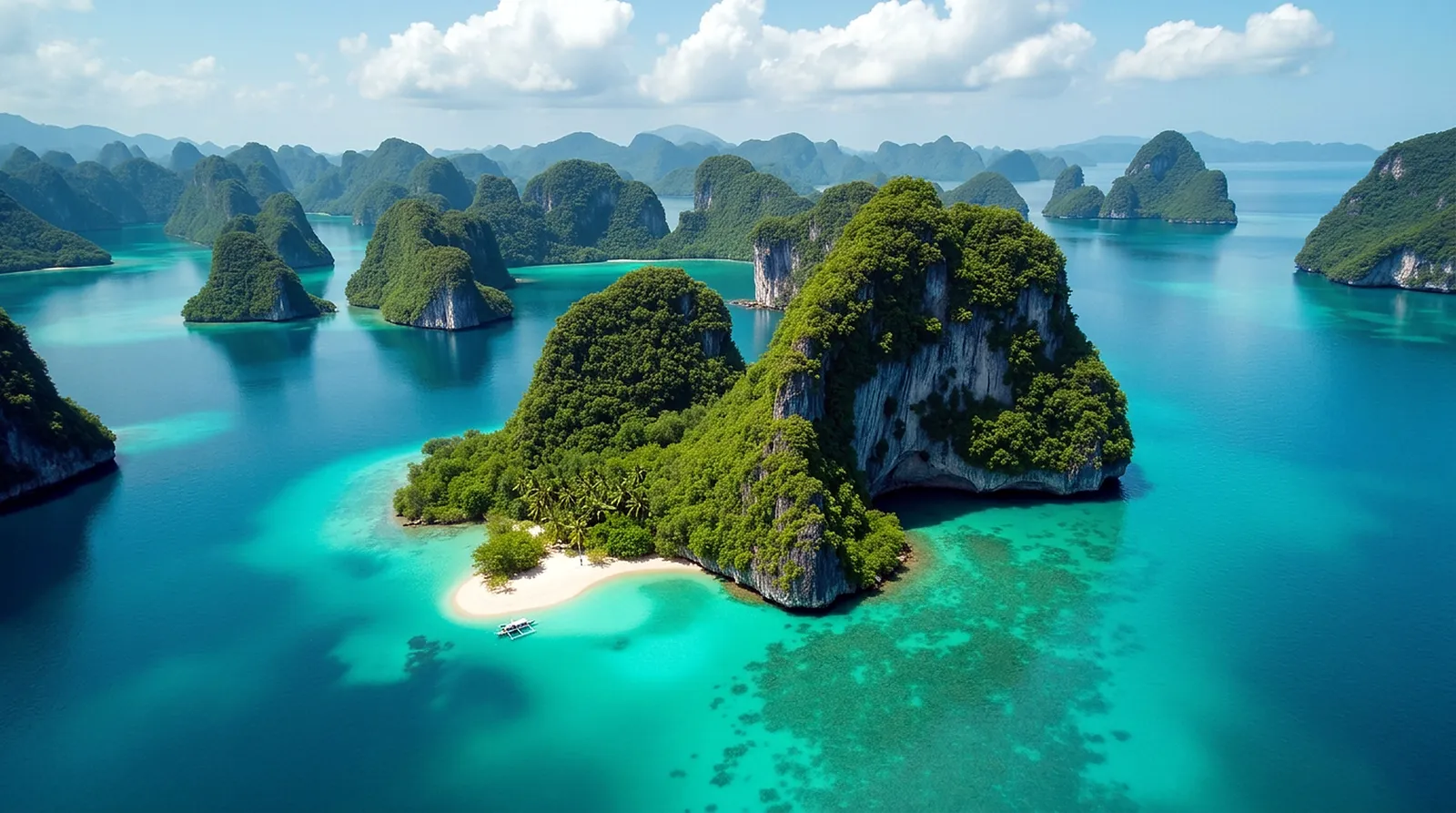
The most biodiverse marine ecosystem on Earth
Raja Ampat — literally 'Four Kings' — is a remote archipelago of more than 1,500 islands in the Indonesian province of West Papua, sitting at the very heart of the Coral Triangle. It is, by every scientific measure, the most biodiverse marine ecosystem on the planet: more than 1,500 species of fish, 700 species of mollusk and 75 percent of all known coral species converge here in a landscape of mushroom-shaped karst islands, hidden lagoons and current-swept passages. The region is so vast and so far-flung that liveaboard travel is the only practical way to combine its three major zones — Dampier Strait in the central north (manta cleaning stations and pelagic action), Misool in the south (soft coral walls and pristine hard-coral gardens), and the open ocean of Kofiau and Wayag (untouched frontier reefs). A Raja Ampat liveaboard is one of the great bucket-list trips of modern diving.
Raja Ampat has two seasons. The dry/calm season (October to April) is when most liveaboards operate: seas are calm, winds are light, visibility is at its best (20-30 m), and manta rays aggregate at Manta Sandy and Magic Mountain in the strait. December to March is the absolute peak for mantas, with daily encounters of 5-15 animals at the cleaning stations. The wet/windy season (May to September) sees stronger southeast winds and bigger swell on the open crossings, with most operators reducing service or relocating to other regions; some boats continue to run a limited Misool-only program protected by the southern islands. The shoulder months of October-November and April-May offer the best balance of weather and crowd density. Whale shark sightings at Cenderawasih Bay (technically a separate region) peak May to October.
All Raja Ampat liveaboards embark from Sorong (SOQ), a working port town on the western tip of West Papua. Sorong is reached by domestic flights from Jakarta (CGK), Makassar (UPG) or Manado (MDC) — typically a 4-5 hour flight from Jakarta with one stop, often overnight. Most international guests fly in via Singapore, Jakarta or Bali, overnight in Jakarta or Sorong, and embark the following morning. The total journey from Europe is 24-36 hours; from the US West Coast 22-28 hours. Indonesian visas on arrival are $35 for most Western nationalities, valid 30 days. Domestic luggage allowances are tight (20 kg checked, 7 kg cabin); confirm dive-gear allowance in advance. Sorong has basic hotels for the obligatory pre/post-trip overnight; most operators arrange this and the airport transfer.
Sorong (SOQ) is the only port for Raja Ampat liveaboards. The harbor is a working commercial port, not a tourist marina — guests typically arrive at the dock by transfer from a Sorong hotel and embark via a small tender. There are no facilities at the dock itself, so embarkation usually happens directly from a chartered hotel pickup to the boat in 30-45 minutes.
Raja Ampat divides into three classic zones. Dampier Strait (central north) hosts the most famous current-swept dives: Cape Kri (recorded as the most fish-diverse single dive site on Earth, with 374 species counted in a single dive), Blue Magic (a manta cleaning station with frequent grey reef shark action), Sardine Reef (clouds of jacks and snappers), and Manta Sandy (a sandy patch where 5-meter mantas hover at cleaning stations). Misool (south) is the soft-coral capital — Boo Windows, Magic Mountain, Whale Rock and Yellitt offer some of the most photogenic underwater landscapes on the planet, with vertical walls covered in red, pink and orange soft coral, swim-throughs and pygmy seahorses. Wayag and Kofiau (far north and west) are remote frontier sites with untouched reefs, sharks and the famous mushroom-island vistas. Topside, Raja Ampat is equally rich — birds-of-paradise hikes, hidden lagoons and some of Indonesia's most photogenic seascapes.
Raja Ampat is a serious commitment in money, time and travel logistics, but it consistently ranks as the best diving most experienced divers will ever do. Tipping is significant: $250-450 per guest per week is standard on Phinisi-style boats, paid in cash at the end. Park fees are mandatory: a Raja Ampat conservation tag costs around $100 per guest (valid one year) plus daily park entry; budget $200-300 in cash for fees. Water is warm (28-30°C) — a 3 mm full wetsuit is enough year-round; some divers use a 2 mm or skin suit. Bring a reef hook, surface marker buoy and dive computer; nitrox is included on most premium boats. Photography: a wide-angle lens with strong strobes is essential for the soft-coral walls of Misool; macro for Dampier's pygmy seahorses and rhinopias.
Raja Ampat is malaria-risk; consult a travel doctor about prophylaxis. Hyperbaric chambers are available in Sorong but evacuation from remote sites takes 12-24 hours; comprehensive dive insurance with hyperbaric coverage is non-negotiable. Wi-Fi on most boats is via Starlink (often included). Power outlets are typically European two-pin, 220V. Most liveaboards run 3-4 dives per day plus night dives 2-3 times per week, with rest days during long crossings between the major zones. Many boats include a topside excursion to a Wayag mushroom-island lookout, a bird-of-paradise hike or a Misool fishing-village visit. Christianity is the dominant religion in West Papua — alcohol is freely available on board.
Raja Ampat liveaboards are among the most expensive in Asia — typical prices run $4,500-9,000 per guest for 7-12 nights, plus park fees, flights, transfers and tips. Currents at sites like Blue Magic, Cape Kri and Magic Mountain can be very strong; Advanced Open Water plus 50+ logged dives is the typical minimum, with some operators requiring 100+. The journey from Europe or North America is long and involves at least one overnight in Jakarta or Sorong; book travel insurance and build buffer days. Domestic Indonesian flights are sometimes delayed; a missed connection means missing the boat. The region is politically sensitive — the indigenous Papuan independence movement occasionally generates news headlines, but the dive areas have been completely safe for decades and operators monitor the situation carefully.
Compare every liveaboard, every itinerary, every cabin — book direct with the operator at the best price.