
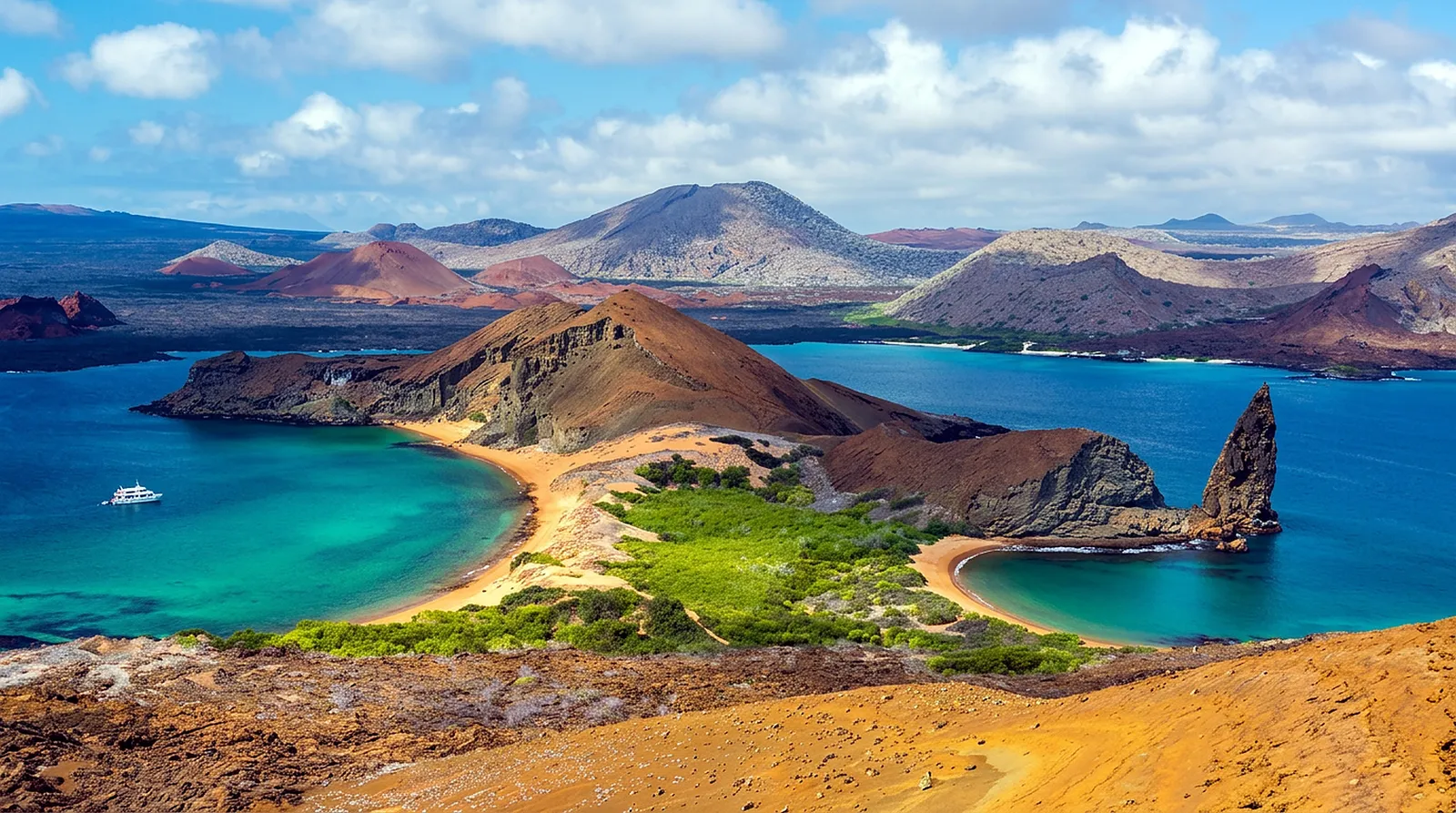
Hammerhead schools, whale sharks and the only place to dive with marine iguanas
The Galápagos Islands sit 1,000 kilometers off the coast of Ecuador, where four major ocean currents — Humboldt, Cromwell, Panama and South Equatorial — collide to create one of the most nutrient-rich and biologically extreme marine environments on Earth. This is not warm-water, postcard reef diving: the Galápagos is cold, current-swept and built for big animals. A Galápagos liveaboard, restricted by Ecuadorian law to a small fleet of permitted vessels, is the only way to reach the legendary northern islands of Wolf and Darwin, where hammerhead schools number in the hundreds, whale sharks the size of buses pass by between June and November, and Galápagos sharks, silkies, eagle rays and oceanic sunfish patrol the cleaning stations. With strict marine park rules, mandatory naturalist guides and a maximum of 16 guests per dive boat, this is bucket-list diving for experienced cold-water divers.
The Galápagos has two distinct seasons. The warm/wet season (December to May) brings 24-27°C surface water, calmer seas, the best visibility (20-25 m on average), and abundant tropical life — manta rays, mobulas, Galápagos sharks, sea turtles and active mating displays from sea lions. The cool/dry season (June to November) is the legendary one: water drops to 17-23°C with strong thermoclines (a 7 mm wetsuit, hood and gloves are standard), surface conditions are rougher, but the cold upwellings bring whale sharks (peaking July-October), schooling hammerheads in their hundreds, mola mola, and dense aggregations of pelagic fish. June to November is when most veteran Galápagos divers visit; December to May suits divers who prefer more comfortable conditions and the chance of bait balls, marlin and orca sightings. The shoulder months of April-May and November are excellent compromises.
All Galápagos liveaboards embark either at Baltra (GPS) or San Cristóbal (SCY), reached by one of two daily flights from mainland Ecuador. Most international guests fly into Quito (UIO) or Guayaquil (GYE), overnight, then take an early-morning domestic flight to the islands. Plan a minimum of one buffer night on each side — flight cancellations are common and missing the boat means missing the trip. Ecuador requires a $20 USD INGALA migration card and a $200 USD Galápagos National Park entrance fee, both paid in cash at the airport (no cards). All international visitors must also fill in the online safe-pass form 24 hours before departure. Naturalist guides, fuel and park fees are typically included in the headline price, but the $200 park entrance is almost always extra.
Liveaboards embark from Baltra (the main airport island, near Santa Cruz) or San Cristóbal — both are working ports with dive-boat tenders that ferry guests from the dock to the mothership. There is no marina in the European sense; you board via a wet landing from a small panga (dive tender). Note that itineraries often start at one island and end at the other, so your domestic-flight return ticket may be from a different airport — confirm before you book onward connections.
The classic Galápagos itinerary is 7 nights, 8 days, with two days at Wolf and two at Darwin in the remote north. Darwin's Arch (now collapsed but the dive site itself is unchanged) and El Derrumbe are world-renowned for scalloped hammerhead schools (often 200-500 fish), whale sharks, Galápagos sharks, silky sharks, eagle rays and turtles. Wolf hosts the Landslide and Shark Bay sites where hammerheads, mola mola and dolphins are common. The central islands (Cousin's Rock off Bartolomé, Punta Vicente Roca off Isabela, Gordon Rocks near Santa Cruz) deliver sea horses, frogfish, marine iguanas grazing underwater (Cape Marshall), penguins, sea lions and the surreal sight of a flightless cormorant fishing at depth. Punta Carrion is a famous check-dive. Most boats schedule three dives per day at central sites and four-plus per day at Wolf and Darwin.
Cold-water gear is mandatory: a 7 mm semi-dry or dry suit, hood, gloves and 3-4 mm boots, even in the warm season. Bring a reef hook, surface marker buoy, dive computer, cutting tool and a bright torch — dark cleaning stations and current-swept walls demand backups. Tipping is significant: $300-500 per guest per week is standard, split between dive crew and naturalist guide. Cash (USD, the official currency) is essential — for tips, the park fee and souvenirs in Puerto Ayora. Photography: the Galápagos is one of the world's great wide-angle destinations — bring your widest lens and strobes. Boats are slow internet at best (some now Starlink); plan to be off-grid. Galápagos requires Advanced Open Water plus a minimum of 50 logged dives; many operators require 100+ and proof of cold-water or current experience.
All visitors are bound by strict national park rules: do not touch wildlife, do not bring food or seeds ashore, follow your naturalist guide at all times during land excursions. Liveaboards combine diving with daily land visits to see giant tortoises (Santa Cruz, Isabela), blue-footed boobies, marine iguanas, Galápagos penguins and frigatebirds — the topside experience is half the trip. Hyperbaric chamber is available in Puerto Ayora (Santa Cruz). Most boats include free-flowing soft drinks, beer and house wine; spirits are charged extra. Vegetarian and special diets are easy with advance notice. The Galápagos sun is extreme — the equator combined with thin atmosphere; reef-safe sunscreen, UV rashguard and hat are essentials.
The Galápagos is one of the world's most expensive liveaboard destinations — typical prices run $5,500-8,500 per guest for 7 nights, plus $200 park fee, $20 INGALA, flights and tips. The number of liveaboard permits is strictly limited and has not increased in over a decade, so trips sell out 12-18 months in advance — book early. Sea conditions, especially on the open-water crossing to Wolf and Darwin (10-14 hours from the central islands), can be very rough — seasickness medication is strongly recommended. Wolf and Darwin currents can be powerful and unpredictable; safety equipment (Nautilus Lifeline, dSMB, audible signaling device) is sometimes mandated by operators. The Galápagos is not a beginner destination — be honest about your experience, comfort with current and cold, and air consumption.
Compare every liveaboard, every itinerary, every cabin — book direct with the operator at the best price.