
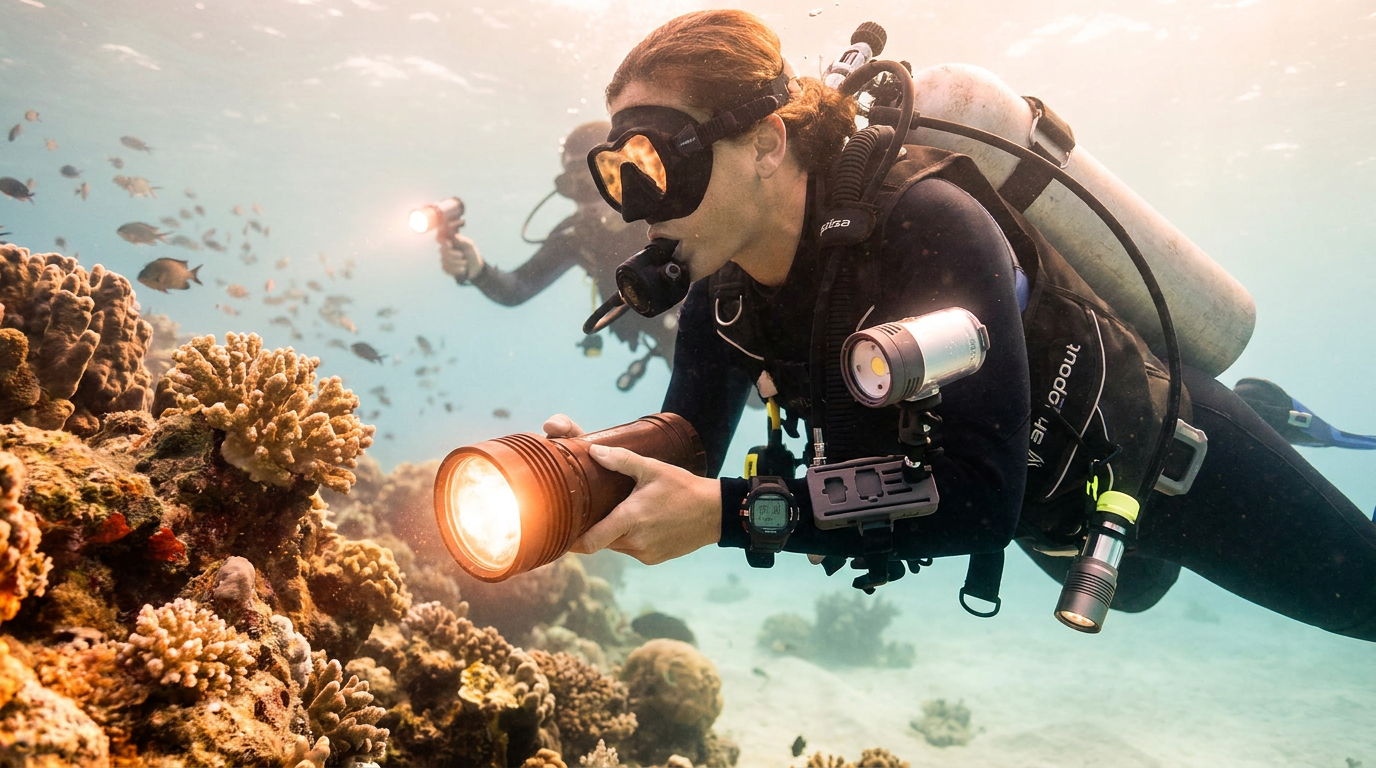
Why every liveaboard diver needs at least two lights
On a liveaboard you'll typically do 3–4 dives a day plus night dives, with no dive shop nearby to rent a replacement if your light dies. The accepted rule is one primary light (1000+ lumens) and one backup (200–500 lumens) clipped to your BCD. The backup also doubles as a torch for signalling, peering into crevices on day dives, and finding gear in your cabin when the boat's lights go out at anchor.
Lumens vs beam angle — which matters more?
Lumens measure raw output; beam angle determines how that light is spread. A 1000-lumen narrow beam (8°) punches further into blue water and is great for spotting eyes in the distance. A 1000-lumen wide beam (60–120°) lights up a larger area — perfect for video, reef tours, and not blinding the buddy in front of you. Most experienced divers carry both: a narrow primary for searching, a wide-beam video light for filming.
Burn time — match it to your dive plan
A typical night dive is 45–60 minutes, but you also want headroom for the surface interval briefing and the swim back to the ladder. Aim for 90+ minutes burn time at full power. Many lights step down (e.g. 100% / 50% / 25%) — useful when you want to conserve battery during a long fluorescence dive. Lithium-ion batteries last longer than alkaline; rechargeables save you smuggling 20 AA batteries through customs.
Build quality: what 'tested to 100m' actually means
Cheap dive lights flood at 30m. Look for IPX8 rating with a tested depth at least 1.5× deeper than you'll ever dive. Aluminium bodies survive boat drops; plastic doesn't. Check that the o-rings are user-replaceable — saltwater eats them, and a $2 o-ring kit on board has saved more night dives than any warranty.
Top picks by use case
Backup / pocket light: Light & Motion GoBe S 500, Mares EOS 5RZ. Primary all-rounder: Big Blue AL1300NP, Mares EOS 12LRZ, OrcaTorch D710. Video / wide beam: Big Blue VL7500P, Light & Motion Sola Video 3800. Tech / narrow spot: DGX 1000 Spot, OrcaTorch D900V. Ask your liveaboard if they sell spare batteries on board — some do, most don't.
Travel & charging on the boat
Boats run on 220V or 110V depending on flag — Maldives is 220V/UK plug, Egypt 220V/EU plug, Caribbean often 110V/US plug. Bring a universal adapter and check that your charger accepts 100–240V (most do). Charge lights between dives in the dry cabin, never in the dive deck where saltwater spray is constant. Label your charger with your name — every liveaboard has at least one identical-looking charger fight per trip.
Frequently Asked Questions
How many lumens do I really need for night diving?
1000–1500 lumens is the sweet spot. Below 800 you'll struggle in green water; above 2500 you blind your buddy and burn battery for no extra benefit.
Can I rent dive lights on the liveaboard?
Some boats rent primaries, but quality and battery condition vary wildly. Bring your own — it's small, light, and you trust it.
Do I need a separate video light?
Only if you're shooting video or photos. For pure recreational night diving, one primary + one backup is enough.
Lithium-ion batteries on flights — what are the rules?
Most airlines allow batteries up to 100Wh in carry-on only. Pack lights with batteries removed, in original packaging, and never in checked luggage.
What's the most common dive-light failure?
Flooding from a damaged or worn o-ring. Inspect, clean, and lightly grease before every trip; carry spare o-rings.
Ready to put that light to work?
Browse liveaboards with night-diving programmes and book your spot.
Find night-dive liveaboardsRelated Searches
Popular searches related to this guide