
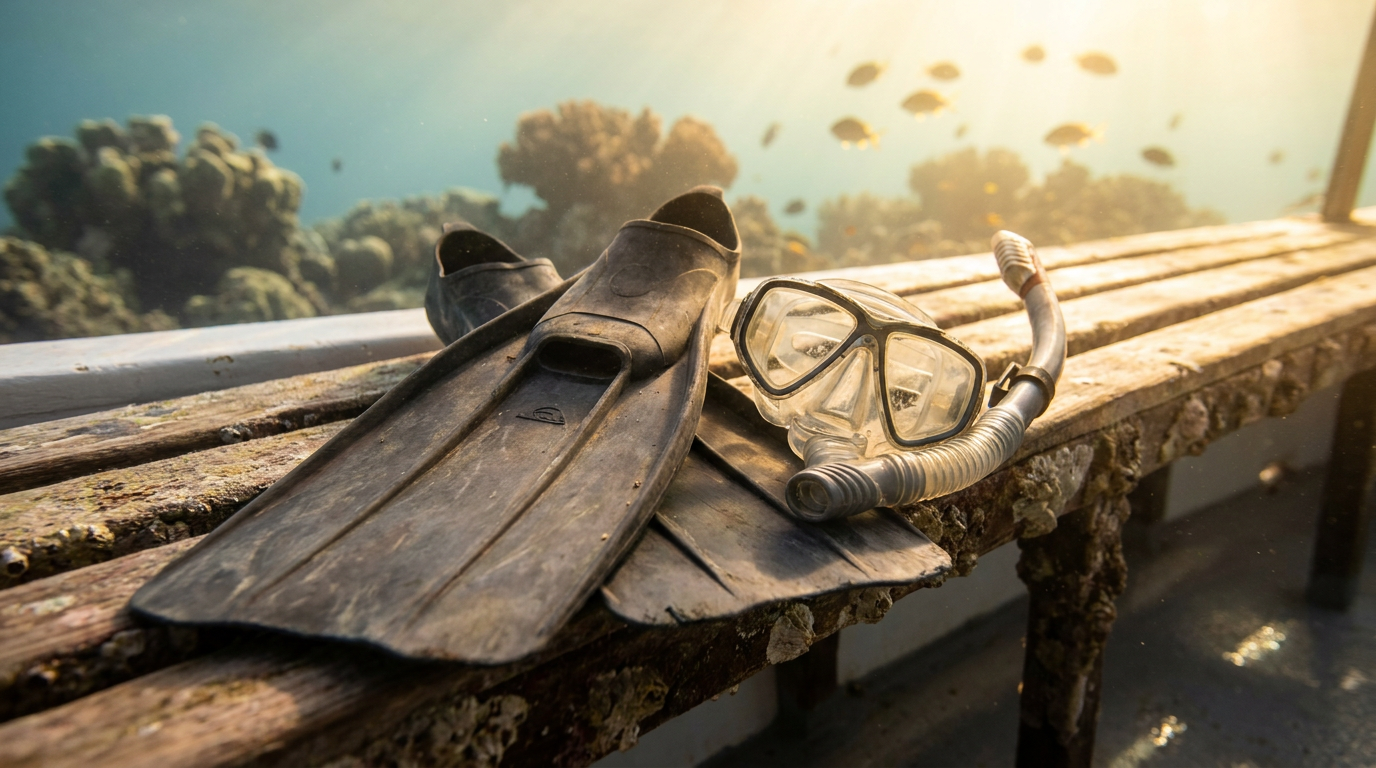
Mask: fit is everything
Brand and price barely matter. A $40 mask that seals to your face will outperform a $150 mask that doesn't. The fit test:
• Place the mask on your face without the strap
• Inhale gently through your nose
• If it stays in place for 5+ seconds, the silicone skirt seals to your face shape
• Look down — heavier masks reveal weak seals here
Avoid one-window masks if you wear contact lenses. Two-window or four-window designs sit closer to the face and reduce internal volume — easier to clear and equalise.
Mask features that actually matter
• Black silicone skirt — eliminates internal reflections for photographers
• Low internal volume — less air to clear and equalise
• Frameless or low-profile frame — smaller pack size for travel
• Prescription-ready — many models accept off-the-shelf corrective lenses ($60–$120 a pair)
Fins: paddle, split or jet
• Paddle fins (Mares Avanti, Scubapro Seawing Nova) — efficient power, work well in current. The all-rounder.
• Split fins (Atomic Split, Apollo Bio-Fin) — easier on knees, less leg fatigue. Weaker in strong current.
• Jet fins (Scubapro Jet Fin, Hollis F1) — short heavy rubber. Tech divers' choice. Excellent for back-kick and frog kick.
• Open-heel + bootie — required for cold water and shore entries
• Full-foot — warm water only, lighter for travel, no booties needed
For liveaboard travel, open-heel travel fins (Mares Volo Race, Aqualung Stratos) at 1.0–1.4 kg per pair save serious luggage weight.
Snorkel: necessary or not?
Once mandatory in dive training, the snorkel is now optional on most dives. Useful for surface swims back to a boat in choppy water; clutters your mask strap and snags lines on wreck or cave dives. The compromise: a foldable pocket snorkel that lives in your BCD pocket.
Travel weight target
A complete mask + open-heel travel fins + booties + snorkel set should weigh under 2.5 kg. Anything over 3.0 kg means you've over-bought.
Frequently Asked Questions
Can I dive without a snorkel?
Yes, on most recreational dives. Some training agencies still require one for entry-level courses. Cave, wreck and tech divers usually leave the snorkel behind.
Do I need prescription dive lenses?
If you wear glasses below -1.5 dioptre, yes — diving without correction is fine in calm water but dangerous in current or murky conditions. Off-the-shelf lenses for popular masks cost $60–$120 a pair.
What's the difference between full-foot and open-heel fins?
Full-foot fins fit like a slipper and are lighter for warm-water travel. Open-heel fins use an adjustable strap and require a neoprene bootie — necessary for cold water and shore entries.
How long do dive masks last?
5–10 years if you keep them out of direct sunlight when not in use. The silicone skirt eventually hardens and stops sealing — that's the time to replace.
Plan your next dive trip
Browse hand-picked liveaboards worldwide and book with expert support.
See liveaboardsRelated Searches
Popular searches related to this guide