
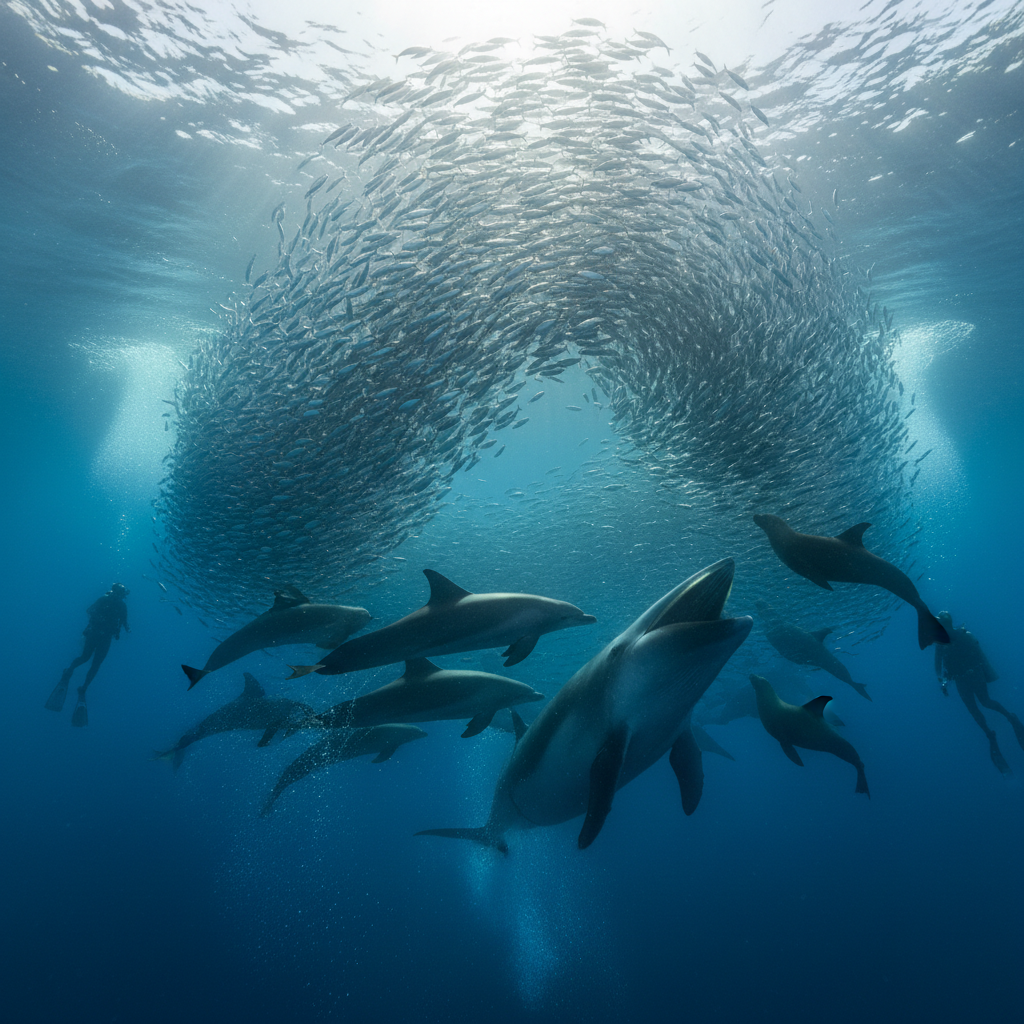
Imagine, if you will, being completely enveloped by a shimmering, pulsing mass of silver. The light refracting off a million scales, creating a living, breathing current around you. Then, from the periphery, a flash of iridescent blue, a sleek form moving with deadly purpose, dissecting the school with surgical precision. This isn't a dream; it's a front-row seat to one of nature's grandest feeding spectacles, the Baja Sardine Run, an experience that promises to redefine your understanding of the ocean's raw power and beauty.
Why Sardine Run Belongs on Your Bucket List
You've heard of the South African Sardine Run, a legendary event that draws divers from across the globe. But what if I told you there's a powerful, equally magnificent spectacle unfolding on the Pacific coast of Baja California Sur, Mexico, one that offers an intimate, uncrowded, and profoundly impactful encounter with pelagic predation? The "Baja Sardine Run" is precisely that—an open-ocean ballet of survival, where immense schools of sardines transform the waters into a vibrant, dynamic arena for the ocean's top predators.
What makes this particular sardine run a genuine bucket-list contender is its intense, often one-on-one nature. Unlike its larger, more geographically dispersed South African counterpart, the Baja event often allows for incredibly close, prolonged interactions. Imagine free-diving alongside a bustling baitball, watching striped marlin dart through, their swords flashing, or witnessing sea lions effortlessly weave through the chaos, snatching their prey. This is not just about observing; it's about being immersed in a primal drama, an authentic wildlife documentary unfolding before your very eyes. It's a dynamic experience, demanding agility and a keen sense of observation, making it perfect for adventurous divers and snorkelers seeking raw, untamed nature.
This is a truly unique opportunity to witness the coordinated hunting strategies of multiple species – a natural feeding frenzy on an unimaginable scale. It’s a chance to witness the intricate web of marine life in its most dramatic form, a testament to the ocean's enduring vitality. If your dive logs speak of adventure, if your heart yearns for untamed encounters, and if you dream of a wildlife experience that transcends the ordinary, then the Baja Sardine Run awaits its rightful place on your ultimate diving itinerary.
What You'll See and Do
The heart of the Baja Sardine Run lies in the massive congregations of sardines that migrate along the coast near Magdalena Bay (San Carlos), Baja California Sur. These enormous aggregations form defensive "baitballs," which in turn attract an astonishing array of predators. Your days will be spent seeking out these baitballs from a panga (a traditional Mexican fishing boat), driven by experienced captains who understand the intricate signs of the ocean – the flocks of frigatebirds circling overhead, the boiling surface indicating a feeding frenzy below.
Once a baitball is located, the real magic begins. You'll primarily experience this spectacular event through high-octane freediving and snorkelling. Imagine slipping into the water, typically 10-20 metres deep over sandy bottoms, but often witnessing the action in the top 5-10 metres. You'll be eye-level with sleek, powerful striped marlin (Kajikia audax), their striking stripes shimmering as they dart through the baitball, herding and striking with their sharp bills. Alongside them, California sea lions (Zalophus californianus) will exhibit their incredible agility and playful intelligence, expertly plucking fish from the swirling mass. Common dolphins (Delphinus delphis) often join the hunt, their powerful bodies torpedoing through the sardines, while Bryde's whales (Balaenoptera edeni) may make an occasional, awe-inspiring pass, gulping down huge mouthfuls.
The interactions are fast-paced and mesmerising. You'll observe coordinated hunting, where marlin work together to "switch" and herd the fish, while sea lions exploit the disarray. The air above the baitball often teems with frigatebirds (Fregata magnificens) and other seabirds dive-bombing for their share. Each encounter is unique, dictated by the unpredictable rhythm of nature. While not a conventional SCUBA dive in the reef sense, some operators may offer opportunities for short SCUBA drops near calmer baitballs or for exploring the vibrant nearshore ecosystems of Magdalena Bay if conditions allow, but the primary focus remains the freediving interaction with the predators and baitballs.
Best Time to Go
The Baja Sardine Run is an annual phenomenon, with the prime window for witnessing this incredible event spanning from October to December. During these months, the waters off Baja California Sur are teeming with life, and the conditions are generally favourable for open-ocean encounters.
Water temperatures during this period typically range from a comfortable 24°C to 28°C (75°F to 82°F) in October, cooling slightly to 21°C to 25°C (70°F to 77°F) by December. These temperatures are generally conducive to extended freediving and snorkelling sessions, though a 3mm to 5mm wetsuit is advisable for comfort and sun protection. Visibility can be excellent, often exceeding 15-20 metres (50-65 feet) in the open ocean, allowing for clear views of the action. While conditions are generally calm, you are operating in the open Pacific, so expect some ocean swell and occasional currents. The weather is typically sunny and warm, but as with any marine activity, a keen eye on forecasts is always recommended.
How to Dive Sardine Run
Accessing the Baja Sardine Run is primarily facilitated by expeditions operating out of Magdalena Bay (San Carlos), or sometimes from Todos Santos, though San Carlos is the more common launching point for sardine run-focused trips. Most expeditions are run as multi-day liveaboard experiences, or specialist day-boat tours from a shore base, allowing you to maximise your time in the hunting grounds. Liveaboards offer the distinct advantage of being able to stay out in the prime locations, increasing your chances of multiple baitball encounters throughout the day without the long transit times inherent in day trips. They also provide comfortable accommodation, expert guides, and hot meals, making the intense days of searching and freediving much more manageable.
Given the nature of the encounters – fast-paced, open-ocean freediving/snorkelling, often involving quick entries and exits from the boat – a strong swimming ability and comfort in ocean swells are paramount. While a formal freediving certification isn't always strictly required by all operators, it is highly recommended to enhance your safety and enjoyment. You'll benefit immensely from understanding breath-hold techniques and efficient finning. You should ideally have at least 50-100 logged dives or significant open-water snorkelling experience, demonstrating your comfort and proficiency in varied conditions. For SCUBA divers, an Advanced Open Water certification is beneficial if any short dives are offered, and a Drift Diver speciality would be advantageous for moving with currents. Nitrox is less relevant here as SCUBA diving is not the primary mode of interaction. A 3-5mm full wetsuit is recommended for thermal protection and abrasion resistance, even in warmer water. Personal gear should include a good quality mask, snorkel, and open-heel fins with boots. For photographers, wide-angle lenses for both stills and video are essential to capture the scale of the baitballs and the dynamic interactions.
Conservation and Responsible Diving
Participating in the Baja Sardine Run means you are a guest in a dynamic and fragile ecosystem. Responsible diving and snorkelling practices are crucial to ensuring the longevity of this incredible phenomenon. Always adhere strictly to your guide's instructions; they are experts in marine animal behaviour and will prioritise both your safety and the welfare of the wildlife. Maintain a respectful distance, especially from larger predators and marine mammals, and never attempt to touch or feed any animals. Remember, you are observing a natural hunting event; interfering in any way is strictly prohibited. Practise impeccable buoyancy control if SCUBA diving, ensuring no contact with the seabed or any marine life. For photographers, ethical behaviour means avoiding intrusive flash photography, especially at night, and prioritising natural behaviour over a perfect shot. The goal is to minimise your impact so that generations to come can also witness this magnificent display of nature's power.
Plan Your Trip
The Baja Sardine Run is an extraordinary adventure, a vibrant tapestry of marine life that will leave an indelible mark on your soul. If you're ready to answer the call of the wild and immerse yourself in one of the ocean's greatest spectacles, explore the premium liveaboard options Blue Rides offers for this unparalleled experience. Our carefully curated itineraries ensure you get the most out of your time in this incredible part of the world.