You’ve dreamt of it, scrolled through countless breathtaking images, maybe even watched documentaries that left you itching for the ocean’s embrace. Now, imagine a place where the barrier between human and oceanic giant simply dissolves, where an encounter of a lifetime isn't just possible, but practically guaranteed. This isn't a fantasy; it's the raw, unfiltered reality of Socorro Island, a realm where giant manta rays don't just exist, they dance with you.
The Revillagigedo Archipelago, often simply called Socorro, stands as a testament to the wild heart of the Pacific. Far from the mainland, these volcanic islands have become a sanctuary for marine life on an epic scale, offering a dive experience that transcends the ordinary. If your soul yearns for profound connection with the ocean's most magnificent creatures, pack your fins, because Socorro is calling.
Why Socorro Giant Mantas Belongs on Your Bucket List
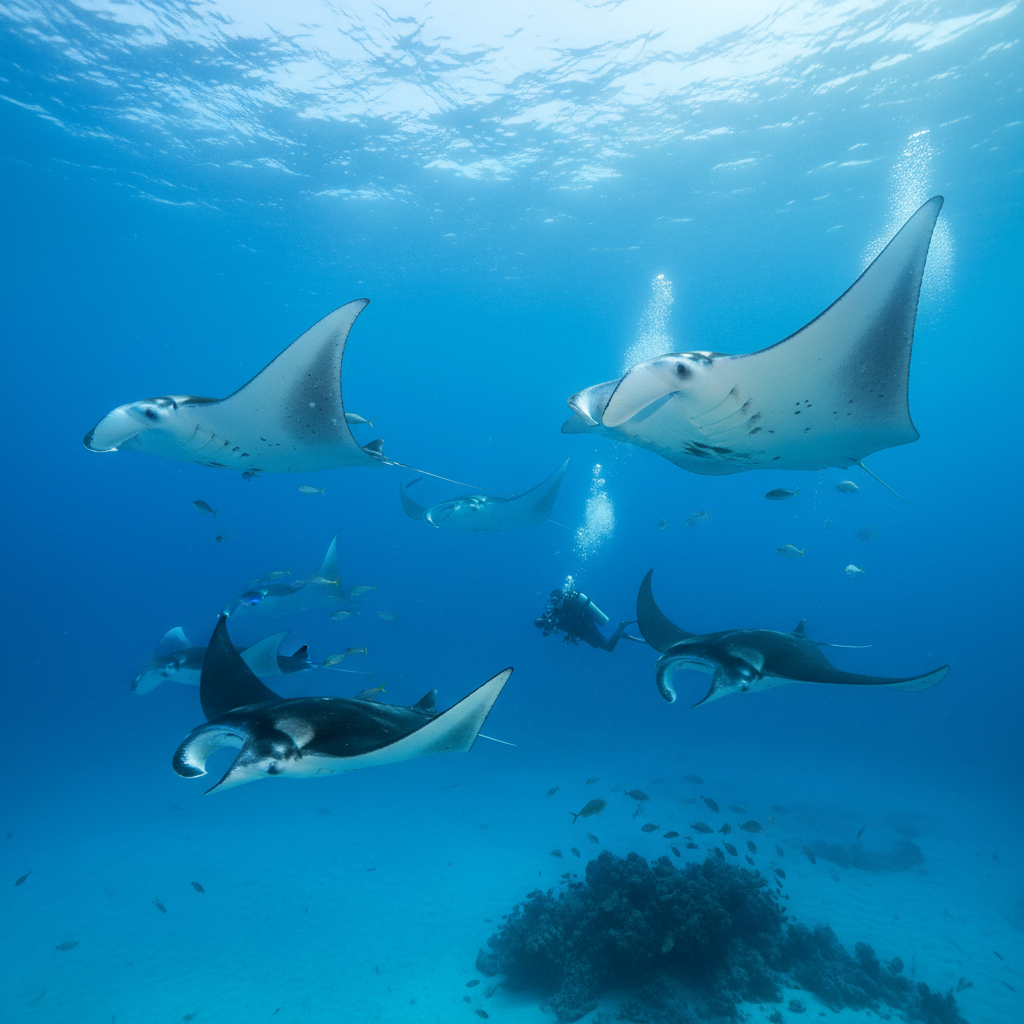
The "Socorro Giant Mantas" experience is not just another dive trip; it's a pilgrimage to one of the planet's most revered marine sanctuaries. What elevates Socorro to bucket list status isn't merely the presence of giant oceanic mantas (Mobula birostris), but their extraordinary behaviour. These aren't shy, fleeting glimpses; Socorro mantas are renowned for their curious, almost interactive nature. They seek out divers, often gliding inches away, making eye contact, and seemingly performing for their human admirers. This level of interaction is virtually unparalleled anywhere else in the world, painting a picture you'll carry in your mind's eye for years to come.
Beyond the mantas, the sheer biodiversity of the Revillagigedo Islands is breathtaking. This is a truly wild, open-ocean environment shaped by powerful currents and deep waters, attracting pelagic giants. Imagine schooling hammerhead sharks (Sphyrna mokarran) circling gracefully, playful bottlenose dolphins (Tursiops truncatus) eager to interact, and various species of whale sharks (Rhincodon typus) making cameo appearances. During certain months, the ethereal song of humpback whales (Megaptera novaeangliae) resonates through the water, as these magnificent mammals migrate through the area, sometimes even surprising divers with their majestic presence. It’s an ecosystem in full, vibrant force, a true spectacle.
This experience is tailor-made for the seasoned diver – someone who appreciates the raw beauty of an untouched marine environment, who is comfortable in deeper, bluer waters, and who possesses a profound respect for marine life. It’s for those who have seen much, but yearn for something truly unique, something that touches the very core of their adventurous spirit. This isn't about crowded reefs or shallow drifts; it's about connecting with the ocean's most magnificent creatures on their terms, in their natural habitat, far from the madding crowds.
What You'll See and Do
Diving in Socorro is an exercise in anticipation and awe. Each descent promises something spectacular, and more often than not, delivers. The star attractions, the giant oceanic mantas, are typically found at cleaning stations around the seamounts and offshore pinnacles. Sites like El Boiler at San Benedicto provide reliable manta encounters, where these magnificent creatures circle slowly, allowing smaller fish to clean parasites from their massive bodies. You’ll spend significant time observing their elegant ballet, their wingspan often reaching an impressive 7 metres (23 feet).
Beyond the mantas, the variety of marine life is astounding. At sites such as Roca Partida, a dramatic solitary rock pinnacle rising from the deep, you'll encounter Galapagos sharks (Carcharhinus galapagensis), silky sharks (Carcharhinus falciformis), and sometimes schooling hammerheads. Moray eels peer from crevices, while jacks, tuna, and wahoo patrol the deeper waters. The playful resident bottlenose dolphins are a highlight, often initiating curious interactions with divers, nudging them gently or circling playfully. Dive depths commonly range from 15 to 30 metres (50 to 100 feet), with most encounters occurring in the shallower end of this range, but deeper dives might be undertaken to appreciate the full scale of the seamounts or for specific pelagic sightings. Surface intervals are often filled with sightings of seabirds such as boobies and frigatebirds, completing the remote island experience.
The dive style is predominantly drift diving, utilising the currents to traverse sites and increase the chances of pelagic encounters. While some shallow reefs exist, the true draw is the deep, blue water and the pelagic life it holds. It's a dive experience that rewards patience and a keen eye, as the ocean's giants can appear from the blue at any moment. Photographers will be in paradise, capturing intimate moments with mantas and dolphins, and sweeping vistas of shark schools. Respect for the animals is paramount; no touching or chasing is permitted, allowing these incredible interactions to occur naturally and without stress to the wildlife.
Best Time to Go
The prime season for diving the Revillagigedo Archipelago, including Socorro Island, runs from November through June. During these months, the ocean conditions are generally more favourable, and the pelagic activity is at its peak. Water temperatures during this period range from approximately 21 to 28°C (70 to 82°F). Early season (November-December) tends to have warmer waters, often around 25-28°C (77-82°F), while the cooler months of February-April can see temperatures drop to 21-24°C (70-75°F). Visibility is typically excellent, often ranging from 15 to 40 metres (50 to 130 feet), providing crystal-clear views of the underwater spectacle.
Currents can be moderate to strong, particularly around the exposed seamounts and pinnacles, which is precisely why the pelagic life congregates here. This necessitates good buoyancy control and comfort with drift diving. Surface conditions can vary, with the Pacific swell sometimes making for a lively open-ocean crossing to and between the islands. The cooler months (February-April) also bring the incredible opportunity to witness humpback whales, as they migrate through the area for breeding and calving. This adds another layer of magic to an already phenomenal destination.
How to Dive Socorro Giant Mantas
Accessing the remote Revillagigedo Islands is exclusively via liveaboard. Due to their protected status and distance from the mainland (approximately 240 nautical miles south of Cabo San Lucas, Baja California Sur), day-boat operations are not feasible. Liveaboards provide a fully self-contained diving expedition, offering multiple dives daily, comfortable accommodation, and delicious food, allowing you to focus entirely on the diving. The journey to Socorro typically takes around 24-26 hours, depending on sea conditions, setting the stage for an epic adventure.
Given the nature of the diving – deep blue water, strong currents, and exposure – a minimum certification level of Advanced Open Water Diver is generally required. Operators also typically recommend a minimum of 50-100 logged dives, with recent experience in similar conditions. Essential courses to consider are enriched air Nitrox, which extends bottom time and reduces nitrogen loading, and a drift diving specialty course. A good quality 5mm or 7mm wetsuit is advisable, particularly for cooler months and multiple dives per day. Given the depth and marine life, a dive computer is indispensable, and a surface marker buoy (SMB) is crucial for diver safety in open water. Remember to pack your best wide-angle lens for photography – you’ll want to capture everything!
Conservation and Responsible Diving
The Revillagigedo Archipelago is a UNESCO World Heritage site and a highly protected marine national park. This designation underscores the critical importance of conservation efforts. Divers play a vital role in maintaining the pristine condition of this ecosystem. Adherence to strict no-touch policies is paramount; do not attempt to touch or chase any marine life, including the mantas and dolphins, no matter how curious they appear. Maintain a respectful distance to allow natural behaviours to unfold without disturbance. Anchoring is prohibited, and liveaboards use mooring buoys or drift with the currents. Photo and video ethics are also important; be mindful of your strobes and lights, ensuring they do not distress animals. By following these guidelines, we ensure that these magnificent interactions can continue for generations to come.
Plan Your Trip
Witnessing the Socorro Giant Mantas is an experience that will redefine your understanding of the ocean's majesty. If you're ready to answer the call of the wild Pacific and immerse yourself in one of the world's most extraordinary underwater encounters, browse our selection of premium liveaboards departing for this incredible Mexican adventure. Your bucket list awaits.