
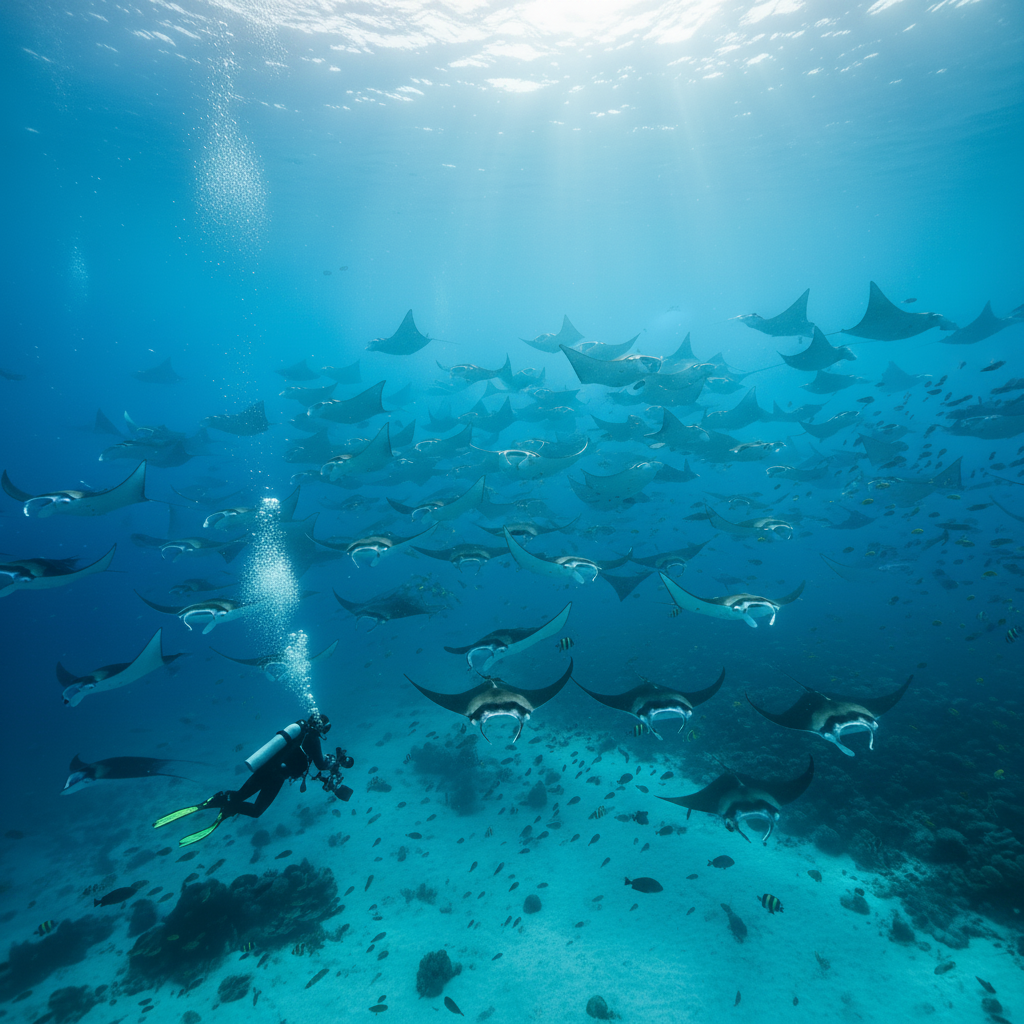
Imagine being suspended in crystal-clear water, the sunlight dappling through the surface, when suddenly, a shadow unfurls above you. Then another. And another. Soon, you’re not just watching; you’re enveloped in a mesmerising ballet, a swirling vortex of giants, their graceful wings propelling them through the water with effortless precision. This isn’t a dream; it’s the Manta Ray Migration in the Maldives, an experience so profoundly awe-inspiring, it redefines what you thought possible underwater.
Why Manta Ray Migration Belongs on Your Bucket List
The sheer scale of the Manta Ray Migration in the Maldives is what elevates it from a remarkable dive to an almost spiritual encounter. While manta rays are found across tropical and subtropical oceans, the seasonal aggregation in Hanifaru Bay, within the Baa Atoll UNESCO Biosphere Reserve, is globally unparalleled. Here, you’re not just hoping to spot a manta; you’re entering a realm where hundreds of these magnificent creatures — both reef and oceanic mantas – gather to feed. Picture this: a feeding frenzy so dense, the water darkens with their presence, and you find yourself amidst a synchronised ballet of up to 200 individuals, their mouths agape, scooping plankton-rich waters. It’s an ecological spectacle driven by a unique confluence of currents and tides, creating a plankton superhighway that acts as an irresistible siren call for these gentle giants.
This isn't merely a dive; it’s an immersion into one of nature's most extraordinary phenomena. For anyone who yearns for monumental wildlife encounters, who seeks to witness the raw power and beauty of the ocean at its most vibrant, this is your pilgrimage. It’s an experience that transcends the typical dive holiday, offering not just sightings, but an intimate, almost overwhelming connection with these intelligent and curious creatures. Whether you're a seasoned diver with hundreds of logged dives or an Advanced Open Water certified enthusiast looking to tick off that ultimate bucket list item, the Manta Ray Migration offers something profoundly moving.
It’s about the "WOW" factor, the sheer impossibility of what you're witnessing. Unlike other destinations where you might encounter one or two mantas, Hanifaru Bay presents a living, breathing tapestry of them. Their graceful movements, the way they glide effortlessly past you, sometimes just inches away, creates indelible memories. It truly is a once-in-a-lifetime opportunity to observe natural behaviour on an epic scale, a grand theatre where you are not just an audience member, but a part of the unfolding drama.
What You'll See and Do
While the undisputed stars of the show are the majestic manta rays, the Manta Ray Migration in Hanifaru Bay offers much more than just these plankton feeders. While snorkeling is the primary way to experience the bay itself due to its protected status and shallow depths, surrounding dive sites throughout the Baa Atoll promise a rich tapestry of Maldivian marine life. When you’re in Hanifaru, you’ll be mesmerised by the mantas forming "cyclones" as they feed, a breathtaking display of cooperative foraging. They barrel roll, loop-the-loop, and swim in formations, mouths wide open, hoovering up the dense soupy plankton. Observing their feeding behaviour from the surface, often in depths as shallow as 2-5 metres, provides an unparalleled view of their elegance and efficiency.
Beyond Hanifaru, your liveaboard will explore other dive sites within the Baa Atoll. Expect vibrant coral reefs teeming with life: colourful parrotfish, inquisitive triggerfish, schooling snappers, and intricate nudibranchs. You’ll likely encounter reef sharks patrolling the thilas (underwater pinnacles) and giris (smaller coral formations), and perhaps even a leopard shark resting on the sandy bottom. Turtles, both green and hawksbill, are common sights, gracefully navigating the coral gardens. Eagle rays often glide past in formation, and the occasional schooling barracuda or trevally can add an exciting dynamic to your dive.
Dives outside Hanifaru Bay are typically drift dives along channels and outside reefs, offering gentle to moderate currents that carry you past an ever-changing landscape. Depths usually range from 15-30 metres (50-100 feet), allowing for plenty of bottom time to appreciate the intricate ecosystems. The focus remains largely on large pelagics and healthy reef systems, with sites like Dhonfanu Thila, Nelivaru Thila, and Anga Faru offering diverse experiences from cleaning stations to vibrant reef walls. While manta sightings are often the highlight, the richness of the Maldivian underwater world ensures every dive is a discovery.
Best Time to Go
The "Manta Ray Migration" in Hanifaru Bay is a seasonal marvel, directly tied to the southwest monsoon. The best time to witness this extraordinary aggregation is from June to November. During these months, the unique oceanographic conditions and currents funnel huge concentrations of plankton into the shallow, sheltered waters of Hanifaru Bay, creating the perfect feeding ground for hundreds of mantas. While sightings can occur outside this window, the sheer numbers and reliability of encounters are highest during this peak season.
Throughout the Maldives, water temperatures remain beautifully consistent, hovering around 28-30°C (82-86°F) year-round, so a 3mm shorty or even just a rash guard is often sufficient. Visibility in the Maldives is legendary, typically ranging from 20-30 metres (65-100 feet), though in Hanifaru Bay itself, when the plankton bloom is richest, visibility can be reduced to 10-15 metres (30-50 feet) – a small price to pay for being surrounded by feeding mantas. Currents can vary from mild to strong, particularly on channel dives, necessitating good buoyancy control. The southwest monsoon brings a slightly higher chance of rain and choppier seas compared to the calmer northeast monsoon (December-May), but these often occur in short bursts and rarely disrupt the diving schedule significantly. The occasional squall simply adds to the dramatic tropical experience.
How to Dive Manta Ray Migration
Your journey to witness the Manta Ray Migration is predominantly facilitated by liveaboards. While a few resorts in the Baa Atoll offer day trips to Hanifaru Bay, a liveaboard offers unparalleled access to a wider range of dive sites and maximizes your chances of being in the right place at the right time for manta encounters, both in Hanifaru and at cleaning stations throughout the atoll. Liveaboards provide multiple daily dives, flexibility with itineraries based on conditions, and the convenience of staying right next to the best dive spots. For Hanifaru Bay itself, it's important to remember that strict regulations are in place: only snorkelling is permitted, limiting the number of people and time in the water to protect the mantas. Your liveaboard crew will brief you thoroughly on these rules.
To fully enjoy a Maldivian liveaboard experience, particularly one focused on these pelagic encounters, an Advanced Open Water certification is highly recommended. This allows you to participate in deeper dives (up to 30m/100ft) and offers more experience in varied conditions. While not strictly mandatory for all dives, having 50+ logged dives under your belt will ensure you're comfortable with drift dives and potentially stronger currents. Completing a PADI Enriched Air Nitrox (EANx) course is also a wise investment; diving with Nitrox allows for longer bottom times, particularly beneficial for multiple dives a day, and reduces nitrogen loading. Additionally, a Drift Diver specialty course can boost your confidence in current-rich environments. For wetsuits, a 3mm shorty or full suit is ample for the warm Maldivian waters, but a full suit can offer protection from sun and minor stings. Always bring a dive computer, and consider a safety sausage (SMB) for drift diving. Minimal extra gear is needed; your liveaboard will be well-equipped.
Conservation and Responsible Diving
Experiencing the Manta Ray Migration brings with it a profound responsibility. The Maldives, particularly Hanifaru Bay, is a beacon for manta ray conservation, and strict guidelines are in place to ensure these majestic creatures are protected. It is imperative that all divers and snorkelers adhere to these rules without exception. Never touch or chase manta rays; maintain a respectful distance, allowing them to approach you on their terms. Sudden movements or attempts to get too close can disrupt their feeding or cleaning behaviour. Flash photography is prohibited as it can disorient them.
Hanifaru Bay operates under a carefully managed system to minimise human impact. Your local guide or liveaboard crew will always provide a detailed briefing on the specific rules of engagement. By respecting these regulations, you contribute directly to the ongoing health and safety of these vulnerable species and the delicate ecosystem they inhabit. Responsible interaction ensures that future generations will also have the privilege of witnessing this incredible natural phenomenon.
Plan Your Trip
The Manta Ray Migration in the Maldives is more than a trip; it’s an immersive journey into the heart of an ecological wonder. If the thought of being surrounded by hundreds of graceful mantas ignites your wanderlust, it's time to make this dream a reality. Blue Rides offers a curated selection of premium liveaboards departing for the Maldives, ready to guide you to this extraordinary encounter. Explore our options and embark on an adventure that promises to be nothing short of life-changing.