
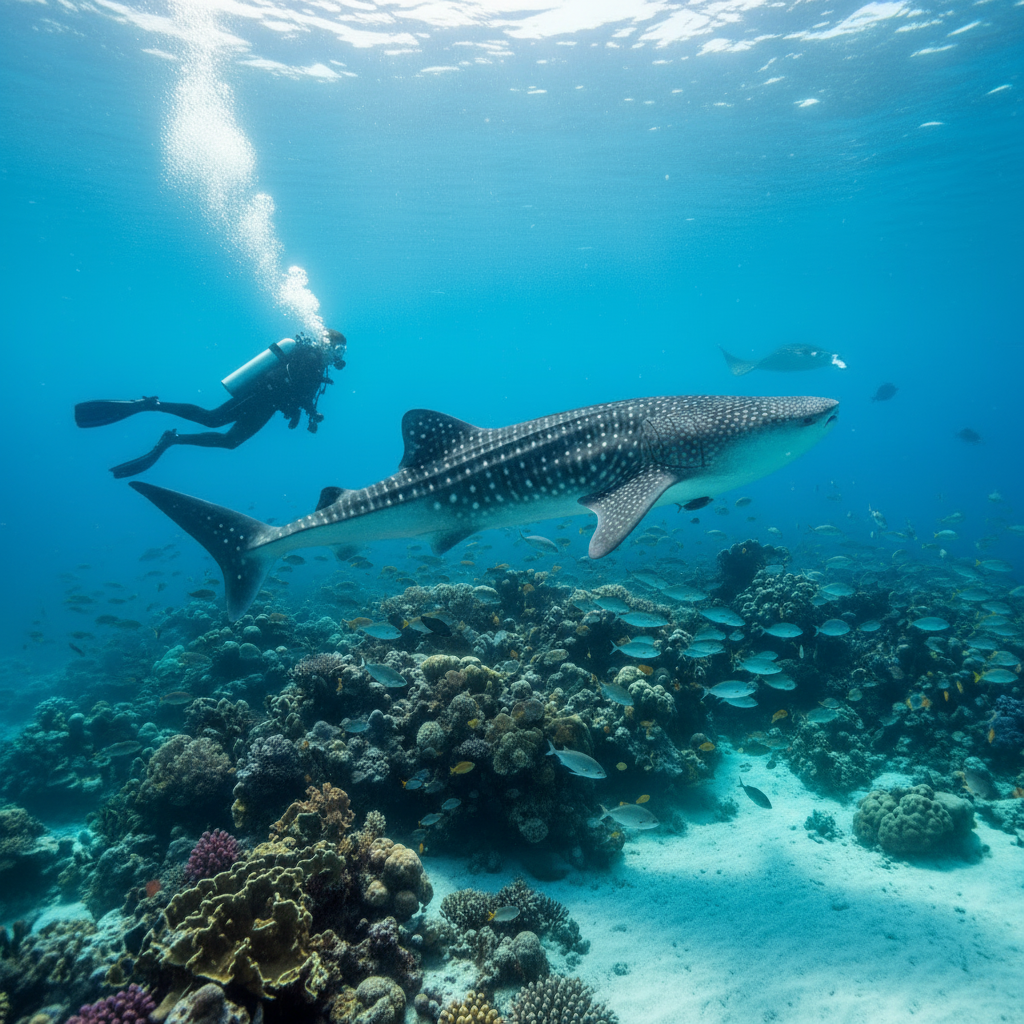
Imagine drifting through crystal-clear waters, the sun’s warmth gently caressing your skin, when a colossal shadow begins to materialise from the azure depths. It’s not a figment of your imagination, nor a distant dream, but a living, breathing bus-sized fish, adorned with an exquisite pattern of spots and stripes, gliding effortlessly beside you. This is the moment you’ve journeyed for, a truly humbling encounter with the ocean's largest fish – the magnificent whale shark – in the undisputed heartland of these gentle giants: the South Ari Atoll, Maldives.
Why Whale Shark Encounters Belongs on Your Bucket List
There are 'once-in-a-lifetime' experiences, and then there are 'Whale Shark Encounters in the Maldives'. This isn't just another dive; it's a profound connection with nature, an almost spiritual communion with one of the most majestic creatures on Earth. What sets South Ari Atoll apart is its unparalleled reliability. While whale sharks are migratory, they frequent the outer reef of this Maldivian atoll year-round, drawn by the consistent plankton blooms that serve as their primary food source. This makes the Maldives not just a destination for whale shark encounters, but the destination for consistently reliable sightings, turning a hopeful quest into a near certainty.
The "wow" factor here isn't merely the size of these creatures, which can reach up to 18 metres in length, but their serene demeanour. Despite their immense scale, whale sharks are filter feeders, completely harmless to humans. Their presence evokes a sense of ancient wonder, an echo of a time when giants truly ruled the seas. Witnessing them cruise gracefully, often just metres away, is an overwhelming sensory experience that redefines your perception of marine life. This is an experience suited for anyone with a love for the ocean, from novice snorkelers to seasoned divers, making it remarkably accessible while still being utterly extraordinary.
Unlike many other megafauna encounters where speed and adrenaline are key, whale shark interactions in the Maldives are characterised by a peaceful, almost meditative quality. You’re not just observing; you’re sharing their underwater world, moving at their unhurried pace. It’s an encounter that leaves an indelible mark on your soul, forging a deep respect for these vulnerable giants and the delicate ecosystem they inhabit. This is the epitome of responsible wildlife tourism, where the focus is on natural interactions rather than forced ones, enhancing both your experience and the well-being of the sharks.
What You'll See and Do
The core of the Whale Shark Encounters experience in South Ari Atoll revolves around swimming or snorkelling alongside these gentle giants. Most encounters happen on the western side of the atoll, along the reef wall that stretches for miles. Sites like Maamigili Beyru are famous for their frequent whale shark sightings. You'll typically be dropped by dhoni (a traditional Maldivian boat) or tender near a sighted whale shark, then gently enter the water, often with just a mask, snorkel, and fins, to swim in parallel with the shark. During these moments, you’ll witness their distinctive slow, rhythmic tail beats propelling their colossal bodies through the water, their massive mouths often agape, filtering plankton.
While the primary focus is the whale sharks, the South Ari Atoll is also teeming with other incredible marine life. The vibrant coral reefs, though slowly recovering in some areas, burst with colour and activity. You’ll frequently encounter eagle rays gliding gracefully, schools of colourful reef fish darting amongst anemones, and often resident green sea turtles munching on seagrass. Occasionally, you might spot manta rays in the cleaning stations or even dolphins playfully leaping in the distance. The clarity of the water, consistently offering visibility upwards of 20-30 metres, enhances every encounter.
For certified divers, the experience can sometimes extend to observing whale sharks at slightly deeper levels, typically between 10-20 metres, as they cruise along the edge of the reef. However, many of the most intimate interactions occur at the surface or very shallow depths, making snorkelling equally, if not more, effective for prolonged encounters. The behaviour of the whale sharks here is often predictable, allowing for sustained observation. You’ll see them surface feeding, cruising slowly along the reef, or sometimes even resting near the sandy bottom – a truly mesmerising tableau of oceanic life.
Best Time to Go
One of the most appealing aspects of encountering whale sharks in the South Ari Atoll is its year-round reliability. Unlike other destinations, the Maldives benefits from consistent currents and plankton availability, meaning there isn't a "bad" season for sightings. However, there are subtle seasonal variations to consider. Broadly, the southwest monsoon season (May to November) typically brings more plankton to the eastern side of the atoll, but whale sharks are consistently seen on the western side where the resident aggregation is present. The northeast monsoon (December to April) generally brings calmer seas and clearer skies, with excellent visibility, making it a popular time for overall dive conditions.
Water temperatures in the Maldives are consistently warm, hovering between 27-30°C (81-86°F) year-round, so a thin wetsuit or even just a rash guard is usually sufficient. Visibility is almost always excellent, typically ranging from 20 to 30 metres (65-100 feet), providing stunning opportunities for photography and clear views of the sharks. While the waters inside the atoll can be very calm, currents can be a factor, particularly on the outer reef where the whale sharks are often found. These currents, however, are usually manageable and contribute to the rich ecosystem, bringing in the nutrients that sustain the marine life. The weather is predominantly sunny, though tropical showers can occur throughout the year, usually clearing quickly to leave behind bright sunshine.
How to Dive Whale Shark Encounters
The most effective and enriching way to experience "Whale Shark Encounters" in South Ari Atoll is undoubtedly via a liveaboard. Liveaboards offer unparalleled access to the best dive and snorkel sites, allowing you to follow the whale sharks' movements and be on location when they are sighted without the daily commute from a resort. This maximises your chances of multiple, prolonged interactions. While some resorts and day-trip operators offer whale shark excursions, these are limited by travel time and fixed schedules, often resulting in shorter and less frequent encounters. A liveaboard, by contrast, provides immersion, putting you exactly where you need to be, often at times when day trippers are long gone.
For most whale shark encounters, particularly those at the surface, no formal diving certification is required, making it accessible to snorkelers of all ages. However, if you wish to participate in dives on the surrounding reefs and potentially encounter whale sharks at depth, an Open Water Diver certification is necessary. We highly recommend having at least 20-30 logged dives to feel comfortable with drift diving, as currents can be present. Further, an Advanced Open Water certification is beneficial for exploring slightly deeper reefs, and a Nitrox certification is a fantastic asset for extending your bottom time, especially during multiple dives in a day. A 3mm shorty or full-length wetsuit is perfect for sun protection and light thermal comfort. As for gear, remember to bring a decent camera with a wide-angle lens – you’ll want to capture the sheer size of these magnificent creatures.
Conservation and Responsible Diving
The Maldives is a pioneering nation in marine conservation, particularly regarding its whale shark population. It's crucial for every visitor to adhere to responsible interaction guidelines. Always maintain a respectful distance of at least 3 metres from the front of the whale shark and 4 metres from its tail. Never touch, ride, or obstruct the path of a whale shark – they are wild animals, and we are guests in their home. Flash photography should be avoided, especially at close range, as it can be disorienting. These guidelines are not just rules; they are pledges to protect these vulnerable creatures and ensure that these incredible encounters remain possible for future generations. Your active participation in responsible tourism directly contributes to their conservation.
Plan Your Trip
Are you ready to witness the majesty of the ocean's largest fish? A Blue Rides liveaboard trip to the South Ari Atoll is your passport to this incredible "Whale Shark Encounters" experience, offering you the best chances for truly unforgettable moments. Explore our range of premium liveaboards and embark on the dive trip of a lifetime.