
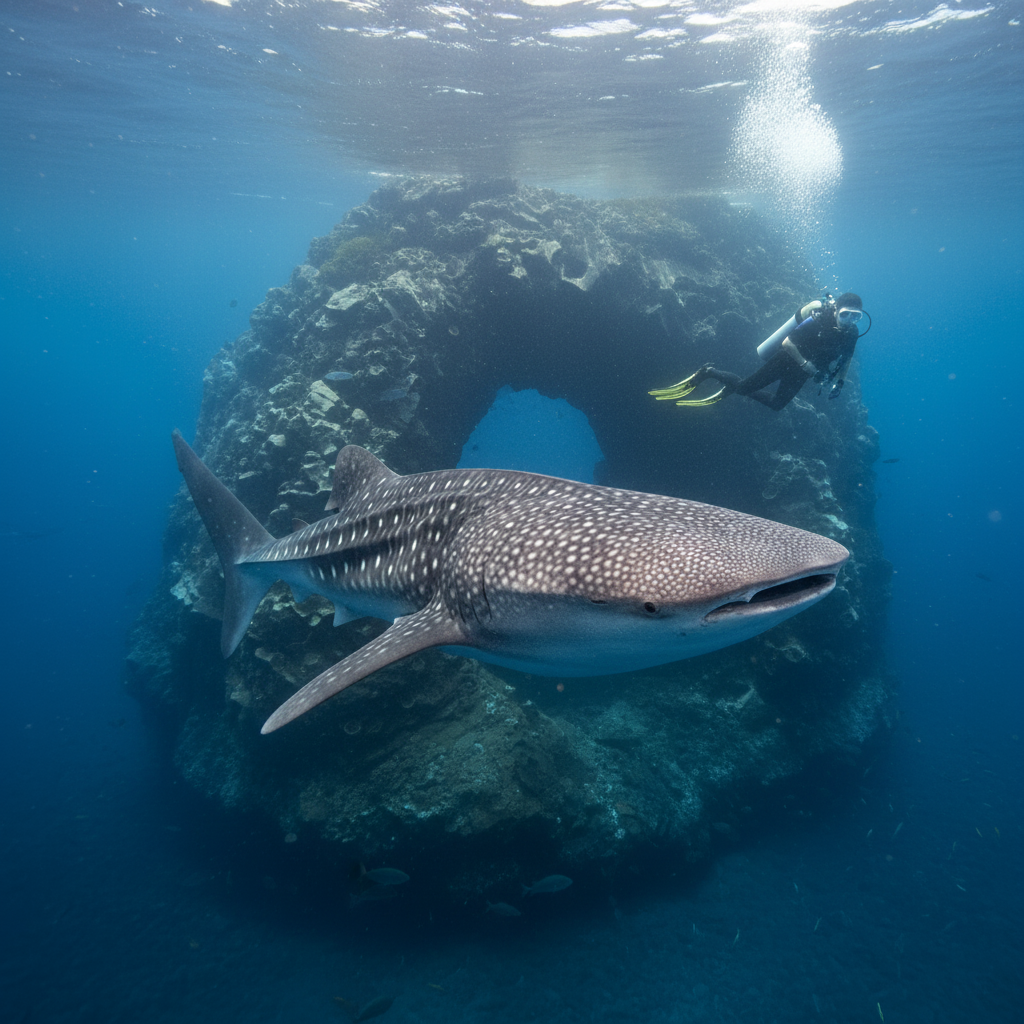
Imagine yourself plunging into an oceanic theatre, where the stage is set amongst the Galápagos’ most remote and hallowed waters. The curtain rises, not on a human performer, but on a creature of mythical scale and profound grace. This isn't just another dive; it's an intimate dance with the ocean's largest fish, a truly humbling experience that etches itself onto your soul. At Darwin’s Arch, this spectacle awaits, a bucket list encounter that redefines your understanding of the marine world.
Why Whale Shark Encounters Belongs on Your Bucket List
The Galápagos Archipelago, already legendary for its unique evolutionary history and endemic species, holds a secret weapon in its northern reaches: Darwin’s Arch. This iconic rock formation isn't just a navigational landmark; it’s a global hotspot for whale sharks, particularly during certain times of the year. What sets this experience apart from other whale shark aggregations around the world? Here, you’re not just seeing whale sharks; you’re encountering some of the largest specimens known, predominantly mature females often exceeding 12 metres in length. These colossal, ancient mariners are drawn to the nutrient-rich currents swirling around Darwin and Wolf Islands, and their sheer size is, simply put, breathtaking.
This isn't a guaranteed, tame aquarium visit. This is raw, wild nature at its finest. The unpredictable magic of the open ocean dictates the terms, adding an element of thrilling anticipation to every dive. It's an experience that suits adventurous divers who yearn for true wilderness, for those who seek to witness nature unscripted and untamed. The sheer scale and peaceful presence of these gentle giants create a profound sense of awe and connection to the marine environment, offering a perspective on the ocean's majesty that few other experiences can rival.
Diving with whale sharks in the Galápagos isn't just about the sharks themselves. It's about being immersed in an ecosystem that has inspired generations of naturalists. The remote location, the powerful currents, and the sheer abundance of life all contribute to an unparalleled sense of discovery. It’s a journey to the edge of the world, physically and metaphorically, to witness one of its greatest natural wonders.
What You’ll See and Do
Your primary goal, undoubtedly, is to encounter the majestic whale shark (Rhincodon typus). Around Darwin’s Arch and Wolf Island, the currents are strong, carrying plankton and small fish that attract these filter feeders. You’ll typically be in open water, often at depths ranging from 10 to 30 metres, drifting along with the current, eyes scanning the deep blue for their colossal silhouettes. When a whale shark appears, it’s a moment of unparalleled excitement, followed by a serene observation as these giants glide effortlessly past, mouths agape, filtering the ocean’s bounty. You’ll be mesmerized by their distinctive斑点 patterns, the sheer breadth of their tails, and the calm, unhurried pace of their existence.
But the underwater drama at Darwin and Wolf extends far beyond whale sharks. This is a shark diver's paradise. Expect to be surrounded by large schools of scalloped hammerheads (Sphyrna lewini), often spiralling majestically or cleaning at specific stations. Galápagos sharks (Carcharhinus galapagensis), silky sharks (Carcharhinus falciformis), and even occasional tiger sharks (Galeocerdo cuvier) are also frequent visitors. You’ll also encounter vast schools of jacks, tuna, and barracuda, creating shimmering walls of silver. Keep an eye out for green sea turtles (Chelonia mydas), majestic manta rays (Mobula birostris), and curious sunfish (Mola mola).
The dive style here is predominantly drift diving due to the strong, often unpredictable currents. You’ll descend and let the current carry you along the underwater topography, observing the incredible marine life that congregates in these productive waters. Encounters are often fleeting, requiring readiness and a keen eye, but when they happen, they are truly unforgettable.
Best Time to Go
The prime season for encountering the colossal female whale sharks around Darwin’s Arch and Wolf Island is generally from June to November. This period coincides with the Galápagos' cooler, drier season, characterised by the Humboldt Current’s influence. This nutrient-rich cold water upwelling brings an abundance of plankton, which acts as a magnet for the whale sharks.
During these months, water temperatures typically range from 20°C to 25°C (68°F to 77°F). While a 5mm or 7mm wetsuit is highly recommended for comfort during longer dives and multiple entries, many opt for a hood or even a semi-dry suit for added warmth. Visibility can vary but is generally excellent, often exceeding 15-25 metres, allowing for clear views of the passing giants. Currents, however, can be very strong and challenging during this season, making it an advanced diving destination. The weather above water tends to be drier, but the seas can be choppier due to cooler winds. While whale shark sightings can occur outside this window, the June-November period offers the highest probability of encountering these incredible animals in their largest forms.
How to Dive Whale Shark Encounters
Accessing Darwin’s Arch and Wolf Island is almost exclusively done via liveaboard. These remote northern islands are too far from the main Galápagos land bases for day trips, making a liveaboard safari the only practical and most rewarding way to experience these world-class dive sites. A typical Galápagos liveaboard itinerary will dedicate several days to diving Darwin and Wolf, allowing for multiple opportunities to encounter whale sharks and other pelagic species. Due to the challenging conditions – strong currents, frequent ocean swells, and deep dives – this destination is best suited for experienced divers. You should have an Advanced Open Water Diver certification or equivalent, and a minimum of 50-100 logged dives is strongly recommended, especially with experience in drift diving and current. Confidence in varying conditions is key.
To enhance your experience and safety, consider specialised courses. Nitrox certification is highly beneficial, allowing for extended bottom times on repetitive dives, crucial for maximising your chances of whale shark encounters, particularly at depth. A PADI or SSI Drift Diver specialty is also invaluable given the prevalence of current. Furthermore, strong buoyancy control is paramount for navigating the currents and safely observing marine life without disturbing it. Gear-wise, ensure your standard dive equipment is well-maintained and reliable. Given the cooler water temperatures, a 5mm or 7mm full-body wetsuit is advisable, with a hood and gloves for optimal thermal protection. A dive computer and a surface marker buoy (SMB) are absolute necessities, the latter for signalling your position to the liveaboard crew after surfacing in what can be vast, open water. Reef hooks, used responsibly for stability in strong currents without damaging the reef, are also often carried by divers here.
Conservation and Responsible Diving
The privilege of diving with whale sharks in the Galápagos comes with a profound responsibility. These magnificent creatures are endangered, and their continued survival relies on respectful and unintrusive human interaction. It is imperative to maintain a safe distance – typically a minimum of 3-4 metres from their body and 4-5 metres from their tail – to avoid startling them or interfering with their natural behaviour. Absolutely no touching of the whale sharks or any other marine life is permitted; these animals are sensitive, and human contact can remove their protective mucus layer or cause undue stress. When photographing, avoid using flash and ensure your focus remains on silent observation rather than aggressive pursuit of the perfect shot. Respect your dive guide’s instructions at all times, as they are experts in responsible interaction within this fragile ecosystem. By adhering to these guidelines, we contribute to the scientific understanding and conservation of these incredible animals for future generations.
Plan Your Trip
An encounter with the whale sharks of Darwin’s Arch is more than just a dive; it’s a profound journey into the heart of the ocean’s wild grandeur. As premium liveaboard specialists, Blue Rides offers an exquisite selection of vessels ready to transport you to this bucket-list destination. Browse our Galápagos liveaboards today and prepare to witness the ocean’s gentle giants in an experience that transcends the ordinary.