
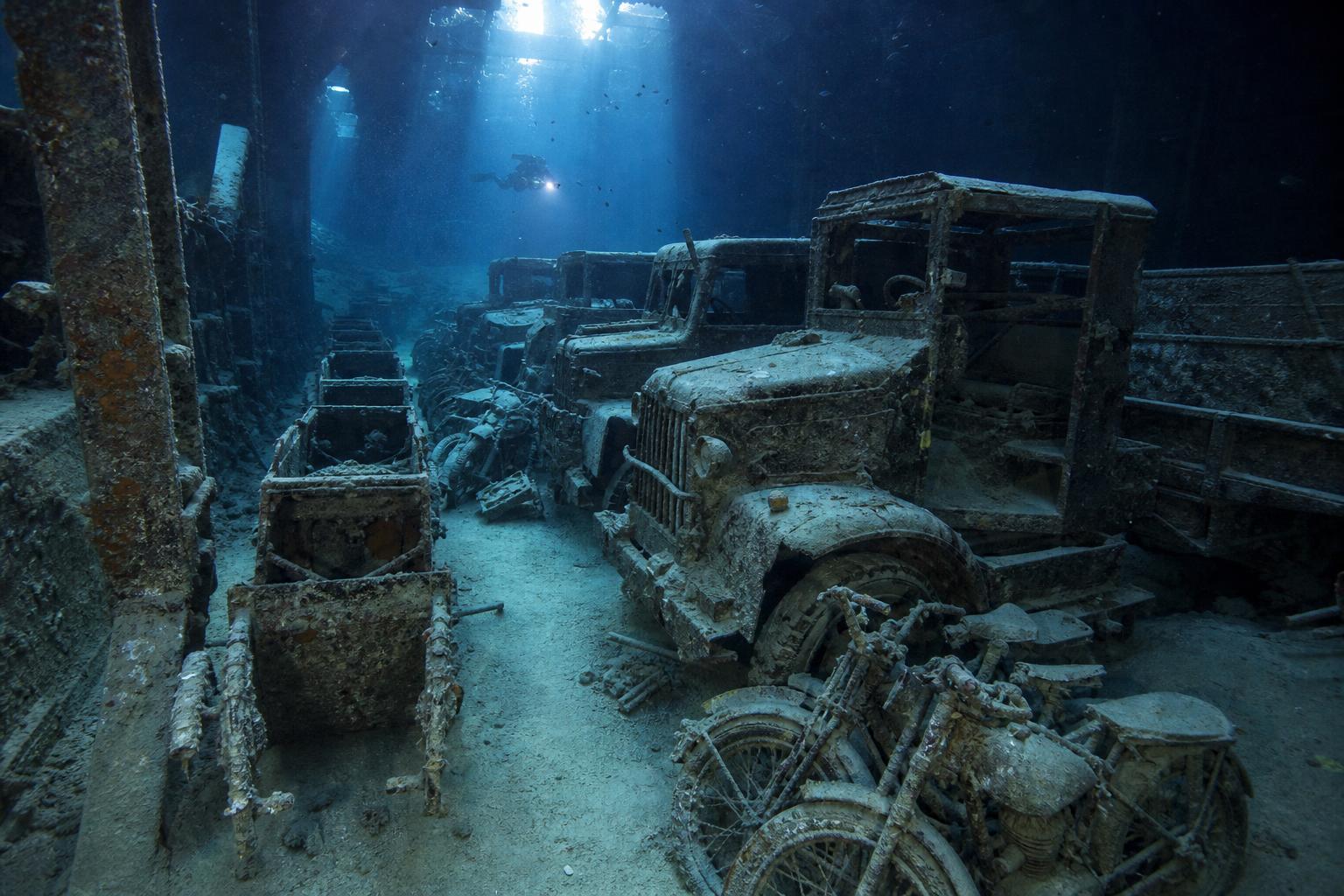
Imagine descending into history, where the ghosts of a global conflict lie entombed beneath the waves, perfectly preserved. This isn't just a dive; it's a pilgrimage to a moment frozen in time, an underwater museum that tells a gripping story with every rivet and every artefact. The SS Thistlegorm isn't merely a shipwreck; it's an experience that transcends recreational diving, offering a profound connection to the past.
Why SS Thistlegorm Wreck Belongs on Your Bucket List
The SS Thistlegorm stands as arguably the world's most famous and certainly one of the most incredibly preserved wreck dives. What elevates this British armed merchant navy ship from an interesting dive to a truly unique, bucket-list-worthy experience is the sheer volume and diversity of its cargo. Sunk by German bombers in October 1941, en route to supply Allied forces in North Africa, she now rests upright on the seabed at a maximum depth of 30 metres, holding a veritable time capsule of World War II equipment. This isn't a deep, dark, or technically challenging wreck; instead, it's accessible to a broad range of divers, offering ample light penetration and generally good visibility, allowing you to truly appreciate its vastness and intricate details.
The "wow" factor here is immediate and enduring. As you fin through colossal hold after colossal hold, you'll feel like an underwater archaeologist, discovering crates of rifles, anti-tank mines, Bedford trucks, two LMS Stanier 8F steam locomotives (on flatbed wagons!), and even entire Norton 16H motorcycles still neatly lined up. It's an overwhelming sense of stepping back in time, witnessing the raw mechanics and logistics of war. The Thistlegorm caters to anyone with a love for history, a passion for exploration, and an appreciation for the extraordinary. It’s a dive that speaks volumes without a single word, leaving an indelible mark on every diver lucky enough to experience it.
What You'll See and Do
Diving the SS Thistlegorm is typically structured over several dives, often including a penetration dive into the holds. The wreck rests on a sandy bottom at 30 metres, with the superstructure rising to about 15-18 metres, offering fantastic opportunities for multi-level diving. Your first descent might take you to the stern area, where the impressive anti-aircraft guns and the gaping hole left by a bomb strike are visible. From there, you often move towards the bridge section, observing the ship's mast and davits, now adorned with soft corals and patrolled by schools of colourful fish.
The real magic happens within the cargo holds. Here, with a torch, you'll meticulously explore Hold No. 1 and No. 2, discovering the legendary motorcycles, jeeps, trucks, and ammunition. Keep an eye out for the crates of wellington boots, airplane wings, and even medical supplies. While the historical cargo is the primary draw, the wreck is also a thriving artificial reef. Expect to encounter resident lionfish, often hovering serenely near the structure, schools of fusiliers, bannerfish, and goatfish. Larger pelagics sometimes cruise by, and moray eels finding refuge in crevices are a common sight. The sheer scale and volume of artefacts demand a slow, methodical approach to truly absorb the detail, making buoyancy control and awareness of your surroundings paramount.
Best Time to Go
The Red Sea, and specifically the Strait of Gubal where the SS Thistlegorm lies, is a year-round diving destination, but each season offers a slightly different experience. The peak season for general comfort is from April to June and September to November. During these months, air temperatures are pleasantly warm, ranging from 25-35°C (77-95°F), and the water temperature is ideal, typically between 26-29°C (79-84°F).
Visibility at the Thistlegorm is generally excellent throughout the year, often exceeding 20-30 metres, though it can occasionally drop with stronger currents. From December to March, the Red Sea can experience cooler air temperatures (18-25°C / 64-77°F) and water temperatures (22-25°C / 72-77°F), requiring a thicker wetsuit (5mm or even 7mm). Currents are usually manageable at the Thistlegorm, but can occasionally be strong, particularly on the deeper sections of the wreck and around the open sea. While the summer months (July-August) can be very hot topside (35-45°C / 95-113°F), the underwater conditions remain good. Overall, for the best balance of comfort and excellent diving conditions, spring and autumn are highly recommended.
How to Dive SS Thistlegorm Wreck
The vast majority of divers experience the SS Thistlegorm aboard a liveaboard vessel, which provides unparalleled access and allows for multiple dives on the wreck, often including a night dive. Liveaboards typically spend a full day or more at the site, journeying from ports like Hurghada or Sharm El Sheikh, encompassing other fantastic Red Sea dive sites like Abu Nuhas, Ras Mohammed, and Tiran. While day boats can access the Thistlegorm from Sharm El Sheikh, the journey is long and often sacrifices deep exploration time at the wreck. For the full, immersive experience, a liveaboard is unequivocally the superior choice.
To dive the SS Thistlegorm, you should hold at least an Advanced Open Water Diver certification due to the maximum depth of 30 metres. However, having significant logged dives (at least 50-70) and prior experience with wreck diving and drift diving is highly recommended. The currents, while often mild, can sometimes be significant, and navigating inside the holds requires good buoyancy control and comfort in confined spaces. A Nitrox certification is a huge advantage, allowing for extended bottom times, especially beneficial when exploring the vastness of the Thistlegorm. A 3mm wetsuit is sufficient for warmer months, but a 5mm or even 7mm might be preferred outside of peak summer. Essential gear for this dive includes a powerful primary dive torch and a backup torch for exploring the holds, a dive computer, and a surface marker buoy (SMB).
Conservation and Responsible Diving
The SS Thistlegorm is a protected historical site and a precious natural habitat. Responsible diving practices are paramount to preserving this underwater treasure for future generations. When diving, maintain excellent buoyancy control to avoid any contact with the wreck itself or its delicate coral growth. Do not touch or disturb any of the historical artefacts; remember, these are part of a shared heritage. Penetrating the holds requires proper training and experience; never venture beyond your comfort or training level. Photographers should be mindful of their fin kicks and equipment, ensuring they do not accidentally damage the site or disturb marine life. Leaving nothing but bubbles and taking nothing but pictures helps ensure the Thistlegorm remains a pristine dive site and an enduring testament to history.
Plan Your Trip
Ready to embark on this extraordinary underwater journey and witness history firsthand? The SS Thistlegorm awaits. Browse the extensive collection of Red Sea liveaboard options available through Blue Rides, tailoring your perfect dive adventure to this iconic wreck and many other incredible sites the region has to offer.