
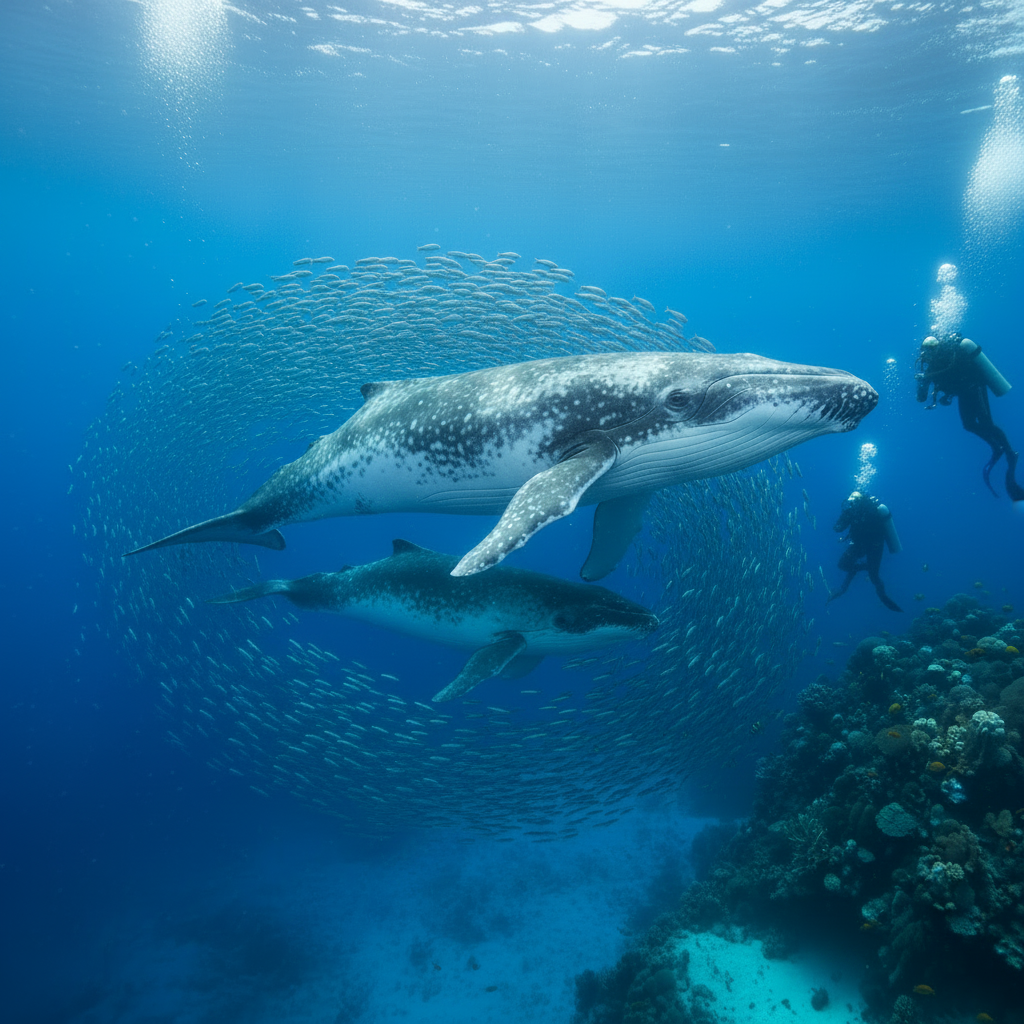
Imagine being in the water, not just observing, but truly interacting with one of the ocean's most magnificent, yet elusive, creatures. You're not in a tank, nor is it a manufactured encounter. This is the wild, untamed ocean, and you're sharing it with something truly special. This is the magic of the Minke Whale Season on Australia's Ribbon Reefs, an experience so profound it redefines what you thought was possible underwater.
Why Minke Whale Season Belongs on Your Bucket List
The annual dwarf minke whale migration through the northern Great Barrier Reef is, without exaggeration, one of the planet's most extraordinary marine encounters. What makes it so utterly unique isn't just the presence of these magnificent baleen whales, but their unparalleled curiosity and willingness to approach humans. Unlike many other whale species that might grace you with a distant sighting, the dwarf minkes of the Ribbon Reefs actively seek out interactions with snorkelers. Picture yourself floating serenely on a line extended from a liveaboard, and a sleek, inquisitive minke whale, sometimes several of them, swims within touching distance, turning its head to peer directly into your mask. This isn't just seeing a whale; it’s an immersive, empathetic connection that will stir your soul.
This phenomenal interaction is largely confined to a relatively small window and a specific geographical area, making it a rare and privileged phenomenon. The Ribbon Reefs, a sequence of ten discrete reefs north of Cairns, form part of the Great Barrier Reef Marine Park, providing a pristine and protected environment for these annual visitors. It's a truly wild encounter, governed by the whales' natural migratory patterns and their innate inquisitiveness. If you're a marine enthusiast, a keen photographer, or simply someone yearning for a profound connection with nature, this experience offers a "wow factor" that few other destinations can rival. It's an opportunity to witness a truly unique animal behaviour, a testament to the health and biodiversity of these incredible reefs.
This experience is ideally suited for adventurous souls who appreciate the raw beauty of nature and understand the privilege of interacting with wildlife on its terms. It's not about adrenaline-pumping dives (though the reef diving is superb); it's about patience, respect, and a deep appreciation for the natural world. If the idea of silent communion with a twenty-foot marine mammal stirs your spirit, then the Minke Whale Season is undoubtedly for you.
What You'll See and Do
The star of the show, of course, is the dwarf minke whale (Balaenoptera acutorostrata subspecies). These charismatic whales, typically 6-8 metres (20-26 feet) long, are identified by their striking white pectoral patches and a distinctive chevron pattern behind their heads. You'll spend significant time in the water, snorkelling, as the regulations dictate that interaction with these whales must be at the surface and entirely on their terms. Operators deploy specially designed 'minke lines' from the back of the vessel, which snorkelers can hold on to. The whales then swim around you, often making multiple passes, circling, and investigating the human presence. Their curiosity is legendary; they might spend hours engaging with snorkelers, offering astonishingly close encounters.
Beyond the magnificent minkes, the Ribbon Reefs themselves are a spectacle of vibrant coral and diverse marine life. When not with the whales, you'll be diving and snorkelling sites like Cod Hole, famous for its resident giant potato cod (Epinephelus tukula) and humphead wrasse (Cheilinus undulatus), which can be hand-fed under supervision. Other notable sites such as Steve's Bommie and Lighthouse Bommie explode with colourful soft and hard corals, teeming with reef sharks (grey reef, whitetip, blacktip), green sea turtles (Chelonia mydas), eagle rays (Aetobatus narinari), and a dizzying array of reef fish from angelfish and anemonefish to barracudas and trevally. The visibility here is often exceptional, enhancing every dive.
While the focus is on the surface interactions with the whales, the diving on the Ribbon Reefs is world-class. Depths typically range from 5-30 metres (15-100 feet), catering to all levels of certified divers. You'll experience stunning wall dives, drift dives along reef passages, and explore vibrant coral gardens. Even during whale encounters, it’s not uncommon to see other pelagic species like manta rays or even the occasional oceanic whitetip shark cruising in the deeper blue. The sheer biodiversity of the Great Barrier Reef ensures that every minute, whether above or below the surface, is filled with discovery.
Best Time to Go
The "Minke Whale Season" is a specific and somewhat narrow window, making timing crucial for this bucket-list experience. The dwarf minke whales typically migrate through the Ribbon Reefs during the Australian winter months, primarily from June to July. While sightings can occur slightly earlier or later, these two months offer the highest probability of sustained, close encounters with the whales.
During this period, the water temperatures in the Ribbon Reefs typically range from a comfortable 24-26°C (75-79°F). Air temperatures are pleasant, generally around 20-25°C (68-77°F), making for ideal topside conditions. Visibility is often outstanding, usually exceeding 20 metres (65 feet) and frequently pushing 30 metres (100 feet plus), thanks to the cooler, drier season and fewer algal blooms. Currents around the Ribbon Reefs can vary from mild to moderate, particularly in passages and around pinnacles, offering exhilarating drift dives. Weather-wise, these months generally bring stable conditions with lower humidity and less chance of tropical cyclones, though the open ocean can always bring a swell. While a little cooler, this season means less rainfall and typically more settled seas, making for a more enjoyable liveaboard experience.
How to Dive Minke Whale Season
Access to the Minke Whale Season experience is almost exclusively via dedicated liveaboard vessels operating out of Cairns. Day trips simply cannot reach the remote northern Ribbon Reefs and provide the necessary time for sustained whale encounters. A liveaboard offers the distinct advantage of being right in the heart of the action, ready for spontaneous whale interactions and providing multiple dives each day on world-class reef sites. These trips typically range from 3 to 7 nights, ensuring ample opportunity for both whale encounters and reef diving.
While the whale interaction itself is a snorkelling activity open to anyone with basic swimming ability, the accompanying reef diving requires PADI Open Water certification or equivalent as a minimum. However, to truly appreciate the variety of dive sites and to maximise your bottom time, we highly recommend Advanced Open Water certification and enriched air nitrox (EANx) certification. Nitrox significantly extends your no-decompression limits, especially beneficial on multi-day liveaboard trips. Given that some sites feature currents, experience with drift diving is also advantageous. For wetsuit thickness, a 3mm shorty or full suit is generally sufficient for the 24-26°C waters, though some may prefer a 5mm for longer periods in the water or if prone to feeling the cold. Essential gear includes your standard dive kit, an SMB (Surface Marker Buoy) for safety, and consider bringing an underwater camera with a wide-angle lens to capture both the whales and the expansive reefscapes.
Conservation and Responsible Diving
The dwarf minke whales of the Great Barrier Reef are a significant and unique population, and their annual appearance is a privilege, not a right. The interactions are conducted under strict permits issued by the Great Barrier Reef Marine Park Authority (GBRMPA) to ensure the well-being of the whales. Operators adhere to a strict Code of Practice, which prioritises minimal impact and maximum respect for these gentle giants. This means no touching the whales – they are wild animals, and any physical interference is prohibited. All interactions are passive and on the whales' terms. Swimmers remain on the surface, holding a line, allowing the whales to approach. It is crucial to follow all crew instructions regarding positioning and behaviour. Ethical photography means using natural light where possible and never pursuing or crowding the whales. Your presence in this pristine environment should be respectful and leave no trace, helping to ensure these incredible encounters can continue for generations to come.
Plan Your Trip
Ready to witness one of the ocean's most magical spectacles? The Minke Whale Season on Australia's Ribbon Reefs is an experience that will stay with you long after you've dried off. This is a highly sought-after trip, and liveaboard spaces book up well in advance. Don't miss your chance to share the water with these intelligent, curious creatures. Browse the range of premium liveaboards departing for the Ribbon Reefs during the Minke Whale Season, and let us help you plan this once-in-a-lifetime adventure.