Bluerides – Blue Rides - Book Liveaboards worldwideOCEAN ADVENTURES
River CruisesRiversNature & WildlifeOur Promise
River CruisesRiversNature & WildlifeOur PromiseSign In

River destinations

  • River destinations
  • Amazon
  • Danube
  • Rhine
  • Mekong
  • Nile

Ships & departures

  • River Cruise Search
  • Deals

Nature & Wildlife

  • Nature & Wildlife

Travel support

  • Our Promise
  • Contact

Contact

Get in Touch

Get in touch anytime, we're happy to help you find the right trip or sort out any question.

EmailWrite us, we usually reply within a few hours.
contact@bluerides.com
WhatsAppChat with us on WhatsApp, Mon–Fri 10:00–16:00 (CET).
Start WhatsApp Chat
PhoneCall us, we're happy to help.
Free call, Mon–Fri 10 AM – 8 PM (CET).
Europe+49 800 1144 990USA+1 888 557 7735UK+44 800 707 4152Australia+61 2 8599 6113Canada+1 888 557 7735
Which river journey is yours?Answer 8 quick questions and find the river cruise that fits you.
8 questions, 1 minute·Plus Gift
Secure Payment MethodsYour payments are fully secured with AES-256 encryption.
Powered byStripeWiseAMEXPayGoogle PaySEPABank
Imprint·Terms & Conditions·Privacy Policy·About·Contact·Liability Waiver·Affiliate Program·Cruise·Blog·
Visit us here

© 2026 Blue Rides. All rights reserved.

Bluerides – Blue Rides - Book Liveaboards worldwideOCEAN ADVENTURES
River CruisesRiversNature & WildlifeOur Promise
River CruisesRiversNature & WildlifeOur PromiseSign In
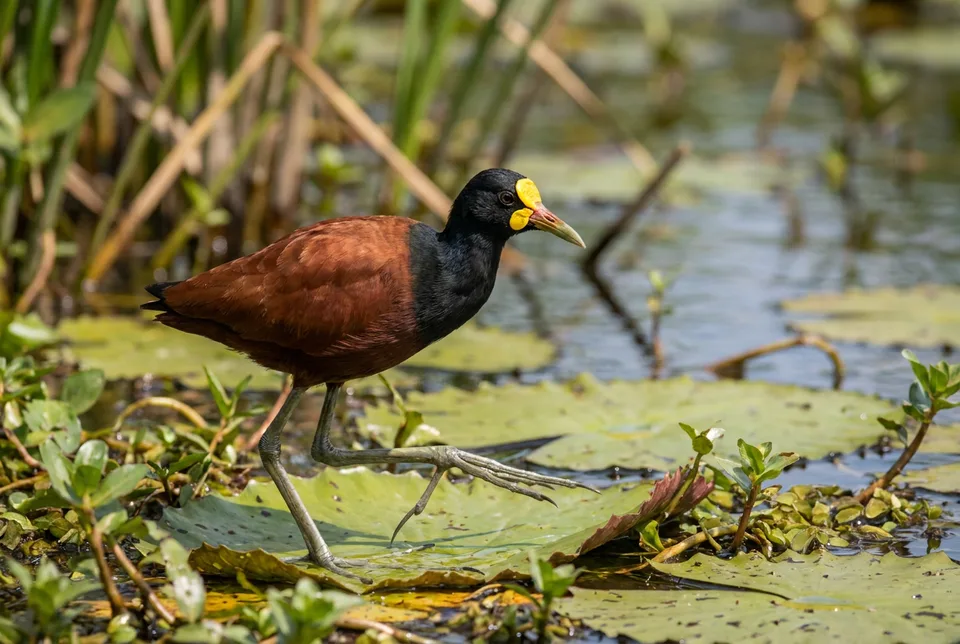
Wattled Jacana in wetland habitat — Amazon, River Cruises wildlifeAI-modified
Home›River Cruises›River Wildlife›Wattled Jacana

Wattled JacanaJacana jacanaWhere and when to see them

Previous speciesWatercockNext speciesWestern Grebe

Wattled Jacana at a glance

The Wattled Jacana is a small freshwater wetland bird with unusually long, thin toes that allow it to walk over floating vegetation. Adults combine chestnut upperparts with a mostly black body, yellow bill and red facial shield and wattles. Smithsonian describes adults as averaging about 25 centimetres long, with females often larger than males. The Peruvian cruise record concerns emergent vegetation along the Iquitos/Nauta tributary itinerary. It does not establish equal viewing opportunities on open river channels or elsewhere in the Amazon basin.
Behaviour & reproduction

Size
About 25 cm (9.8 in) long
Weight
Not verified
Lifespan
Not verified
Status
Global status not verified

Wattled Jacanas are active during the day and walk with a conspicuous high-stepping gait. They call while flying or foraging, with a loud kak call used when predators are nearby. Their breeding organisation differs from a conventional pair: a female may associate with several males, while males perform virtually all incubation and chick care. Females compete over these social groups. Smithsonian also describes sharp spurs at the wrist that the birds use in fights with territorial rivals. These are natural behaviours to observe without encouraging a response.

Top wildlife locations

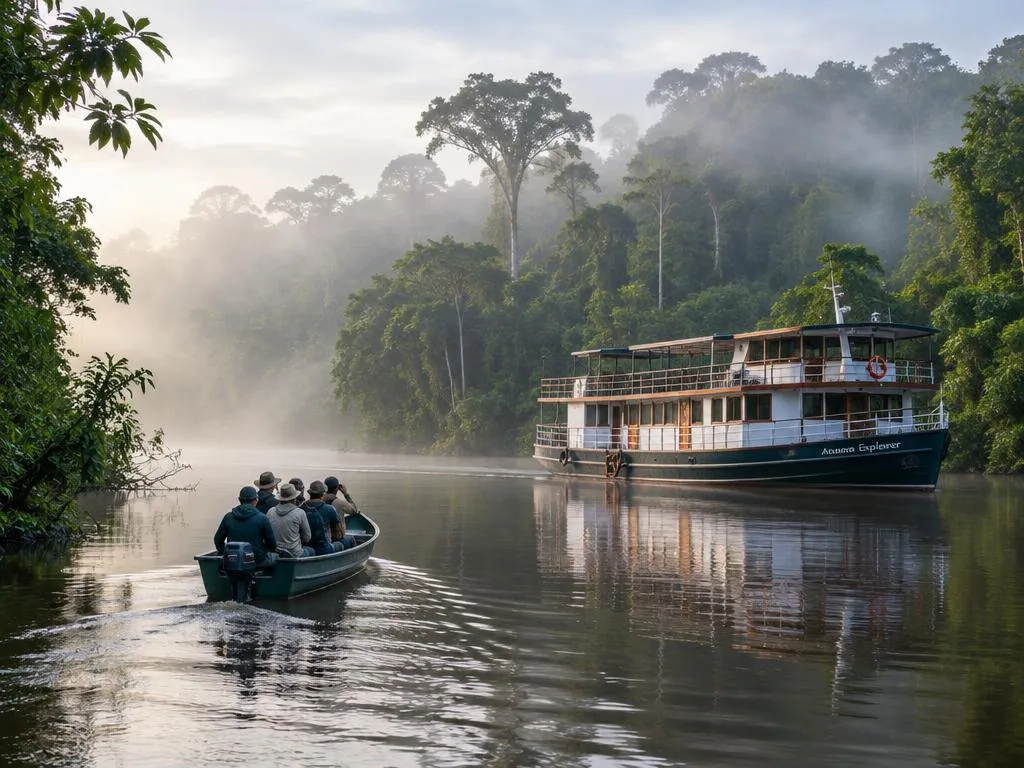
Amazon river landscape — River Cruises wildlife habitatAI-modified

Amazon

Peru — Iquitos/Nauta, Ucayali and connected tributaries (2017 cruise)

Explore river cruises

Destinations describe the species' habitat, not guaranteed cruise stops. Some animals require an optional inland excursion or are found in restricted reserves.

Fun facts about the Wattled Jacana

  • Long toes support walking on floating vegetation.
  • Adults average about 25 cm (9.8 in) long.
  • Females are often larger than males.
  • Juveniles have a pale stripe above the eye.
  • Its diet includes both invertebrates and plant foods.
  • The pointed bill flips and tugs lily pads.
  • A female may associate with several males.
  • Males perform virtually all incubation and chick care.
  • Small sharp wrist spurs are used in territorial fights.

Best time to see the Wattled Jacana

The Peruvian species list documents Wattled Jacanas during a March 2017 cruise, reporting birds in emergent vegetation and sometimes with young. That is useful historical occurrence evidence, but one dated voyage cannot demonstrate a recurring March viewing season. No repeatable, species-specific local monthly pattern was verified, so the viewing calendar remains empty. General wetland ecology and the presence of young are not substitutes for local viewing data. Ask the guide about current water access and recent observations without treating those reports as a sighting guarantee.

Wattled Jacana: season matrix by destination

Highlighted months reflect the stated local evidence, not guaranteed encounters. Neutral months mean no verified monthly viewing window, not absence. Observation records and recommended viewing windows are distinct.

Amazon

No repeatable, species-specific local viewing months verified. Empty months indicate insufficient evidence, not absence.

JanFebMarAprMayJunJulAugSepOctNovDec
Explore river cruises

Where the Wattled Jacana lives

Smithsonian places the species in freshwater ecosystems and wetlands in South America, also noting Panama and Trinidad. Floating leaves and mats of vegetation are particularly relevant to its way of moving and feeding. The saved Peruvian cruise report describes birds in emergent vegetation, connecting that general habitat account to a specific river itinerary. This is stronger guidance than simply searching anywhere on the Amazon, but it remains a historical reach-level observation. An open main channel should not be presented as equivalent to a vegetated wetland margin.

What the Wattled Jacana eats

Wattled Jacanas mainly eat invertebrates, including insects, worms, small crustaceans, snails and other molluscs. They also consume fruit and the seeds of aquatic plants, so describing the species as exclusively insect-eating would be inaccurate. Smithsonian describes the pointed bill flipping and tugging leaves and lily pads during foraging. The long toes let the bird move over the floating surfaces where this searching takes place. Neither the Smithsonian account nor the checked local report supplies a Peruvian prey inventory or a seasonal feeding calendar for this cruise reach.

Species at a glance

Common name
Wattled Jacana
Scientific name
Jacana jacana
Animal group
Birds
Size
About 25 cm (9.8 in) long
Weight
Not verified
Lifespan
Not verified
Status
Global status not verified
Identification
Look for the combination of long, thin toes, high-stepping gait, chestnut back and wings, and mostly black body. Adults have a yellow bill, red fleshy forehead shield and reddish wattles near the bill base; the legs and toes are bluish grey. Juveniles differ markedly, with brown upperparts, white underparts and a pale stripe above the eye. Chicks show buff, brown and black camouflage. Age-related differences mean that an immature bird should not be rejected simply because it lacks the adult dark body and facial ornaments.

Wattled Jacana: frequently asked questions

Where can I see the Wattled Jacana?
Amazon. On an appropriate guided tributary or side-channel outing, scan the vegetation surface rather than only the open water. Follow a bird long enough to see its high-stepping movement and the way it works leaves with its bill. A clear side view can reveal the chestnut back and contrasting dark body; the face requires a closer optical view. Keep the boat at a respectful distance and do not use calls to elicit an alarm response. The registered historical itinerary does not guarantee a jacana encounter on every departure.
When is the best time to see the Wattled Jacana?
The Peruvian species list documents Wattled Jacanas during a March 2017 cruise, reporting birds in emergent vegetation and sometimes with young. That is useful historical occurrence evidence, but one dated voyage cannot demonstrate a recurring March viewing season. No repeatable, species-specific local monthly pattern was verified, so the viewing calendar remains empty. General wetland ecology and the presence of young are not substitutes for local viewing data. Ask the guide about current water access and recent observations without treating those reports as a sighting guarantee.
How big does the Wattled Jacana get?
About 25 cm (9.8 in) long. Adult weight: Not verified. Size varies with age, sex and population.
How should I behave around the Wattled Jacana?
On an appropriate guided tributary or side-channel outing, scan the vegetation surface rather than only the open water. Follow a bird long enough to see its high-stepping movement and the way it works leaves with its bill. A clear side view can reveal the chestnut back and contrasting dark body; the face requires a closer optical view. Keep the boat at a respectful distance and do not use calls to elicit an alarm response. The registered historical itinerary does not guarantee a jacana encounter on every departure.
What does the Wattled Jacana eat?
Wattled Jacanas mainly eat invertebrates, including insects, worms, small crustaceans, snails and other molluscs. They also consume fruit and the seeds of aquatic plants, so describing the species as exclusively insect-eating would be inaccurate. Smithsonian describes the pointed bill flipping and tugging leaves and lily pads during foraging. The long toes let the bird move over the floating surfaces where this searching takes place. Neither the Smithsonian account nor the checked local report supplies a Peruvian prey inventory or a seasonal feeding calendar for this cruise reach.
Are wildlife sightings guaranteed on a river cruise?
No. Animals move freely and routes, weather, access restrictions and local conditions influence every outing. Confirm the actual itinerary and shore program before booking.

Compare wildlife in the same destinations

Explore other birds recorded in these destinations. Similar surroundings do not mean the animals share the same habits or viewing season.

Species comparison by animal group and destination
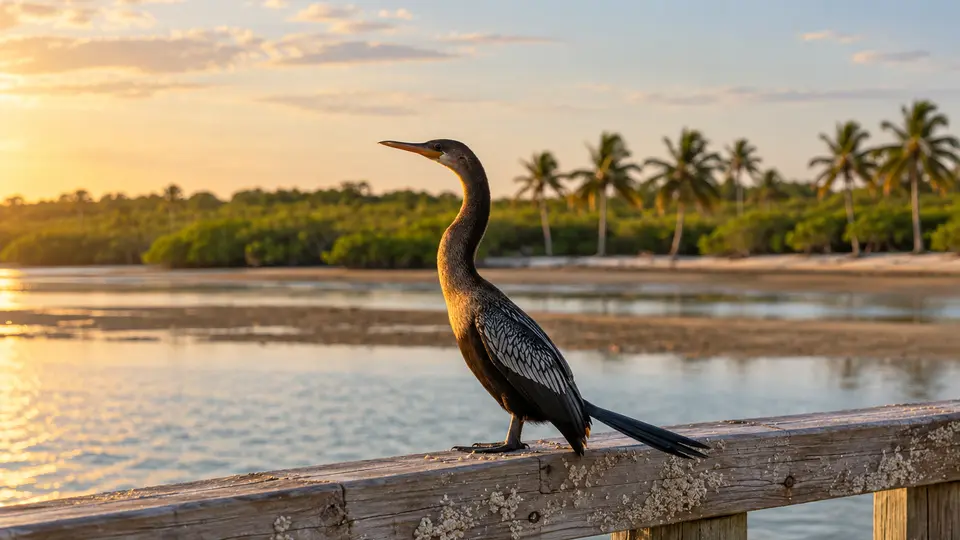
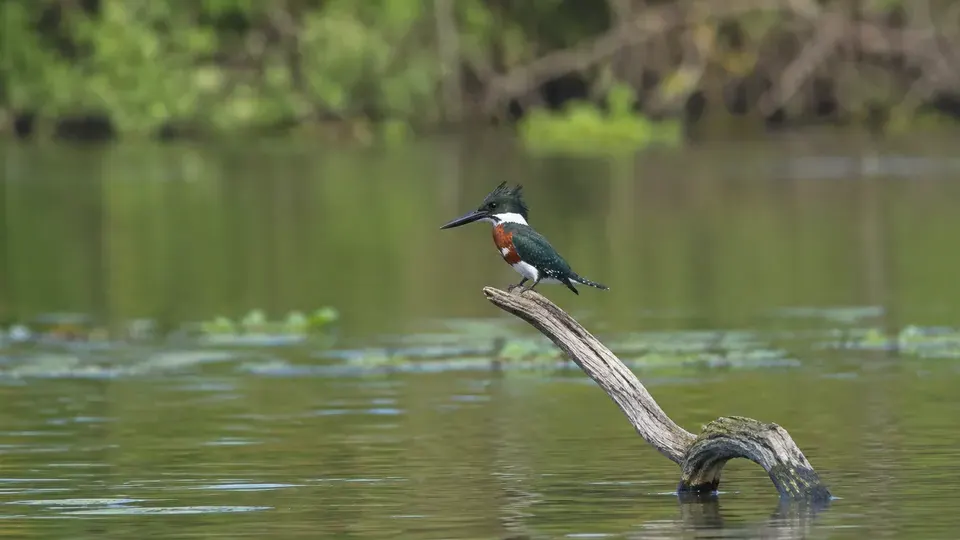
Wattled Jacana in wetland habitat — Amazon, River Cruises wildlifeAI-modifiedWattled JacanaAmazon kingfisher in wetland habitat — Amazon, River Cruises wildlifeAI-modifiedAmazon KingfisherAnhinga in wetland habitat — Amazon, River Cruises wildlifeAI-modifiedAnhinga
Animal groupBirdsAnimal groupBirdsAnimal groupBirds
DestinationsAmazonDestinationsAmazonDestinationsAmazon
Scientific name
Jacana jacana
Scientific name
Scientific name
Previous speciesWatercockNext speciesWestern Grebe
All river wildlife
On this page
  • 01About
  • 02Behaviour & reproduction
  • 03Top wildlife locations
  • 04Fun facts
  • 05Best season
  • 06Season matrix by destination
  • 07Habitat
  • 08Diet
  • 09Species at a glance
  • 10Questions & answers
  • 11Compare

Find your river cruise

AI-modified
Plan your trip

Find your next river journey

Compare destinations, shore programs and dates with the animals and habitats you would love to see.

  • Daily shore excursions
  • Responsible wildlife watching
  • Boutique river ships
Explore river cruises