Bluerides – Blue Rides - Book Liveaboards worldwideOCEAN ADVENTURES
River CruisesRiversNature & WildlifeOur Promise
River CruisesRiversNature & WildlifeOur PromiseSign In

River destinations

  • River destinations
  • Amazon
  • Danube
  • Rhine
  • Mekong
  • Nile

Ships & departures

  • River Cruise Search
  • Deals

Nature & Wildlife

  • Nature & Wildlife

Travel support

  • Our Promise
  • Contact

Contact

Get in Touch

Get in touch anytime, we're happy to help you find the right trip or sort out any question.

EmailWrite us, we usually reply within a few hours.
contact@bluerides.com
WhatsAppChat with us on WhatsApp, Mon–Fri 10:00–16:00 (CET).
Start WhatsApp Chat
PhoneCall us, we're happy to help.
Free call, Mon–Fri 10 AM – 8 PM (CET).
Europe+49 800 1144 990USA+1 888 557 7735UK+44 800 707 4152Australia+61 2 8599 6113Canada+1 888 557 7735
Which river journey is yours?Answer 8 quick questions and find the river cruise that fits you.
8 questions, 1 minute·Plus Gift
Secure Payment MethodsYour payments are fully secured with AES-256 encryption.
Powered byStripeWiseAMEXPayGoogle PaySEPABank
Imprint·Terms & Conditions·Privacy Policy·About·Contact·Liability Waiver·Affiliate Program·Cruise·Blog·
Visit us here

© 2026 Blue Rides. All rights reserved.

Bluerides – Blue Rides - Book Liveaboards worldwideOCEAN ADVENTURES
River CruisesRiversNature & WildlifeOur Promise
River CruisesRiversNature & WildlifeOur PromiseSign In
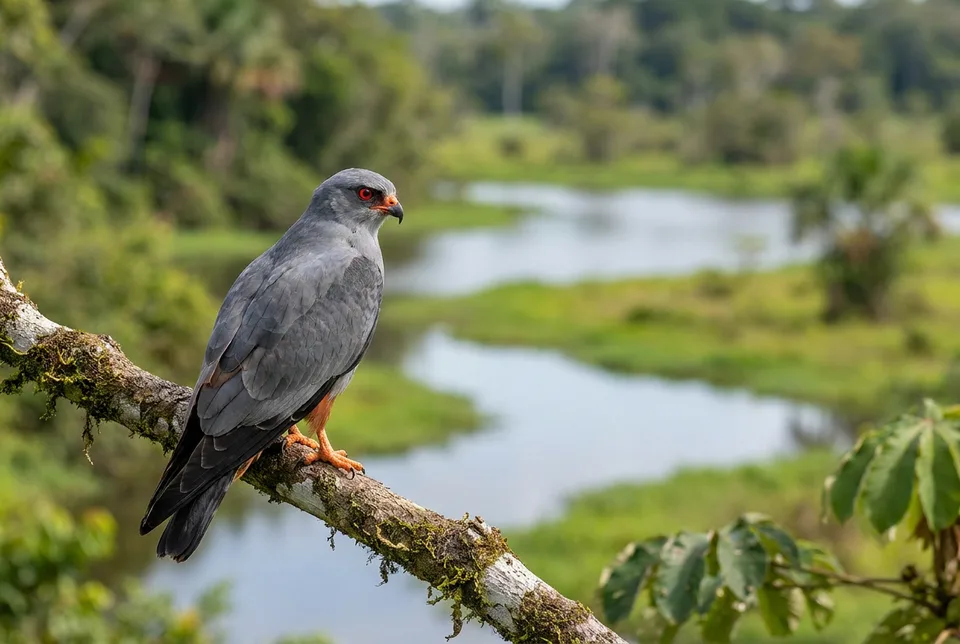
Plumbeous Kite in wetland habitat — Amazon, River Cruises wildlifeAI-modified
Home›River Cruises›River Wildlife›Plumbeous Kite

Plumbeous KiteIctinia plumbeaWhere and when to see them

Previous speciesPlaintive CuckooNext speciesProboscis Bat

Plumbeous Kite at a glance

The Plumbeous Kite is a compact Neotropical raptor whose lead-grey plumage can appear almost featureless against a bright sky. Its hunting style is more revealing than its colour: insects are often captured in flight, and a feeding bird may remain airborne while handling a catch. The Peregrine Fund gives a body length of 33–37 centimetres, making this a much smaller predator than the large eagles that dominate popular images of Amazon wildlife. The river association here is the Peruvian Iquitos–Nauta and Ucayali tributary itinerary documented by a 2017 cruise list. It is not a claim for every Amazon cruise region. On that route, looking above river-edge trees from a guided skiff may be more productive than watching the water for a hunting bird. Species reference: https://peregrinefund.org/explore-raptors-species/kites/plumbeous-kite

Behaviour & reproduction

Size
33–37 cm (13.0–14.6 in) body length; wingspan 84–94 cm (33.1–37.0 in).
Weight
190–257 g (6.7–9.1 oz).
Lifespan
Species-specific lifespan not verified.
Status
Least Concern, as reported by The Peregrine Fund.

This kite catches prey with its feet and uses several hunting methods rather than one fixed technique. It can take insects on the wing, pluck prey from vegetation and descend towards animals on the ground. The Peregrine Fund describes gatherings around emerging winged termites, illustrating how a temporary food concentration can bring birds together. It also reports following marmoset troops that flush insects. Those are species-level behaviours, not verified routine events on the registered Peruvian cruise. Pairs cooperate in constructing a small stick platform, lining it with softer material. Most clutches contain a single egg, although the northern part of the range can differ. Keep a generous distance from any suspected nest; the best visitor observation is natural flight and hunting away from a breeding site.

Top wildlife locations

Amazon river landscape — River Cruises wildlife habitatAI-modified

Amazon

Peru — Iquitos/Nauta, Ucayali and connected tributaries (2017 cruise) Guided skiff/side-channel viewing; not guaranteed from main ship. Scan river-edge trees, banks and open water.


Explore river cruises

Destinations describe the species' habitat, not guaranteed cruise stops. Some animals require an optional inland excursion or are found in restricted reserves.

Fun facts about the Plumbeous Kite

  • Its common name refers to lead-grey plumage.
  • Insects form the main part of its diet.
  • Prey can be eaten while the kite remains airborne.
  • Its feet are used to seize prey.
  • It may follow marmosets that flush insects.
  • Pairs build a small platform nest together.
  • Most clutches contain one egg.

Best time to see the Plumbeous Kite

The local source is a March 2017 cruise species list. It demonstrates an encounter on that itinerary but cannot support an annual March season or any wider numerical month range. Plumbeous Kite movements elsewhere in its broad range likewise cannot be applied automatically to Iquitos, Nauta or the Ucayali side channels. The location calendar remains empty. On an actual excursion, visibility will depend on where birds are hunting or perching and whether the skiff has an unobstructed view above the trees. Ask the naturalist to include a deliberate sky scan during stops rather than treating all river wildlife as water-level subjects. A useful observation window is one with enough time and stable viewing conditions to follow flight structure, not an unsupported promise tied to a particular month.

Plumbeous Kite: season matrix by destination

Highlighted months reflect the stated local evidence, not guaranteed encounters. Neutral months mean no verified monthly viewing window, not absence. Observation records and recommended viewing windows are distinct.

Amazon

The March 2017 cruise list is a single dated itinerary, not a recurring seasonal source. No months assigned.

JanFebMarAprMayJunJulAugSepOctNovDec
Explore river cruises

Where the Plumbeous Kite lives

Woodland and forest edges provide the backdrop for this small raptor, with open airspace offering opportunities to intercept flying insects. Along the registered Amazon route, river margins and connected tributaries give observers a gap in the canopy through which to search. That viewing advantage should not be confused with dependence on the main river itself. A perched bird may be high in a shoreline tree and easily overlooked until it launches. The documented itinerary includes the Ucayali and smaller drainages around Iquitos and Nauta; those are the appropriate limits for the local association. A 2017 tour record does not measure present-day habitat quality or population density. Conservation of wooded margins matters even when the animal is seen over open water, because a flight sighting alone reveals only part of its requirements.

What the Plumbeous Kite eats

Insects dominate the menu described by The Peregrine Fund. Listed prey include ants, termites, cicadas, dragonflies, butterflies, lacewings, grasshoppers and crickets. The kite also occasionally takes vertebrates such as bats, birds, lizards, snakes and frogs. That breadth should not obscure the importance of aerial insects in its ordinary feeding ecology. Watch for the feet moving towards the bill during flight, a useful clue that prey has been caught and is being eaten without landing. A low swoop does not automatically mean an attempt to catch fish; fishing is not the feeding strategy described in the retrieved specialist account. No Iquitos-specific diet percentages or recurring insect-emergence calendar were verified. Do not infer that a visible insect swarm will necessarily attract this species.

Species at a glance

Common name
Plumbeous Kite
Scientific name
Ictinia plumbea
Animal group
Birds
Size
33–37 cm (13.0–14.6 in) body length; wingspan 84–94 cm (33.1–37.0 in).
Weight
190–257 g (6.7–9.1 oz).
Lifespan
Species-specific lifespan not verified.
Status
Least Concern, as reported by The Peregrine Fund.
Identification
Look for a small, mostly grey kite with long pointed wings and a relatively short tail. Richer rufous colouring in the flight feathers can become apparent in a favourable view, while an adult’s reddish eye is usually a close-range feature rather than a reliable deck-level mark. Young birds are patterned differently, so a streaked individual should not be rejected simply because it is not uniformly lead-coloured. Plumage tone changes markedly between harsh overhead light and a side-lit perch. Compare the overall proportions and the pattern of the wings rather than identifying from grey colour alone. The name describes a useful general impression, not a diagnostic test. A distant bird that lacks visible distinguishing features is best recorded as an unidentified kite until photographs or prolonged views resolve it.

Plumbeous Kite: frequently asked questions

Where can I see the Plumbeous Kite?
Amazon. Scan the sky above the river-edge canopy before looking into the branches themselves. Follow any small grey raptor long enough to assess wing shape, tail and hunting movements. A brief silhouette is rarely enough to separate similar kites confidently, especially against glare. In a skiff, ask for the engine to be reduced or stopped only where safe and permitted, then allow other passengers to obtain a stable view without crowding one side. Photographs showing the underwing or a perched side view can help the guide check the identification later. Do not encourage close approaches to nesting trees. This profile applies to the documented Peruvian tributary excursion, where a smaller boat improves the angle of view; it is not a guarantee that birds will pass close to a moving cruise vessel.
When is the best time to see the Plumbeous Kite?
The local source is a March 2017 cruise species list. It demonstrates an encounter on that itinerary but cannot support an annual March season or any wider numerical month range. Plumbeous Kite movements elsewhere in its broad range likewise cannot be applied automatically to Iquitos, Nauta or the Ucayali side channels. The location calendar remains empty. On an actual excursion, visibility will depend on where birds are hunting or perching and whether the skiff has an unobstructed view above the trees. Ask the naturalist to include a deliberate sky scan during stops rather than treating all river wildlife as water-level subjects. A useful observation window is one with enough time and stable viewing conditions to follow flight structure, not an unsupported promise tied to a particular month.
How big does the Plumbeous Kite get?
33–37 cm (13.0–14.6 in) body length; wingspan 84–94 cm (33.1–37.0 in).. Adult weight: 190–257 g (6.7–9.1 oz).. Size varies with age, sex and population.
How should I behave around the Plumbeous Kite?
Scan the sky above the river-edge canopy before looking into the branches themselves. Follow any small grey raptor long enough to assess wing shape, tail and hunting movements. A brief silhouette is rarely enough to separate similar kites confidently, especially against glare. In a skiff, ask for the engine to be reduced or stopped only where safe and permitted, then allow other passengers to obtain a stable view without crowding one side. Photographs showing the underwing or a perched side view can help the guide check the identification later. Do not encourage close approaches to nesting trees. This profile applies to the documented Peruvian tributary excursion, where a smaller boat improves the angle of view; it is not a guarantee that birds will pass close to a moving cruise vessel.
What does the Plumbeous Kite eat?
Insects dominate the menu described by The Peregrine Fund. Listed prey include ants, termites, cicadas, dragonflies, butterflies, lacewings, grasshoppers and crickets. The kite also occasionally takes vertebrates such as bats, birds, lizards, snakes and frogs. That breadth should not obscure the importance of aerial insects in its ordinary feeding ecology. Watch for the feet moving towards the bill during flight, a useful clue that prey has been caught and is being eaten without landing. A low swoop does not automatically mean an attempt to catch fish; fishing is not the feeding strategy described in the retrieved specialist account. No Iquitos-specific diet percentages or recurring insect-emergence calendar were verified. Do not infer that a visible insect swarm will necessarily attract this species.
Are wildlife sightings guaranteed on a river cruise?
No. Animals move freely and routes, weather, access restrictions and local conditions influence every outing. Confirm the actual itinerary and shore program before booking.

Compare wildlife in the same destinations

Explore other birds recorded in these destinations. Similar surroundings do not mean the animals share the same habits or viewing season.

Species comparison by animal group and destination
Plumbeous Kite in wetland habitat — Amazon, River Cruises wildlifeAI-modifiedPlumbeous KiteAmazon kingfisher in wetland habitat — Amazon, River Cruises wildlifeAI-modifiedAmazon KingfisherAnhinga in wetland habitat — Amazon, River Cruises wildlifeAI-modifiedAnhinga
Animal groupBirdsAnimal groupBirdsAnimal groupBirds
DestinationsAmazonDestinationsAmazonDestinationsAmazon
Scientific name
Ictinia plumbea
Scientific name
Scientific name
Previous speciesPlaintive CuckooNext speciesProboscis Bat
All river wildlife
On this page
  • 01About
  • 02Behaviour & reproduction
  • 03Top wildlife locations
  • 04Fun facts
  • 05Best season
  • 06Season matrix by destination
  • 07Habitat
  • 08Diet
  • 09Species at a glance
  • 10Questions & answers
  • 11Compare

Find your river cruise

AI-modified
Plan your trip

Find your next river journey

Compare destinations, shore programs and dates with the animals and habitats you would love to see.

  • Daily shore excursions
  • Responsible wildlife watching
  • Boutique river ships
Explore river cruises