Bluerides – Blue Rides - Book Liveaboards worldwideOCEAN ADVENTURES
River CruisesRiversNature & WildlifeOur Promise
River CruisesRiversNature & WildlifeOur PromiseSign In

River destinations

  • River destinations
  • Amazon
  • Danube
  • Rhine
  • Mekong
  • Nile

Ships & departures

  • River Cruise Search
  • Deals

Nature & Wildlife

  • Nature & Wildlife

Travel support

  • Our Promise
  • Contact

Contact

Get in Touch

Get in touch anytime, we're happy to help you find the right trip or sort out any question.

EmailWrite us, we usually reply within a few hours.
contact@bluerides.com
WhatsAppChat with us on WhatsApp, Mon–Fri 10:00–16:00 (CET).
Start WhatsApp Chat
PhoneCall us, we're happy to help.
Free call, Mon–Fri 10 AM – 8 PM (CET).
Europe+49 800 1144 990USA+1 888 557 7735UK+44 800 707 4152Australia+61 2 8599 6113Canada+1 888 557 7735
Which river journey is yours?Answer 8 quick questions and find the river cruise that fits you.
8 questions, 1 minute·Plus Gift
Secure Payment MethodsYour payments are fully secured with AES-256 encryption.
Powered byStripeWiseAMEXPayGoogle PaySEPABank
Imprint·Terms & Conditions·Privacy Policy·About·Contact·Liability Waiver·Affiliate Program·Cruise·
Visit us here

© 2026 Blue Rides. All rights reserved.·

Bluerides – Blue Rides - Book Liveaboards worldwideOCEAN ADVENTURES
River CruisesRiversNature & WildlifeOur Promise
River CruisesRiversNature & WildlifeOur PromiseSign In
Green-tailed Jacamar in wetland habitat — Amazon, River Cruises wildlife
Home›River Cruises›River Wildlife›Green-tailed Jacamar

Green-tailed JacamarGalbula galbulaWhere and when to see them

Previous speciesGreen Whip SnakeNext speciesGreen-winged Teal

Green-tailed Jacamar at a glance

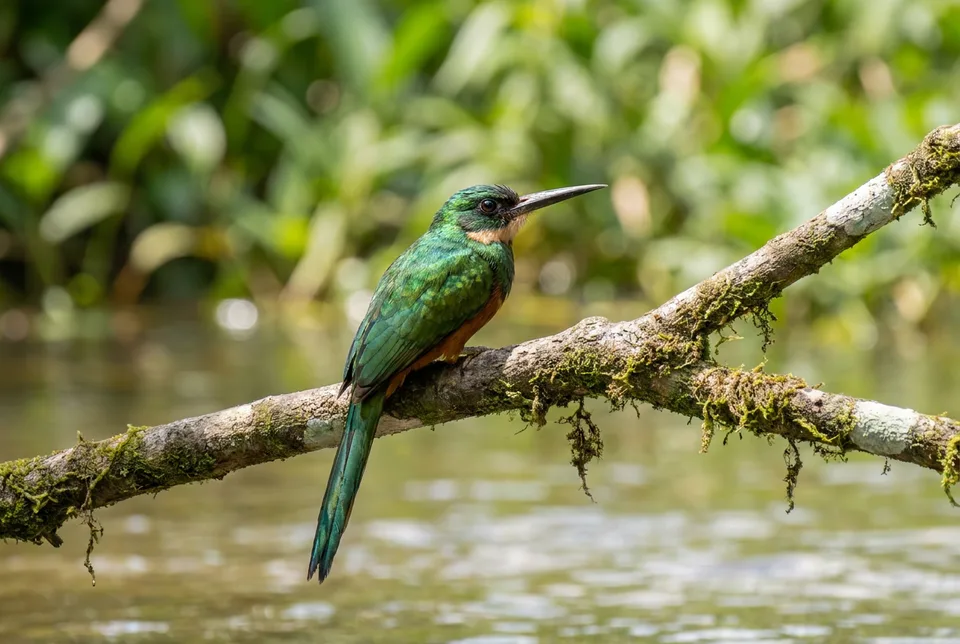
A Green-tailed Jacamar can initially suggest a hummingbird because of its metallic plumage and needle-like bill, but the resemblance hides a different feeding method. Cornell's eBird describes a bird that watches from a prominent perch and intercepts flying insects. The combination of a green upper body and rusty belly is especially striking when sunlight reaches a riverside opening. In this batch its Amazon connection is specifically the Rio Negro islands of Anavilhanas National Park in Brazil. It is therefore a guided island-forest or canoe-excursion subject, not a general promise for Amazon cruise itineraries. An observer may obtain a better view of one quietly perched bird than of several fast-moving silhouettes. The bird's association with river edges and secondary vegetation helps explain why a forest-margin stop can be more useful than scanning uninterrupted open water. Species account: https://ebird.org/species/grtjac1
Behaviour & reproduction

Size
18–22 cm (7.1–8.7 in) long; Oiseaux.net species account.
Weight
not verified
Lifespan
not verified
Status
Least Concern, as reported by Oiseaux.net; assessment date not verified.

The characteristic sequence is to wait, launch into the air after an insect, and return to a perch to handle the catch. eBird notes that the same perch may be reused, giving patient observers an opportunity to watch repeated hunting flights without approaching. Pairs or small groups may remain within a few metres of the ground. Despite their small size, these birds can be conspicuous through energetic movements and loud squeaking calls. A call can establish where to look, but a confirmed identification still benefits from seeing the bird rather than assigning every squeak in the understory to a jacamar. Do not crowd a productive hunting station: movement near the perch can interrupt the very behaviour that makes the species rewarding to observe. A stationary canoe and a quiet group are more useful than repeatedly repositioning.

Top wildlife locations

Amazon river landscape — River Cruises wildlife habitat

Amazon

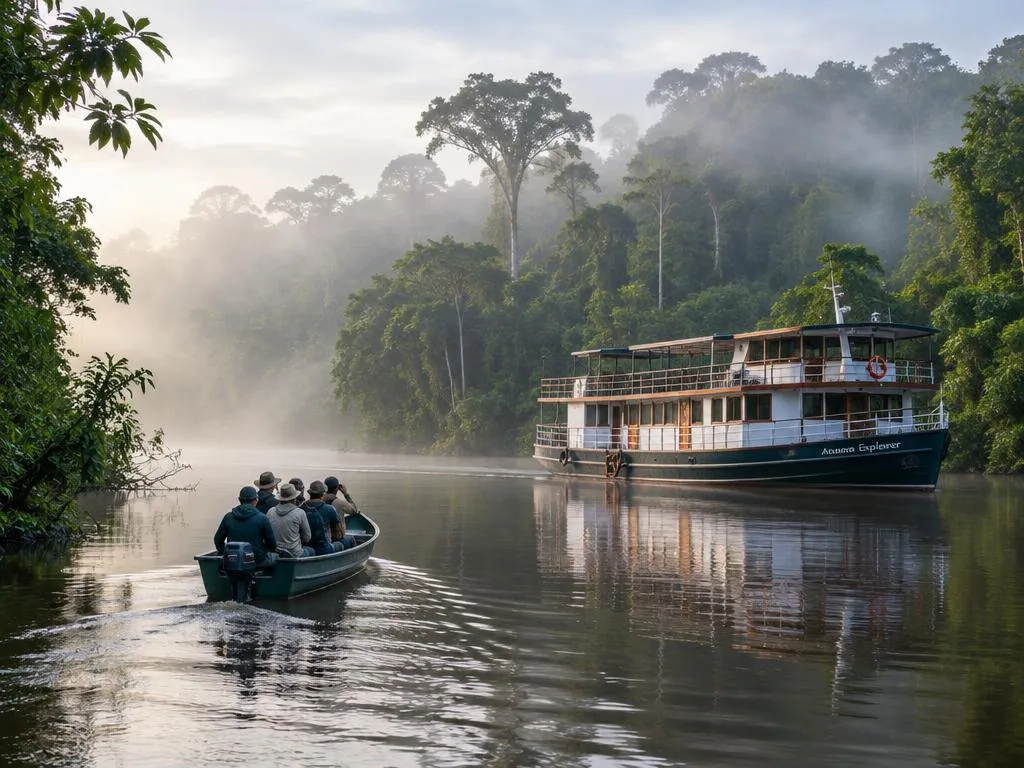
Brazil — Rio Negro, Anavilhanas National Park islands Optional guided canoe/island forest excursion; small forest birds require close-range birding.
Explore river cruises

Destinations describe the species' habitat, not guaranteed cruise stops. Some animals require an optional inland excursion or are found in restricted reserves.

Fun facts about the Green-tailed Jacamar

  • Its food is caught in flight.
  • A hunting perch may be used repeatedly.
  • The belly is rusty rather than green.
  • The long bill is straight and pointed.
  • Pairs or small groups may occur.
  • Squeaking calls can reveal a hidden bird.
  • The registered reach is Anavilhanas, not the whole Amazon.

Best time to see the Green-tailed Jacamar

No recurring local observation calendar was verified for Green-tailed Jacamar on the Anavilhanas islands. The registry establishes the excursion setting, while the retrieved species account explains where and how to search; neither supplies a supported series of numbered months for that reach. Amazon rainfall patterns or a broad Brazilian distribution would not fill that evidence gap. Plan around a specialist guide's current knowledge of accessible island habitat and park restrictions, without presenting that advice as a historical occurrence matrix. The practical objective is a quiet visit to suitable river-edge woodland, with enough time to inspect hunting perches. A short shore stop may miss a bird that remains concealed or temporarily feeds elsewhere. Accordingly, the location's empty month array means insufficient verified seasonal evidence, not that the bird is absent throughout the year.

Green-tailed Jacamar: season matrix by destination

Highlighted months reflect the stated local evidence, not guaranteed encounters. Neutral months mean no verified monthly viewing window, not absence. Observation records and recommended viewing windows are distinct.

Amazon

A recurring local source with an explicit monthly observation calendar was not verified. Registry guidance: Optional guided canoe/island forest excursion; small forest birds require close-range birding.

JanFebMarAprMayJunJulAugSepOctNovDec
Explore river cruises

Where the Green-tailed Jacamar lives

Secondary forest, river edges and disturbed habitats are identified in eBird's species account. That habitat description should not be mistaken for universal abundance in any cleared Amazon landscape. In the registered reach, islands and their wooded margins provide the relevant setting, and a guide must choose an accessible location consistent with national-park rules. Look along gaps where a low branch overlooks an open flight space rather than concentrating exclusively on the highest canopy. Vegetation can conceal a perched bird even when its hunting flight is obvious. Water level changes the route a canoe can take and the height of accessible branches relative to the observer, but no local study retrieved here established a month-by-month relationship between water level and sightings. The profile consequently separates habitat suitability from a numerical observation season.

What the Green-tailed Jacamar eats

Flying insects are the verified food category. The long bill is used in aerial capture, and eBird explicitly describes the return to a perch where prey is dispatched and consumed. A photograph of prey handling may reveal more than a momentary flight view, but a distant image should not be used to claim a particular insect species without sufficient detail. Local prey proportions, daily feeding rates and the importance of different insect groups at Anavilhanas were not verified. The jacamar's insect hunting is also a useful distinction from nectar-feeding birds that share brilliant green colours. Do not attract it with food or manipulate insects to stage a hunting event. Watching a bird resume its natural perch-to-air routine gives a clearer picture of its ecological role than a close encounter produced by disturbance.

Species at a glance

Common name
Green-tailed Jacamar
Scientific name
Galbula galbula
Animal group
Birds
Size
18–22 cm (7.1–8.7 in) long; Oiseaux.net species account.
Weight
not verified
Lifespan
not verified
Status
Least Concern, as reported by Oiseaux.net; assessment date not verified.
Identification
Look for iridescent green plumage above, a rusty belly and a very long pointed bill. The small body and upright perch posture help distinguish the silhouette from a larger kingfisher. Rapid sallies after insects and a return to a prominent branch add useful behavioural evidence. eBird describes an energetic bird of low river-edge vegetation and notes a loud squeaking call. Lighting deserves particular attention: structural colours may look dark in shade, so an apparently dull bird should not be excluded before it turns. Conversely, green colour by itself is not enough, because several tropical birds can flash green in flight. Obtain a side view that shows the bill, lower body and tail together. For an uncertain photograph, retain the original image and ask a local guide rather than forcing an identification.

Green-tailed Jacamar: frequently asked questions

Where can I see the Green-tailed Jacamar?
Amazon. Ask the guide to pause when a small metallic bird crosses an opening. Follow the flight back to its perch, then use binoculars before moving the canoe or walking closer. Check both the rusty belly and the long straight bill, as reflected green light alone can be misleading. When watching from a boat, keep paddling and conversation to a minimum while maintaining safe clearance from vegetation. An island excursion offers much more realistic opportunities than a moving cruise deck because the bird often stays close to low forest cover. Photograph from the existing route, avoiding the temptation to clear leaves for an unobstructed view. Repeated returns to one perch are a reason to wait, not a reason to surround it. No playback or feeding is necessary to appreciate the aerial hunting sequence.
When is the best time to see the Green-tailed Jacamar?
No recurring local observation calendar was verified for Green-tailed Jacamar on the Anavilhanas islands. The registry establishes the excursion setting, while the retrieved species account explains where and how to search; neither supplies a supported series of numbered months for that reach. Amazon rainfall patterns or a broad Brazilian distribution would not fill that evidence gap. Plan around a specialist guide's current knowledge of accessible island habitat and park restrictions, without presenting that advice as a historical occurrence matrix. The practical objective is a quiet visit to suitable river-edge woodland, with enough time to inspect hunting perches. A short shore stop may miss a bird that remains concealed or temporarily feeds elsewhere. Accordingly, the location's empty month array means insufficient verified seasonal evidence, not that the bird is absent throughout the year.
How big does the Green-tailed Jacamar get?
18–22 cm (7.1–8.7 in) long; Oiseaux.net species account.. Adult weight: not verified. Size varies with age, sex and population.
How should I behave around the Green-tailed Jacamar?
Ask the guide to pause when a small metallic bird crosses an opening. Follow the flight back to its perch, then use binoculars before moving the canoe or walking closer. Check both the rusty belly and the long straight bill, as reflected green light alone can be misleading. When watching from a boat, keep paddling and conversation to a minimum while maintaining safe clearance from vegetation. An island excursion offers much more realistic opportunities than a moving cruise deck because the bird often stays close to low forest cover. Photograph from the existing route, avoiding the temptation to clear leaves for an unobstructed view. Repeated returns to one perch are a reason to wait, not a reason to surround it. No playback or feeding is necessary to appreciate the aerial hunting sequence.
What does the Green-tailed Jacamar eat?
Flying insects are the verified food category. The long bill is used in aerial capture, and eBird explicitly describes the return to a perch where prey is dispatched and consumed. A photograph of prey handling may reveal more than a momentary flight view, but a distant image should not be used to claim a particular insect species without sufficient detail. Local prey proportions, daily feeding rates and the importance of different insect groups at Anavilhanas were not verified. The jacamar's insect hunting is also a useful distinction from nectar-feeding birds that share brilliant green colours. Do not attract it with food or manipulate insects to stage a hunting event. Watching a bird resume its natural perch-to-air routine gives a clearer picture of its ecological role than a close encounter produced by disturbance.
Are wildlife sightings guaranteed on a river cruise?
No. Animals move freely and routes, weather, access restrictions and local conditions influence every outing. Confirm the actual itinerary and shore program before booking.

Compare wildlife in the same destinations

Explore other birds recorded in these destinations. Similar surroundings do not mean the animals share the same habits or viewing season.

Species comparison by animal group and destination
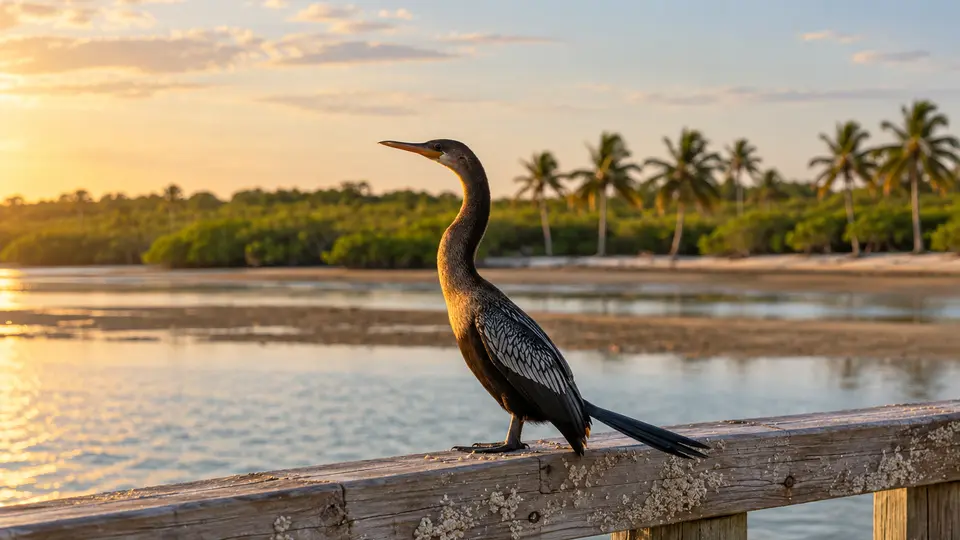
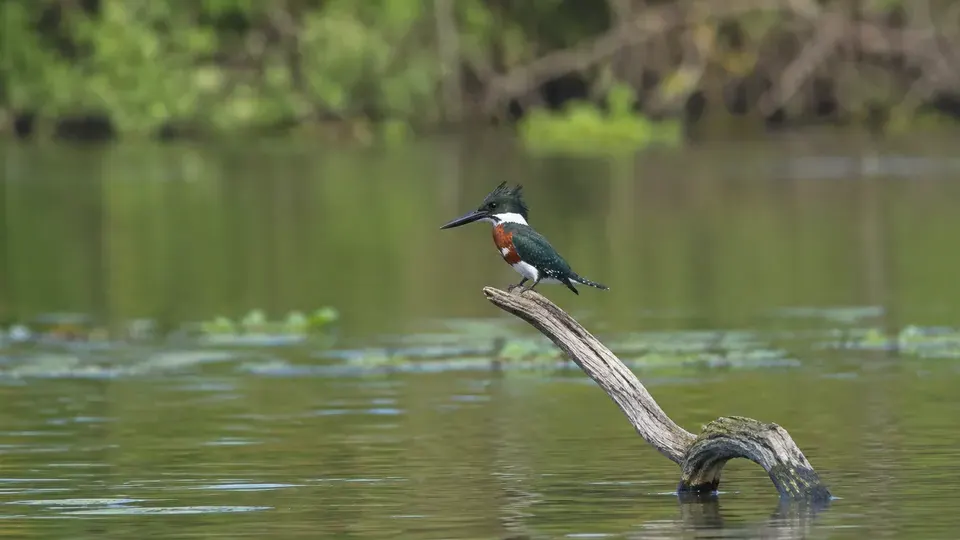
Green-tailed Jacamar in wetland habitat — Amazon, River Cruises wildlifeGreen-tailed JacamarAmazon kingfisher in wetland habitat — Amazon, River Cruises wildlifeAmazon KingfisherAnhinga in wetland habitat — Amazon, River Cruises wildlifeAnhinga
Animal groupBirdsAnimal groupBirdsAnimal groupBirds
DestinationsAmazonDestinationsAmazonDestinationsAmazon
Scientific name
Galbula galbula
Scientific name
Scientific name
Previous speciesGreen Whip SnakeNext speciesGreen-winged Teal
All river wildlife
On this page
  • 01About
  • 02Behaviour & reproduction
  • 03Top wildlife locations
  • 04Fun facts
  • 05Best season
  • 06Season matrix by destination
  • 07Habitat
  • 08Diet
  • 09Species at a glance
  • 10Questions & answers
  • 11Compare

Find your river cruise

Plan your trip

Find your next river journey

Compare destinations, shore programs and dates with the animals and habitats you would love to see.

  • Daily shore excursions
  • Responsible wildlife watching
  • Boutique river ships
Explore river cruises