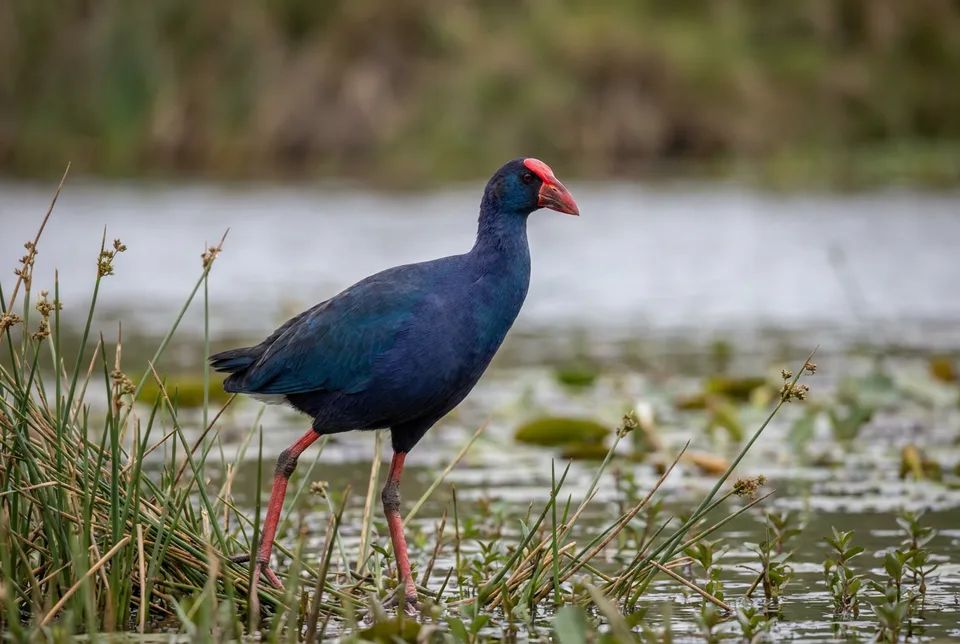
The African Swamphen is a large wetland rail with blue-purple plumage, a greenish back and a striking red bill and forehead shield. Its long reddish legs and toes help it move through reeds and floating vegetation. This is a freshwater bird, not a marine animal. On a Nile river cruise in Egypt, suitable vegetated margins and connected wetlands are the relevant habitat; open water alone is not enough. The Blue Rides river registry records the species on the Luxor–Esna–Edfu–Kom Ombo–Aswan corridor from a dated March 2007 birdwatching trip. That record supports a historical occurrence, not a promised sighting on every itinerary. It belongs to Rallidae, the rail family, and is an African member of a group formerly treated as the widespread Purple Swamphen. The Biodiversity and Development Institute describes scattered populations from Senegal to Ethiopia, an outlying population in Egypt’s Nile valley, Madagascar, and a more continuous range in East, Central and Southern Africa. This broad distribution is separate from the limited cruise-route evidence: it does not establish presence at every Nile landing. Adults of both sexes have similar plumage, so colour alone is not a reliable way to tell a male from a female.

Nile
Nile, Egypt: Luxor–Esna–Edfu–Kom Ombo–Aswan. A dated 19–26 March 2007 cruise trip report records the bird. Vegetated wetland margins are the relevant observation context; no individual cruise stop or current sighting is guaranteed. A species account independently identifies an outlying population in Egypt’s Nile valley, giving broader geographical context to the trip report. It does not identify a reliable cruise stop. Look for sheltered, still or slow-moving water with reeds, sedges or other dense emergent vegetation, and check whether the booked itinerary actually includes legal access to that habitat. Temple schedules and ordinary navigation through the corridor are not substitutes for a planned wetland visit.